Centripetal Acceleration & Resultant Force
Key idea: Explain inward acceleration in uniform circular motion and apply a = v²/r = rω² and the corresponding resultant-force equations.
Continue where you stopped
The core idea
On this page
Learning objectives
- Explain and apply centripetal acceleration and resultant-force relationships.
1. Definitions (Must Know)
A. Uniform circular motion
Uniform circular motion is motion in a circle at constant speed (constant magnitude of velocity).
B. Centripetal acceleration, a_c
Centripetal acceleration, a_c, is the acceleration directed towards the centre of the circle.
C. Centripetal force, F_c
Centripetal force, F_c, is the resultant force towards the centre that produces centripetal acceleration.
It is not a new kind of force: it is provided by real forces like tension, friction, normal reaction components, or gravity.
2. Key Ideas (What Earns Marks)
- Even if speed is constant, velocity changes direction, so there is acceleration.
- Centripetal acceleration: a_c = v²/r = rω²
- Centripetal force (resultant inward force): F_c = ma_c = mv²/r = mrω²
- In circular-motion force questions, write a radial equation: ∑ F_(towards centre) = mv²/r
- Centripetal force acts perpendicular to velocity, so it does no work on the object (speed stays constant unless there is a tangential force).
Centripetal force is the inward resultant of real forces already on the object. Do not add a separate Fc on top of tension, friction, normal reaction, or weight components.
3. Detailed Explanations
A. Why there is acceleration at constant speed
Velocity is a vector. In uniform circular motion, the direction of the velocity changes continuously, so velocity changes even if speed is constant.
Therefore the object accelerates.
B. Deriving a_c = v²/r (exam-safe sketch)
Over a small time Δ t, the velocity vector turns by a small angle Δθ.
The velocity magnitude stays v, but its direction changes, producing a change in velocity Δ v.
For small angles, Δ v ≈ vΔθ and Δθ/Δ t = ω.
So:
a = (Δ v)/(Δ t) ≈ vΔθ/(Δ t) = vω
Using v = rω gives:
a = vω = v(v/r) = v²/r
C. Centripetal force is the resultant radial force
Once you know a_c, Newton’s 2nd law gives:
∑ F_radial = ma_c
So the key skill is identifying which real forces have components towards the centre.
The radial equation describes the component of acceleration perpendicular to the instantaneous velocity. If speed also changes, analyse the tangential component separately; v²/r is still the instantaneous inward component for motion along a circular path.
Draw the real forces (tension, weight, normal, friction). Their resultant towards the centre is F_c.
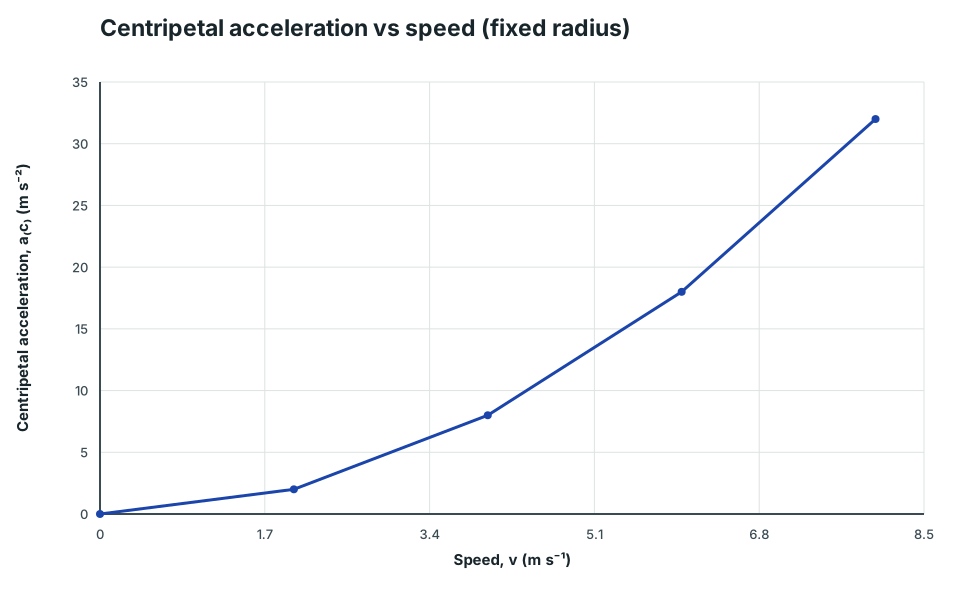
D. Visual: why a_c grows quickly with speed
For a fixed radius, a_c = v²/r so a_c increases with the square of speed.
Centripetal acceleration vs speed (fixed radius)
A curved plot showing centripetal acceleration increasing with the square of speed.
Scroll across the graph to read all labels.
View figure data
| Speed, v (m s⁻¹) | Example (r = 2.0 m) |
|---|---|
| 0 | 0 |
| 2 | 2 |
| 4 | 8 |
| 6 | 18 |
| 8 | 32 |
4. Common Mistakes
- Drawing “centripetal force” as an extra force on the free-body diagram.
- Using ∑ F = 0 because speed is constant (constant speed does not mean zero resultant force).
- Putting forces in the wrong direction (centripetal acceleration is always towards the centre).
- Mixing up r (radius) with diameter.
5. Exam Tips
- Choose “towards the centre” as positive and write ∑ F_radial = mv²/r.
- State which force (or component) provides the centripetal force.
- If the path is vertical, the direction “towards the centre” flips between top/bottom — redraw the radial direction each time.
6. Worked Examples
Modelled example 1
Find centripetal acceleration
Problem
Study the worked solution
Choose the radial relation
Method
Use a_c = v²/r.Reason
Speed and radius are the supplied circular-motion variables.Working
a_c = (2.0)²/0.80Calculate and direct
Method
Obtain 5.0 m s⁻² towards the centre.Reason
Centripetal acceleration is radial and inward.Working
a_c = 5.0 m s⁻² inward.
Guided practice 2
Find centripetal force
Problem
Try this before viewing the solution
Hints
Hint 1: force follows acceleration
View solution step by step
Build the radial equation
Method
Set the inward resultant to mv²/r.Reason
Newton’s second law applies in the radial direction.Working
F_radial = mv²/rEvaluate
Method
Substitute the data.Reason
All quantities are in SI units.Working
F_radial = 0.50(3.0)²/1.2 = 3.75 N
Common misconception 3
Tension provides centripetal force (horizontal circle)
Learner model
Try this before viewing the solution
View solution step by step
Correct the force model
Method
Keep tension as the real inward force and do not add another force.Reason
“Centripetal force” is the radial resultant required by the motion.Working
T = ∑ F_radial.Calculate tension
Method
Set T = mv²/r.Reason
The prompt states tension alone supplies the radial resultant.Working
T = 0.20(5.0)²/0.60 = 8.33 N
Examiner practice 4
Maximum speed on a flat track
Examination question
Try this before viewing the solution
View solution step by step
Identify radial force
1 markMethod
Use friction as the inward resultant at the limiting speed.Reason
Weight and normal reaction balance vertically.Working
F_friction = mv²/r.Convert force
1 markMethod
Write 7.2 kN = 7200 N.Reason
SI force units are required.Working
F = 7200 N.Rearrange
1 markMethod
Use v = square root of (Fr/m).Reason
Speed appears squared in the radial equation.Working
v = square root of (7200(60)/1200).Evaluate
1 markMethod
Obtain 19.0 m s⁻¹.Reason
This is the speed at the friction limit.Working
vₘₐₓ = 19.0 m s⁻¹.
Self-mark with the mark scheme
Compare your response with each mark point. Select a point only when your response contains that evidence.
Self-mark the interaction model and calculation.
Challenge 5
Vertical circle (tension at the top)
Changing-direction transfer
Try this before viewing the solution
Hints
Hint 1: redraw inward at the top
View solution step by step
Build the top radial equation
Method
Take downward/inward as positive and include both T and mg.Reason
Both real forces point towards the centre at the top.Working
T + mg = mv²/rSolve for tension
Method
Subtract weight from the required radial resultant.Reason
Gravity supplies part of the inward force.Working
T = 0.50(6.0)²/1.2-0.50(9.81) = 10.1 N
7. Mind Stretchers
Mind stretcher 1: Why doesn’t F_c change the speed?Extension
Explain why the centripetal force does no work in uniform circular motion.
Show Answer
Work done depends on the component of force along the displacement.
In uniform circular motion, the centripetal force is radial while the displacement/velocity is tangential, so they are perpendicular. The component along the motion is zero, so no work is done and speed stays constant (unless another tangential force acts).
Mind stretcher 2: If the string breaks…Extension
A ball on a string is moving in a circle. The string snaps.
Describe the direction of the ball’s motion immediately after.
Show Answer
It moves off in a straight line tangent to the circle at the point the string snaps (in the direction of its instantaneous velocity).
Mind stretcher 3: Optional (Enrichment)Extension
A. Banking (component of normal reaction)
On a banked track, a component of the normal reaction can provide the centripetal force.
If the question gives a banking angle, you resolve forces and apply ∑ F_radial = mv²/r.
B. Vertical circles (tension varies)
In vertical circular motion, the speed and the required centripetal force can change with position.
Problems often combine:
- radial force equation ∑ F_radial = mv²/r, and
- energy conservation between positions.
Continue with the next resource in this course.
Course and syllabus information
- Course
- GCE A-Level H2 Physics
- Edition
- GCE A-Level H2 Physics 2027