Magnetic Fields Due to Currents
Key idea: Use standard results for B due to a long straight wire, circular coil centre and long solenoid, and solve B and force-per-length questions (A Level Physics).
Continue where you stopped
The core idea
On this page
Learning objectives
- Calculate and represent magnetic fields produced by currents.
- Sketch magnetic field lines due to currents in a long straight wire, a flat circular coil and a long solenoid.
- Analyse forces on current-carrying conductors, current balances and interactions between parallel currents.
1. Definitions (Must Know)
A. Magnetic field (due to currents)
A magnetic field is a field of force produced by current-carrying conductors (and also by permanent magnets).
B. Field patterns you must be able to sketch
- Long straight wire: concentric circles centred on the wire.
- Flat circular coil: field lines concentrate through the centre of the coil.
- Long solenoid: nearly uniform field inside (straight, parallel, equally spaced lines); outside field is weaker and loops back.
C. Magnetic flux density due to a long straight wire
At distance r from a long straight wire carrying current I:
B = (μ₀ I)/(2π r)
D. Magnetic flux density at the centre of a flat circular coil
For a coil of N turns and radius r carrying current I:
B = (μ₀ N I)/2r
E. Magnetic flux density inside a long solenoid
For a long solenoid (inside the solenoid):
B = μ₀ n I
where n is turns per unit length (m⁻¹).
F. Force between two parallel current-carrying wires
Two long parallel wires separated by distance d carrying currents I₁ and I₂ exert forces on each other. The force per unit length on each wire is:
F/l = (μ₀ I₁ I₂)/(2π d)
- same current direction → attractive
- opposite current directions → repulsive
2. Key Ideas (What Earns Marks)
- Use the correct result for the geometry (wire / coil / solenoid).
- For a straight wire, B ∝ 1/r: doubling r halves B.
- Direction of field lines around a current-carrying wire: use the right-hand grip rule.
- A ferrous core inside a solenoid increases B (the core becomes magnetised and reinforces the field).
- Parallel wires: same current directions attract; opposite directions repel.
This lesson covers A Level 9478 learning outcomes 17a–17d and 17i.
3. Detailed Explanations
A. Right-hand grip rule (direction)
Point your right thumb along conventional current; your curled fingers show the magnetic field direction. Apply the rule separately to each current element in a coil or solenoid.
B. Why the field gets weaker with distance from a straight wire
For a straight wire, B ∝ 1/r. As you move further away, the same “circulating” field is spread over a larger circumference, so the field strength decreases.
Long straight wire: B decreases as 1/r (scaled)
A 1/r curve showing how magnetic flux density decreases with distance from a long straight current-carrying wire.
Scroll across the graph to read all labels.
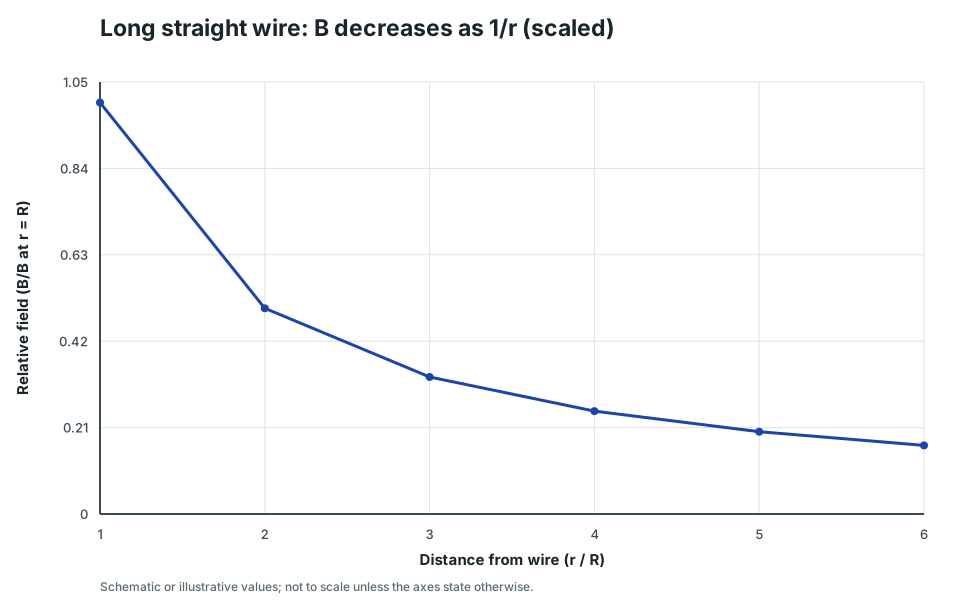
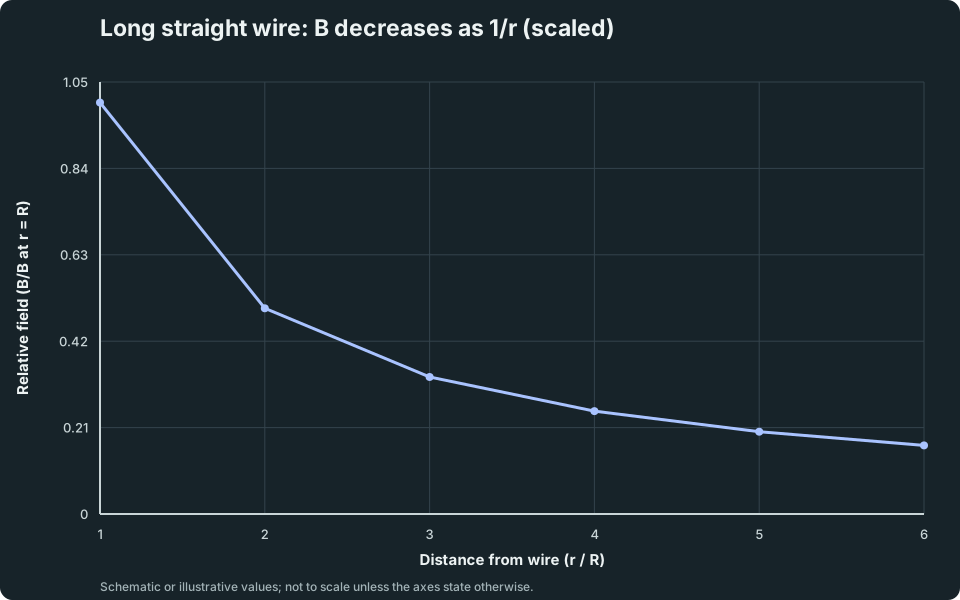
View figure data
| Distance from wire (r / R) | B ∝ 1/r |
|---|---|
| 1 | 1 |
| 2 | 0.5 |
| 3 | 0.333 |
| 4 | 0.25 |
| 5 | 0.2 |
| 6 | 0.1667 |
C. Long solenoid field and ferrous cores
Inside a long solenoid, field lines are nearly straight, parallel and evenly spaced, so B is approximately uniform away from the ends.
Adding a ferrous core increases the flux density because the core magnetises and strengthens the field.
D. Why parallel currents attract/repel (direction reasoning)
Each wire produces a magnetic field, and the other wire (a current-carrying conductor) experiences a force in that field.
You only need the rule:
- same direction currents → attract
- opposite direction currents → repel
4. Common Mistakes
- Using cm/mm for r or d without converting to metres.
- Mixing symbols: r (distance from wire / coil radius) vs d (wire separation).
- Using the solenoid formula for a short coil (the “long solenoid” approximation).
- Drawing field lines without direction arrows.
5. Exam Tips
- Label r, d, N, and n on the diagram before substituting.
- If asked “how does B change?”, use proportional reasoning first (e.g. B ∝ 1/r).
- When sketching a solenoid field, make the inside lines denser than the outside lines (stronger inside).
6. Worked Examples
Modelled example 1
Straight wire: find B at a distance
Problem
Study the worked solution
Choose the geometry
Method
Use B = μ₀I/(2π r).Reason
The source is specified as a long straight wire.Working
B = μ₀I/(2π r)Convert distance
Method
Use r = 0.040 m.Reason
The permeability value is in SI units.Working
4.0 cm = 0.040 m.Evaluate
Method
Obtain 3.0 × 10⁻⁵ T.Reason
The equation gives field magnitude; direction follows the right-hand grip rule.Working
B = ((4π × 10⁻⁷)(6.0))/2π(0.040) = 3.0 × 10⁻⁵ T
Guided practice 2
Circular coil: field at the centre
Problem
Try this before viewing the solution
Hints
Hint 1: select the coil formula
View solution step by step
Identify the turn quantity
Method
Use total turns N = 20.Reason
The centre-field formula for a flat coil sums the field from every turn.Working
B = μ₀NI/2rSubstitute and evaluate
Method
Obtain 5.0 × 10⁻⁴ T.Reason
The radius is 0.050 m.Working
B = ((4π × 10⁻⁷)(20)(2.0))/2(0.050) = 5.0 × 10⁻⁴ T
Common misconception 3
Parallel wires: force per unit length
Learner claim
Try this before viewing the solution
View solution step by step
Calculate force per length
Method
Obtain 4.0 × 10⁻³ N m⁻¹.Reason
The named long-parallel-wire result includes both currents and their separation.Working
F/l = ((4π × 10⁻⁷)(10)(6.0))/(2π(3.0 × 10⁻³)) = 4.0 × 10⁻³ N m⁻¹Determine direction
Method
The wires attract.Reason
Same-direction parallel currents produce forces towards each other.Working
Same directions ⇒ attraction.
Examiner practice 4
Long solenoid: field inside
Examination question
Try this before viewing the solution
View solution step by step
Calculate turn density
1 markMethod
n = 2.0 × 10³ m⁻¹.Reason
The long-solenoid equation uses turns per unit length, not total turns alone.Working
n = N/L = 800/0.40 = 2.0 × 10³ m⁻¹Select the solenoid result
1 markMethod
Use B = μ₀nI.Reason
The stated long air-core geometry supports this model.Working
B = μ₀nIEvaluate
1 markMethod
B = 3.77 × 10⁻³ T ≈ 3.8 × 10⁻³ T.Reason
Substitute the calculated turn density and current.Working
B = (4π × 10⁻⁷)(2.0 × 10³)(1.5) = 3.77 × 10⁻³ T
Self-mark with the mark scheme
Compare your response with each mark point. Select a point only when your response contains that evidence.
Self-mark turn density, model and field value.
Challenge 5
Force between two wires (find F)
Independent transfer
Try this before viewing the solution
Hints
Hint 1: calculate density before total force
View solution step by step
Find force per length
Method
F/l = 2.56 × 10⁻³ N m⁻¹.Reason
The long-wire interaction is naturally expressed per unit length.Working
F/l = ((4π × 10⁻⁷)(8.0)(8.0))/(2π(5.0 × 10⁻³)) = 2.56 × 10⁻³ N m⁻¹Find force on the segment
Method
F = 5.12 × 10⁻⁴ N.Reason
Multiply the force per metre by 0.20 m.Working
F = (2.56 × 10⁻³)(0.20) = 5.12 × 10⁻⁴ NState direction
Method
The force on each segment is towards the other wire.Reason
The currents are in the same direction, so the interaction is attractive.Working
Direction: attraction.
7. Mind Stretchers
Mind stretcher 1: Doubling distance from a wireExtension
For a long straight wire with fixed current, what happens to B if you double the distance from the wire?
Show Answer
For a straight wire, B ∝ 1/r. Doubling r halves B.
Mind stretcher 2: Link F/l to B (synthesis)Extension
Show that the force per unit length between two parallel wires can be written as F/l = I₂B₁, where B₁ is the magnetic field produced by wire 1 at the location of wire 2.
Show Answer
At the position of wire 2, the field due to wire 1 is: B₁ = (μ₀ I₁)/(2π d)
Wire 2 experiences force on length l given by F = BIl (perpendicular case), so: F = B₁I₂l ⇒ F/l = I₂B₁
Substituting for B₁ gives: F/l = (μ₀ I₁ I₂)/(2π d)
8. Optional (Enrichment)
A. Beyond these three geometries
More complex current geometries are handled using Biot–Savart or Ampère’s law. In this syllabus, you use the provided results for straight wire, circular coil centre, and long solenoid.
Continue with the next resource in this course.
Course and syllabus information
- Course
- GCE A-Level H2 Physics
- Edition
- GCE A-Level H2 Physics 2027