Circular paths in a magnetic field
Key idea: For motion perpendicular to a uniform magnetic field, magnetic force supplies the centripetal force at constant speed. The circular radius is mv/(B|q|).
Offline pages
Saved on this device only. Connect at least once every 30 days to confirm Premium. Sign-out or a change of account removes saved copies.
Loading guide controls…
Guided lessons · coming soon
Guided lesson
Guided steps
- Use the magnetic force as the centripetal force and follow how momentum sets the radius.
- Decide which path the particle follows when it leaves the field and the force ends.
- Follow the radius calculation using momentum directly, without finding speed first.
- Convert millitesla to tesla, calculate momentum and then find the electron’s radius.
- Find the alpha particle’s radius and initial curve direction, using its full charge.
- Follow why a larger circle and a larger speed cancel in the time for one revolution.
- Find both ratios for the faster proton and calculate the revolution time.
- Derive the radius equation, then use equal kinetic energy to find the radius ratio.
On this page
You stopped at:
ContinueA beam of electrons fired into a uniform magnetic field, at right angles to it, bends round into a circle. The magnetic force never changes the speed of the electrons, only their direction, and that is exactly what a centripetal force does. Combining the magnetic force with circular motion gives the radius of the circle.
A circular path
A charged particle moving at right angles to a uniform magnetic field feels a force BQv of constant size, always at right angles to its velocity. A force like that keeps the speed constant and makes the particle move in a circle. The magnetic force provides the centripetal force:
where p = mv is the momentum. This classical relation applies when the speed is much smaller than the speed of light. Faster or heavier particles move in larger circles; a stronger field or a larger charge makes the circle smaller. The radius is a distance, so use the size of the charge. The sign of the charge decides which way the path curves. For a proton or electron, the charge magnitude is e = 1.60 × 10⁻¹⁹ C.
The particle moves in a circle only while it is in the field. When it leaves, there is no more force, and it carries on in a straight line along the direction it had at the edge of the field.
Check your understanding 1 After the field ends
A particle reaches the edge of a magnetic field with its velocity pointing diagonally upwards and right. There are no forces outside the field. Which path does it follow next?
Show answer
The particle keeps its exit velocity: a straight line diagonally upwards and right, tangent to the circle at the exit. Removing the force removes the acceleration, not the velocity.
Worked example 1
Radius from momentum
Problem
A proton with momentum 4.0 × 10⁻²⁰ kg m s⁻¹ enters a uniform magnetic field of 0.50 T at right angles to it. Find the radius of its path.
Show full solution
Choose the relation
Method
Use r = p/BQ.Reason
The momentum is given, so there is no need to find the speed first.Working
Answer
r = p/BQ
Radius
Working
Answer
r = (4.0 × 10⁻²⁰)/((0.50)(1.60 × 10⁻¹⁹)) = 0.50 m
Quick check
Doubling the field at the same momentum would halve the radius.
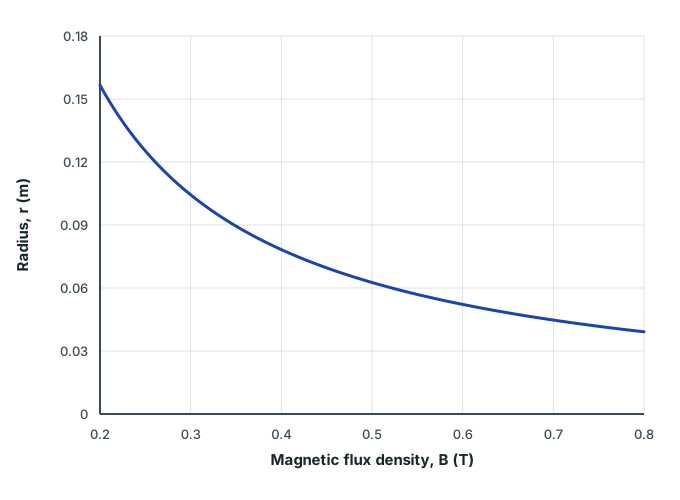
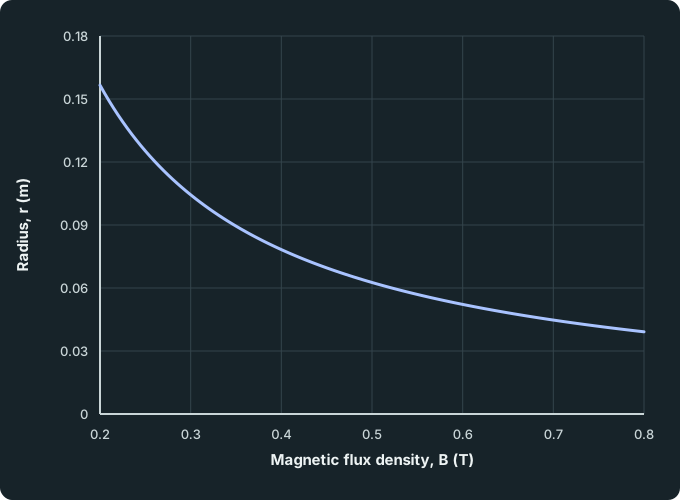
The graph shows how the radius depends on the field for protons moving at 3.0 × 10⁶ m s⁻¹. Since r ∝ 1/B, equal increases in B do not reduce the radius by equal amounts.
Magnetic path radius at fixed proton speed
An inverse radius-versus-field curve. At 0.20 T the radius is 0.157 m; at 0.40 T it is 0.0783 m. The speed and particle type are fixed.
Scroll across the figure to read all labels.
View figure data
| Magnetic flux density, B (T) | Proton radius: r = mv/(|q|B) |
|---|---|
| 0.200 | 0.15656 |
| 0.205 | 0.15274 |
| 0.210 | 0.14911 |
| 0.215 | 0.14564 |
| 0.220 | 0.14233 |
| 0.225 | 0.13917 |
| 0.230 | 0.13614 |
| 0.235 | 0.13324 |
| 0.240 | 0.13047 |
| 0.245 | 0.12781 |
| 0.250 | 0.12525 |
| 0.255 | 0.12279 |
| 0.260 | 0.12043 |
| 0.265 | 0.11816 |
| 0.270 | 0.11597 |
| 0.275 | 0.11386 |
| 0.280 | 0.11183 |
| 0.285 | 0.10987 |
| 0.290 | 0.10797 |
| 0.295 | 0.10614 |
| 0.300 | 0.10437 |
| 0.305 | 0.10266 |
| 0.310 | 0.10101 |
| 0.315 | 0.09940 |
| 0.320 | 0.09785 |
| 0.325 | 0.09635 |
| 0.330 | 0.09489 |
| 0.335 | 0.09347 |
| 0.340 | 0.09210 |
| 0.345 | 0.09076 |
| 0.350 | 0.08946 |
| 0.355 | 0.08820 |
| 0.360 | 0.08698 |
| 0.365 | 0.08579 |
| 0.370 | 0.08463 |
| 0.375 | 0.08350 |
| 0.380 | 0.08240 |
| 0.385 | 0.08133 |
| 0.390 | 0.08029 |
| 0.395 | 0.07927 |
| 0.400 | 0.07828 |
| 0.405 | 0.07731 |
| 0.410 | 0.07637 |
| 0.415 | 0.07545 |
| 0.420 | 0.07455 |
| 0.425 | 0.07368 |
| 0.430 | 0.07282 |
| 0.435 | 0.07198 |
| 0.440 | 0.07116 |
| 0.445 | 0.07037 |
| 0.450 | 0.06958 |
| 0.455 | 0.06882 |
| 0.460 | 0.06807 |
| 0.465 | 0.06734 |
| 0.470 | 0.06662 |
| 0.475 | 0.06592 |
| 0.480 | 0.06523 |
| 0.485 | 0.06456 |
| 0.490 | 0.06390 |
| 0.495 | 0.06326 |
| 0.500 | 0.06263 |
| 0.505 | 0.06200 |
| 0.510 | 0.06140 |
| 0.515 | 0.06080 |
| 0.520 | 0.06022 |
| 0.525 | 0.05964 |
| 0.530 | 0.05908 |
| 0.535 | 0.05853 |
| 0.540 | 0.05799 |
| 0.545 | 0.05745 |
| 0.550 | 0.05693 |
| 0.555 | 0.05642 |
| 0.560 | 0.05592 |
| 0.565 | 0.05542 |
| 0.570 | 0.05493 |
| 0.575 | 0.05446 |
| 0.580 | 0.05399 |
| 0.585 | 0.05353 |
| 0.590 | 0.05307 |
| 0.595 | 0.05263 |
| 0.600 | 0.05219 |
| 0.605 | 0.05176 |
| 0.610 | 0.05133 |
| 0.615 | 0.05091 |
| 0.620 | 0.05050 |
| 0.625 | 0.05010 |
| 0.630 | 0.04970 |
| 0.635 | 0.04931 |
| 0.640 | 0.04893 |
| 0.645 | 0.04855 |
| 0.650 | 0.04817 |
| 0.655 | 0.04781 |
| 0.660 | 0.04744 |
| 0.665 | 0.04709 |
| 0.670 | 0.04674 |
| 0.675 | 0.04639 |
| 0.680 | 0.04605 |
| 0.685 | 0.04571 |
| 0.690 | 0.04538 |
| 0.695 | 0.04505 |
| 0.700 | 0.04473 |
| 0.705 | 0.04441 |
| 0.710 | 0.04410 |
| 0.715 | 0.04379 |
| 0.720 | 0.04349 |
| 0.725 | 0.04319 |
| 0.730 | 0.04289 |
| 0.735 | 0.04260 |
| 0.740 | 0.04231 |
| 0.745 | 0.04203 |
| 0.750 | 0.04175 |
| 0.755 | 0.04147 |
| 0.760 | 0.04120 |
| 0.765 | 0.04093 |
| 0.770 | 0.04067 |
| 0.775 | 0.04040 |
| 0.780 | 0.04014 |
| 0.785 | 0.03989 |
| 0.790 | 0.03964 |
| 0.795 | 0.03939 |
| 0.800 | 0.03914 |
Guided practice 2
An electron beam
Problem
Electrons moving at 2.0 × 10⁷ m s⁻¹ enter a uniform magnetic field of 5.0 mT at right angles to it. Convert the field to tesla, find the momentum of one electron, then find the radius of its path. The mass of an electron is 9.11 × 10⁻³¹ kg.
Find the radius
Show the steps Optional working
Hints
Hint 1
units
5.0 mT = 5.0 × 10⁻³ T. Use the size of the electron’s charge.
Show full solution
Radius
Working
Answer
B = 5.0 × 10⁻³ T and p = mv = (9.11 × 10⁻³¹)(2.0 × 10⁷) = 1.82 × 10⁻²³ kg m s⁻¹.
r = mv/BQ = ((9.11 × 10⁻³¹)(2.0 × 10⁷))/((5.0 × 10⁻³)(1.60 × 10⁻¹⁹)) = 0.023 m
Try it yourself 3
An alpha particle
Problem
An alpha particle, of mass 6.68 × 10⁻²⁷ kg and charge + 3.20 × 10⁻¹⁹ C, moves to the right at 1.0 × 10⁶ m s⁻¹ into a uniform magnetic field of 0.20 T directed into the page. Find the radius of its path, and the direction in which it starts to curve.
Find the radius and direction
Hints
Hint 1
charge
The alpha particle carries two units of charge, which is already included in 3.20 × 10⁻¹⁹ C.
Show solution step by step
Radius
Reason
The magnetic force provides the centripetal force.Working
Answer
r = ((6.68 × 10⁻²⁷)(1.0 × 10⁶))/((0.20)(3.20 × 10⁻¹⁹)) = 0.10 m
Direction
Working
Answer
First finger into the page, second finger to the right: the thumb points up the page, so the path curves upwards.
Time for one revolution
One revolution is a distance 2π r at speed v, so the time it takes is
The speed cancels. A faster particle of the same kind moves on a larger circle, but takes the same time to go round. For a proton in a 0.20 T field, T = 3.3 × 10⁻⁷ s for speeds much smaller than the speed of light.
Check your understanding 2 Twice as fast
A proton moves in a circle in a uniform 0.20 T field. Its mass is 1.67 × 10⁻²⁷ kg. Compare it with a proton moving at twice the speed in the same field, with both speeds much smaller than the speed of light. Find the ratio of the second radius to the first, the ratio of their revolution times, and the time for one revolution.
Show answer
The radius ratio is 2. The time ratio is 1: T = 2π r/v, and both r and v double. Substituting r = mv/(BQ) gives T = 2π m/(BQ), so
T = (2π(1.67 × 10⁻²⁷))/((0.20)(1.60 × 10⁻¹⁹)) = 3.3 × 10⁻⁷ s for either proton.
Exam-style question 1
Ions with equal kinetic energy
Examination question
Two singly charged positive ions enter the same uniform magnetic field at right angles to it, with equal kinetic energies. Ion Y has four times the mass of ion X.
(a) Show that the radius of an ion’s path is r = mv/BQ. [2 marks]
(b) Find the ratio (radius of Y's path)/(radius of X's path). [3 marks]
Write your answer before viewing the mark scheme
Show solution step by step
(a) Radius
2 marksMethod
Equate the magnetic force to the centripetal force.Reason
The magnetic force is the only force, and it points to the centre of the circle.Working
Answer
BQv = mv²/r, so r = mv/BQ
Momentum at equal kinetic energy
2 marksReason
The speeds are not equal, so write mv in terms of the kinetic energy Eₖ.Working
Answer
Eₖ = p²/2m, so mv = p = square root of 2mEₖ and r = (square root of 2mEₖ)/BQ ∝ square root of m
(b) Ratio
1 markWorking
Answer
rY/rX = square root of 4 = 2
Self-mark with the mark scheme
Tick each mark point that your answer includes.
Tick each point only if your answer states it clearly.
Common mistakes
- Adding the magnetic force and the centripetal force as two separate forces; they are the same force.
- Assuming r ∝ m when the particles have equal kinetic energy instead of equal speed.
- Giving a negative charge a negative radius; the sign of the charge changes only the direction of curving.
- Continuing the circle after the particle has left the field.
- Using B in mT without converting to tesla.
Spotted an error? Report a correction
Syllabus and review details
- GCE A-Level H2 Physics 2027 · 2027
Content Overview, PDF pages 9–10; Subject Content, PDF pages 11–30
Last reviewed: