Velocity Selector
Key idea: Use crossed electric and magnetic fields to select particles of speed v = E/B, with clear force directions and exam-style calculations (A Level Physics).
Continue where you stopped
The core idea
On this page
Learning objectives
- Apply crossed electric and magnetic fields to velocity selection.
1. Definitions (Must Know)
A. Velocity selector
A velocity selector uses perpendicular electric and magnetic fields to allow only particles with a particular speed to pass through undeflected.
B. Forces used
- Electric force: F_E = qE
- Magnetic force (when vector v⊥ vector B): F_B = Bqv
2. Key Ideas (What Earns Marks)
- For no deflection, forces must balance in magnitude: qE = Bqv ⇒ v = E/B
- The selected speed does not depend on q or m (they cancel).
- Direction matters:
- vector E gives a force along vector E for q > 0 (opposite for q < 0),
- vector B gives a force perpendicular to both vector v and vector B.
This lesson targets learning outcome 17m: perpendicular electric and magnetic fields used for velocity selection.
3. Detailed Explanations
A. How the selector works (why only one speed passes)
Imagine a beam entering a region where:
- vector E is vertical,
- vector B is perpendicular to the page,
- the beam velocity vector v is horizontal.
Then:
- electric force has magnitude qE (constant),
- magnetic force has magnitude Bqv (depends on v),
- the two forces can be arranged to oppose each other.
Only one speed gives equal magnitudes, so the net force is zero and the beam travels straight.
B. What happens if v is too small or too large?
Assuming the forces oppose:
- if v < E/B, then Bqv < qE → electric force dominates → deflection in the electric-force direction.
- if v > E/B, then Bqv > qE → magnetic force dominates → deflection in the magnetic-force direction.
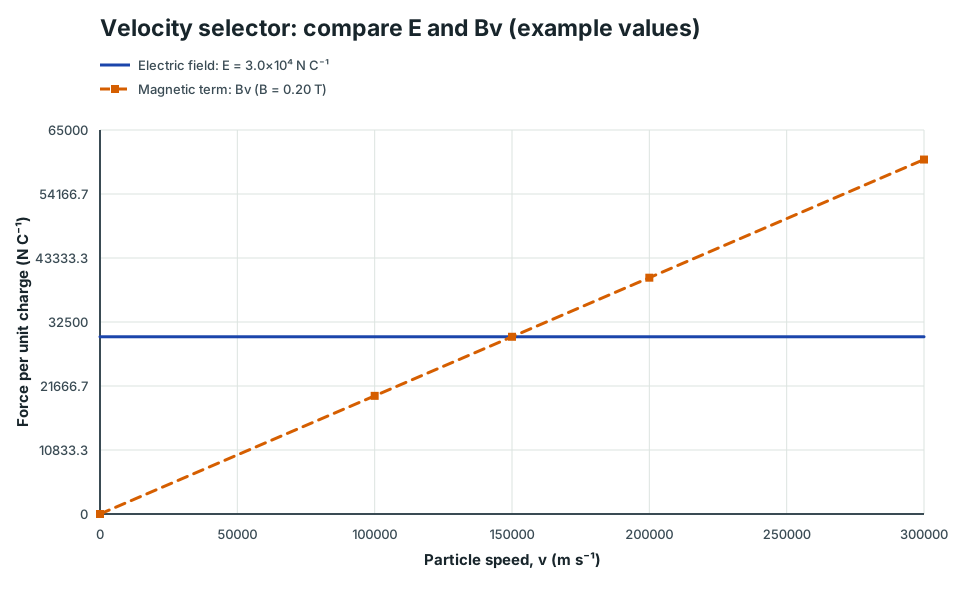
Velocity selector: compare E and Bv (example values)
A constant E line and a rising Bv line; their intersection gives the selected speed v = E/B.
Scroll across the graph to read all labels.
View figure data
| Series | Particle speed, v (m s⁻¹) | Particle speed, v uncertainty | Force per unit charge (N C⁻¹) | Force per unit charge uncertainty |
|---|---|---|---|---|
| Electric field: E = 3.0×10⁴ N C⁻¹ | 0 | 30000 | ||
| Electric field: E = 3.0×10⁴ N C⁻¹ | 300000 | 30000 | ||
| Magnetic term: Bv (B = 0.20 T) | 0 | 0 | ||
| Magnetic term: Bv (B = 0.20 T) | 100000 | 20000 | ||
| Magnetic term: Bv (B = 0.20 T) | 150000 | 30000 | ||
| Magnetic term: Bv (B = 0.20 T) | 200000 | 40000 | ||
| Magnetic term: Bv (B = 0.20 T) | 300000 | 60000 |
4. Common Mistakes
- Forgetting that the magnetic force depends on v (so it is the “speed filter”).
- Using F_B = Bqv when vector v is not perpendicular to vector B (should be Bqv sin θ).
- Mixing up field directions and force directions (especially for negative charges).
- Using E in V/cm instead of converting to V/m.
5. Exam Tips
- Write the balance condition first: qE = Bqv.
- Cancel q explicitly so you don’t lose signs.
- If asked for directions, draw a quick sketch of vector v, vector E, and vector B and label the two forces.
6. Worked Examples
Modelled example 1
Find the selected speed
Problem
Study the worked solution
Set the balance
Method
Use |q|E = B|q|v with the forces opposed.Reason
Undeflected motion requires zero resultant transverse force.Working
|q|E = B|q|vCancel charge and solve
Method
v = E/B.Reason
Both force magnitudes contain the same charge magnitude.Working
v = E/BEvaluate
Method
v = 1.5 × 10⁵ m s⁻¹.Reason
The result depends only on the two field magnitudes under the perpendicular geometry.Working
v = (3.0 × 10⁴)/0.20 = 1.5 × 10⁵ m s⁻¹
Guided practice 2
Find E for a required speed
Problem
Try this before viewing the solution
Hints
Hint 1: make electric field the subject
View solution step by step
Rearrange the selector condition
Method
Use E = vB.Reason
The electric force must match the speed-dependent magnetic force.Working
E = vBEvaluate
Method
E = 1.0 × 10⁶ V m⁻¹.Reason
Multiply the target speed by magnetic flux density.Working
E = (2.0 × 10⁶)(0.50) = 1.0 × 10⁶ V m⁻¹
Common misconception 3
Find B for a required speed
Learner claim
Try this before viewing the solution
View solution step by step
Repair the rearrangement
Method
Use B = E/v.Reason
The balance condition is E = Bv.Working
B = E/vEvaluate
Method
B = 0.25 T.Reason
The quotient has the correct field magnitude and units.Working
B = (5.0 × 10⁴)/(2.0 × 10⁵) = 0.25 T
Examiner practice 4
Find v from plate voltage and separation
Examination question
Try this before viewing the solution
View solution step by step
Find electric field
1 markMethod
E = 3.0 × 10⁴ V m⁻¹.Reason
The approximately uniform plate field is V/d.Working
E = 600/(2.0 × 10⁻²) = 3.0 × 10⁴ V m⁻¹State force balance
1 markMethod
|q|E = B|q|v with opposite directions.Reason
Undeflected transmission requires zero net force.Working
v = E/BCalculate speed
1 markMethod
v = 2.0 × 10⁵ m s⁻¹.Reason
Divide the electric field by magnetic flux density.Working
v = (3.0 × 10⁴)/0.15 = 2.0 × 10⁵ m s⁻¹
Self-mark with the mark scheme
Compare your response with each mark point. Select a point only when your response contains that evidence.
Self-mark electric field, force balance and speed.
Challenge 5
Net force when the speed is not selected
Independent transfer
Try this before viewing the solution
Hints
Hint 1: compare force per charge
View solution step by step
Compare force magnitudes
Method
Bv = 1.5 × 10⁴ V m⁻¹ < E.Reason
Dividing both force magnitudes by |q| leaves E and Bv.Working
Bv = (0.10)(1.5 × 10⁵) = 1.5 × 10⁴ V m⁻¹Predict deflection
Method
The electric force is larger, so the ion deflects in the direction of vector E.Reason
The ion is positive and the opposed magnetic force is too small to balance it.Working
F_E > F_B; net force follows vector E.
7. Mind Stretchers
Mind stretcher 1: Why does the selected speed not depend on charge sign?Extension
Explain why the speed condition v = E/B is the same for positive and negative charges (even though the forces reverse direction).
Show Answer
For a given field arrangement, both F_E = qE and F_B = Bqv reverse direction when q changes sign.
So the forces still oppose each other and balance at the same speed because the magnitudes are still equal when |q|E = B|q|v.
Mind stretcher 2: How velocity selection helps measure m/qExtension
Explain why a velocity selector is often used before a “B-field only” region when an instrument needs to determine m/q for ions.
Show Answer
The selector ensures all ions entering the next region have the same speed v = E/B (known from fields you control).
In a magnetic-only region, the radius is: r = mv/|q|B So measuring r lets you find m/q because v and B are known. Without velocity selection, different speeds would give different radii even for the same m/q.
8. Optional (Enrichment)
A. Link to beam deflection in uniform fields
See Deflection of Charged Particles for the standard “electric field gives parabolic path; magnetic field gives circular/helical path” comparison.
Continue with the next resource in this course.
Course and syllabus information
- Course
- GCE A-Level H2 Physics
- Edition
- GCE A-Level H2 Physics 2027