Eddy Currents
Key idea: Explain how eddy currents are induced by changing flux, why they cause heating and magnetic braking, and how lamination/slits reduce losses (A Level Physics).
Continue where you stopped
The core idea
On this page
Learning objectives
- Explain simple applications of electromagnetic induction, including motional e.m.f. and eddy currents.
1. Definitions (Must Know)
A. Eddy currents
Eddy currents are circulating currents induced in a bulk conductor when the magnetic flux through it changes.
2. Key Ideas (What Earns Marks)
- Eddy currents appear when flux linkage changes: ε = -d(NΦ)/dt.
- By Lenz’s law, eddy currents produce magnetic effects that oppose the change that created them.
- Eddy currents cause:
- heating (energy dissipated as I²R),
- magnetic braking / damping (retarding forces on motion).
- Laminating a core reduces eddy current losses by breaking up large current loops.
Eddy currents are a simple application of electromagnetic induction (18f) and connect directly to transformer core losses (hysteresis + eddy currents).
3. Detailed Explanations
A. Why a falling magnet slows down in a copper tube
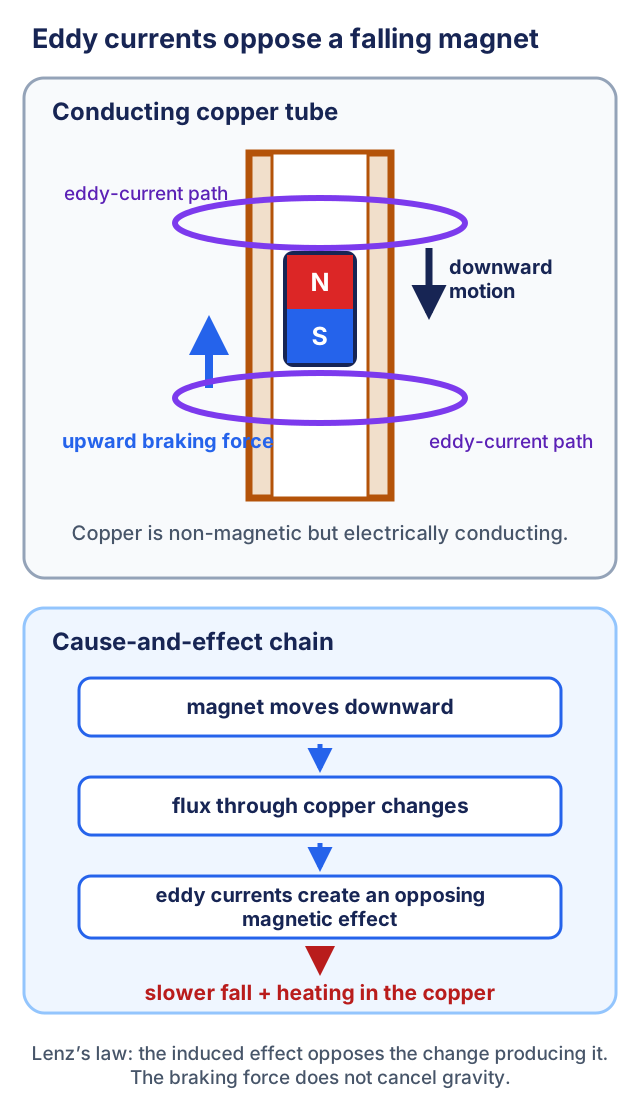
As the magnet falls, the magnetic flux through the copper changes. This induces eddy currents in the copper. By Lenz’s law, the magnetic field from the eddy currents opposes the change, producing an upward retarding force on the magnet.
B. Why eddy currents cause heating
Eddy currents flow through the resistance of the conductor. Electrical energy is dissipated as thermal energy at a rate ∝ I²R, so the metal warms up.
4. Common Mistakes
- Saying eddy currents happen just because “a magnet is near” (you need a change in flux linkage).
- Mixing up “eddy currents oppose motion” with “eddy currents oppose the field” (they oppose the change).
- Forgetting that heating is a real energy loss mechanism.
5. Exam Tips
- For “explain” questions, use this chain:
- changing flux → induced e.m.f. → eddy currents → magnetic effect opposes change → damping/braking + heating.
- If the question asks how to reduce eddy currents: “use a laminated core” or “use slotted conductor”.
6. Worked Examples
Modelled example 1
Qualitative: why does lamination reduce losses?
Problem
Study the worked solution
Identify the unwanted process
Method
Changing core flux induces eddy currents in the conducting core.Reason
A bulk conductor provides closed paths in which induced currents can circulate.Working
changing flux → induced e.m.f. → eddy currentsState what lamination changes
Method
Thin insulated sheets break large circulating paths into smaller loops.Reason
The insulation interrupts paths across the sheets, increasing their effective resistance and reducing enclosed loop area.Working
bulk core → separated conducting sheetsComplete the energy argument
Method
Smaller eddy currents cause less heating, so transformer energy loss decreases.Reason
For a current path, thermal dissipation is associated with I²R.Working
smaller I → less I²R heating
Guided practice 2
Copper pipe demo (qualitative)
Problem
Try this before viewing the solution
Hints
Hint 1: start with the changing quantity
Hint 2: compare the materials
View solution step by step
Establish induction
Method
The moving magnet changes the magnetic flux through sections of the copper pipe, inducing eddy currents.Reason
Faraday’s law requires a changing flux, not merely a nearby magnet.Working
motion → changing flux → circulating currentApply Lenz’s law
Method
The eddy-current magnetic effect opposes the change, producing an upward retarding force.Reason
The induced effect opposes the change that produced it, so it brakes the falling magnet.Working
retarding force opposite the downward motionAccount for material and energy
Method
Copper permits substantial currents and warms by I²R dissipation; plastic does not provide mobile charge carriers for such currents.Reason
The magnet’s mechanical energy is transferred mainly to thermal energy in the pipe.Working
copper: braking + heating; plastic: little braking
Common misconception 3
Slits and damping
Learner claim
Try this before viewing the solution
View solution step by step
Reject the edge argument
Method
The damping decreases; the number of edges is not the controlling factor.Reason
Eddy-current magnitude depends on usable closed conducting paths and their resistance.Working
more edges ⇏ larger eddy currentsTrace the path change
Method
The slits interrupt large circulating loops and leave smaller, higher-resistance paths.Reason
That reduces the induced current for a given flux-change rate.Working
slits → smaller loops → smaller currentInfer the motion change
Method
A smaller opposing magnetic effect produces weaker damping and less energy dissipation.Reason
Lenz’s-law braking is weaker when the eddy currents are smaller.Working
smaller current → smaller retarding force
Examiner practice 4
Desirable vs undesirable eddy currents
Examination question
Try this before viewing the solution
View solution step by step
Name a useful situation
1 markMethod
Eddy-current braking or damping is useful, for example in an eddy-current brake.Reason
The question requires a valid application, not just the phrase “magnetic braking”.Working
useful example: eddy-current brakeExplain the useful effect
1 markMethod
Induced currents create a magnetic effect opposing the motion.Reason
Lenz’s law supplies a non-contact retarding force.Working
changing flux → opposing magnetic effectName an unwanted situation
1 markMethod
Eddy currents are unwanted in a transformer core.Reason
The core carries changing flux and can support circulating currents.Working
unwanted example: transformer coreExplain the unwanted effect
1 markMethod
The currents dissipate energy as heat and reduce transformer efficiency.Reason
The conducting core has resistance, so eddy currents cause thermal loss.Working
I²R heating
Self-mark with the mark scheme
Compare your response with each mark point. Select a point only when your response contains that evidence.
Self-mark one valid use, its explanation, one unwanted case and its explanation.
Challenge 5
Scaling idea (rates and heating)
Independent transfer
Try this before viewing the solution
Hints
Hint 1: link the three relations
View solution step by step
Scale induced e.m.f.
Method
The induced e.m.f. magnitude triples.Reason
Faraday’s law makes |ε| proportional to the rate of change of flux linkage.Working
|ε| ∝ |d(NΦ)/dt|Scale current
Method
The eddy current magnitude triples.Reason
Resistance is stated to remain roughly constant, so I = ε/R.Working
I_new/I_old = 3Scale heating
Method
The heating power increases by a factor of nine.Reason
At constant resistance, power depends on the square of current.Working
P_new/P_old = (I_new/I_old)² = 3² = 9
7. Mind Stretchers
Mind stretcher 1: Motion dependenceExtension
A metal plate swings through a magnetic field. Explain why the damping is strongest when the plate is moving fastest.
Show Answer
Faster motion causes a larger rate of change of flux linkage.
So the induced e.m.f. is larger, eddy currents are larger, and the opposing magnetic effect (and energy dissipation) is stronger.
Mind stretcher 2: Energy transferExtension
A conductor experiences eddy-current braking. Where does the kinetic energy go, and why must an external agent do work to keep it moving at constant speed?
Show Answer
Eddy currents dissipate energy as heat in the conductor (I²R), so kinetic energy is converted mainly to thermal energy.
By Lenz’s law, the induced effects oppose the motion, creating a retarding force. To maintain constant speed, an external agent must provide an equal forward force and do work, supplying the energy that ends up as heat.
Continue with the next resource in this course.
Course and syllabus information
- Course
- GCE A-Level H2 Physics
- Edition
- GCE A-Level H2 Physics 2027