Magnetic Flux
Key idea: Define magnetic flux Φ and flux linkage NΦ, use Φ = BA cosθ and NΦ = NBA cosθ, and solve induction-style flux questions in exams (A Level Physics).
Continue where you stopped
The core idea
On this page
Learning objectives
- Use magnetic flux and flux-linkage relationships.
1. Definitions (Must Know)
A. Magnetic flux, Φ
Magnetic flux, Φ, through a plane surface is:
Φ = BA cos θ
where:
- B is magnetic flux density (T),
- A is the area of the surface (m²),
- θ is the angle between vector B and the normal to the surface.
Unit: weber (Wb), where 1 Wb = 1 T m².
B. Flux linkage, NΦ
For a coil with N turns, the magnetic flux linkage is:
NΦ = NBA cos θ
2. Key Ideas (What Earns Marks)
- If the field is perpendicular to the surface, θ = 0° and cos θ = 1, so Φ = BA.
- If the field is parallel to the surface, θ = 90° and Φ = 0.
- In induction, what matters is usually how fast NΦ changes with time.
θ is measured between vector B and the normal to the surface, not between vector B and the plane.
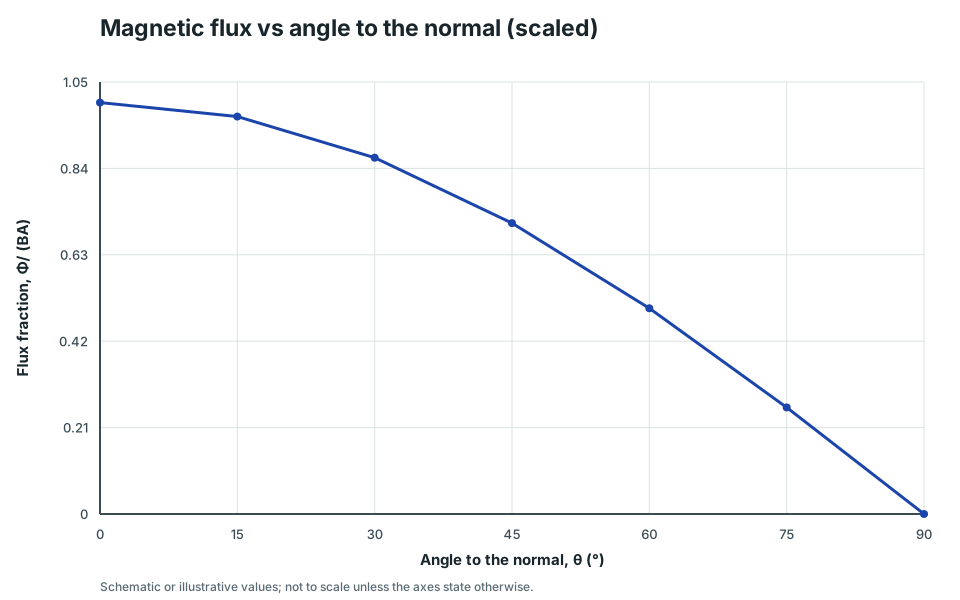
Magnetic flux vs angle to the normal (scaled)
A cosine curve showing that flux falls from BA to 0 as the angle between the field and the surface normal increases from 0° to 90°.
Scroll across the graph to read all labels.
View figure data
| Angle to the normal, θ (°) | Φ/(BA) = cosθ |
|---|---|
| 0 | 1 |
| 15 | 0.966 |
| 30 | 0.866 |
| 45 | 0.707 |
| 60 | 0.5 |
| 75 | 0.259 |
| 90 | 0 |
3. Detailed Explanations
A. Why the cosine appears
Only the component of vector B perpendicular to the surface contributes to flux:
B_⊥ = B cos θ ⇒ Φ = B_⊥ A = BA cos θ
B. What changes flux linkage
From NΦ = NBA cos θ, flux linkage changes if any of these change:
- magnetic flux density B,
- coil area A,
- coil orientation θ,
- number of turns N (usually fixed for a given coil).
4. Common Mistakes
- Using the wrong angle (using the angle to the plane instead of the normal).
- Mixing up flux Φ (Wb) with flux density B (T).
- Forgetting to convert cm² to m².
5. Exam Tips
- Write down the normal direction as a small arrow on the surface before you decide θ.
- If the surface is rotated, sketch vector B and the normal at least once to avoid the sin/cos swap.
6. Worked Examples
Modelled example 1
Flux through a surface
Problem
Study the worked solution
Interpret the orientation
Method
The field is parallel to the surface normal, so θ = 0°.Reason
The flux angle is measured to the normal, not to the plane.Working
cos 0° = 1.Calculate flux
Method
Φ = 1.0 × 10⁻³ Wb.Reason
Use Φ = BA cos θ = BA.Working
Φ = (0.40)(2.5 × 10⁻³) = 1.0 × 10⁻³ Wb
Guided practice 2
Rotated surface
Problem
Try this before viewing the solution
Hints
Hint 1: project onto the normal
View solution step by step
Use the stated angle
Method
Apply Φ = BA cos 60°.Reason
The question already gives the angle between vector B and the normal.Working
Φ = (0.15)(1.2 × 10⁻²) cos 60°Evaluate
Method
Φ = 9.0 × 10⁻⁴ Wb.Reason
cos 60° = 0.50.Working
Φ = 9.0 × 10⁻⁴ Wb
Common misconception 3
Flux linkage of a coil
Learner claim
Try this before viewing the solution
View solution step by step
Distinguish the quantities
Method
Flux per turn is Φ = BA = 2.4 × 10⁻⁴ Wb.Reason
The learner stopped before including the number of turns.Working
Φ = (0.80)(3.0 × 10⁻⁴) = 2.4 × 10⁻⁴ WbCalculate linkage
Method
NΦ = 4.8 × 10⁻² Wb turn.Reason
All 200 turns link the same flux.Working
NΦ = (200)(2.4 × 10⁻⁴) = 4.8 × 10⁻² Wb turn
Examiner practice 4
Angle given to the plane of the coil
Examination question
Try this before viewing the solution
View solution step by step
Convert the angle
1 markMethod
θ = 70° to the normal.Reason
The normal is 90° to the plane.Working
θ = 90°-20° = 70°Select the equivalent relation
1 markMethod
Use Φ = BA cos 70° = BA sin 20°.Reason
Flux uses the perpendicular area component.Working
Φ = BA sin 20°Evaluate
1 markMethod
Φ = 5.13 × 10⁻⁴ Wb.Reason
Substitute the field, area and plane-angle sine.Working
Φ = (0.30)(5.0 × 10⁻³) sin 20° = 5.13 × 10⁻⁴ Wb
Self-mark with the mark scheme
Compare your response with each mark point. Select a point only when your response contains that evidence.
Self-mark the angle conversion, relation and value.
Challenge 5
Find B from a measured flux
Independent transfer
Try this before viewing the solution
Hints
Hint 1: find area in square metres
View solution step by step
Find area
Method
A = (0.080)² = 6.4 × 10⁻³ m².Reason
Area conversion squares the length conversion.Working
A = 6.4 × 10⁻³ m²Infer flux density
Method
B = 0.20 T.Reason
The plane is perpendicular to vector B, so Φ = BA.Working
B = (1.28 × 10⁻³)/(6.4 × 10⁻³) = 0.20 TDistinguish turns
Method
N is unnecessary because flux per turn, not flux linkage, is given.Reason
Turns enter only through NΦ.Working
Use Φ, not NΦ.
7. Mind Stretchers
Mind stretcher 1: Doubling flux linkageExtension
A coil has fixed N and A. Give two different ways to double NΦ without changing N or A.
Show Answer
From NΦ = NBA cos θ:
- double B, or
- change orientation so cos θ doubles (e.g. rotate from θ = 60° to θ = 0°, since cos 60° = 0.5 and cos 0° = 1).
Mind stretcher 2: Can flux be negative?Extension
In calculations, can Φ (or NΦ) be negative? What does a negative sign represent?
Show Answer
Yes. Flux is treated as a signed quantity when you choose a direction for the area normal.
A negative flux means the magnetic field component through the surface is opposite to the chosen normal direction (i.e. it points “into” the surface relative to your chosen positive direction).
8. Optional (Enrichment)
A. Base units of weber
Using 1 Wb = 1 T m² and 1 T = 1 N A⁻¹m⁻¹:
Wb = N m A⁻¹ = J A⁻¹
Continue with the next resource in this course.
Course and syllabus information
- Course
- GCE A-Level H2 Physics
- Edition
- GCE A-Level H2 Physics 2027