Elastic Potential Energy (Force–Extension Graph)
Key idea: Determine work done and elastic potential energy from force–extension area, using one-half kx squared only in the Hooke's-law region.
Continue where you stopped
The core idea
On this page
Learning objectives
- Represent fields and relate work done by a field to potential-energy change.
- Use force–extension graphs to determine elastic potential energy.
1. Definitions (Must Know)
A. Extension, x (m)
Extension, x, is the increase in length of an object:
extension = final length − original length.
B. Force–extension graph
A force–extension graph plots force F (N) against extension x (m).
C. Elastic potential energy, Eₑ (J)
Elastic potential energy, Eₑ, is energy stored when an object is elastically deformed.
D. “Area under the graph”
The area under a graph is the area between the curve and the x-axis.
For an F–x graph, the unit is: N m = J
2. Key Ideas (What Earns Marks)
- Elastic potential energy stored in a deformed material equals the area under the force–extension graph:
- If Hooke’s law applies (F = kx, straight line through the origin):
- If the graph is not a straight line, find the area by splitting it into simple shapes (triangles/trapezia/rectangles).
3. Detailed Explanations
A. Why “area under the graph” gives energy
For a constant force parallel to the displacement, work done is W = Fx.
If the force changes with extension, then:
- split the extension into small parts Δ x,
- work done on each part is approximately FΔ x,
- total work is the sum of those areas.
So the work done stretching the object is the area under the F–x curve. If the deformation is elastic (no energy lost), this work becomes elastic potential energy stored.
B. Hooke’s law case (straight line)
When F = kx, the F–x graph is a straight line through the origin, so the area is a triangle:
Linear and non-linear force–extension responses
One line shows a Hooke's-law response through the origin. A second response curves upward, so its work must be obtained from the actual area under the data.
Scroll across the graph to read all labels.
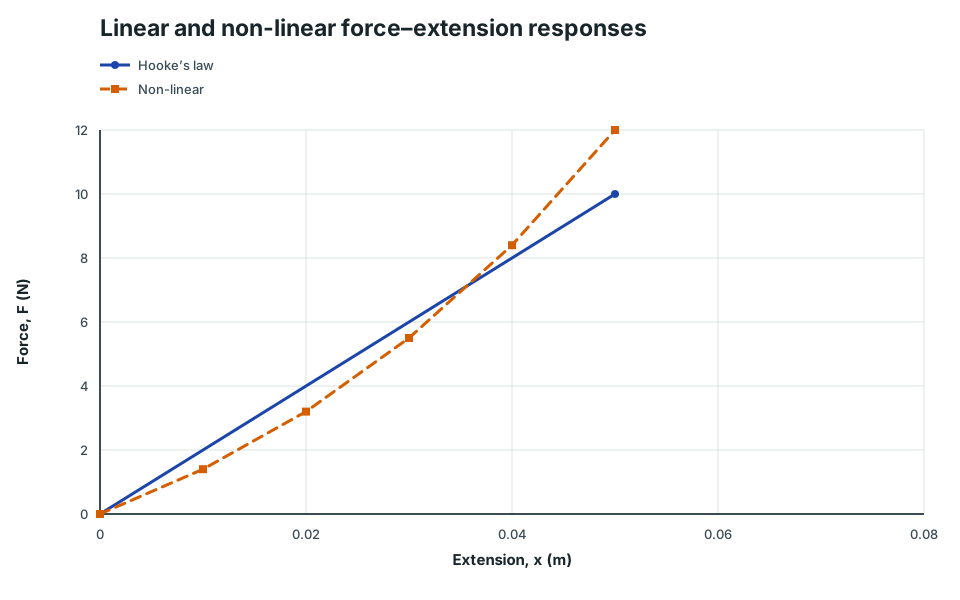
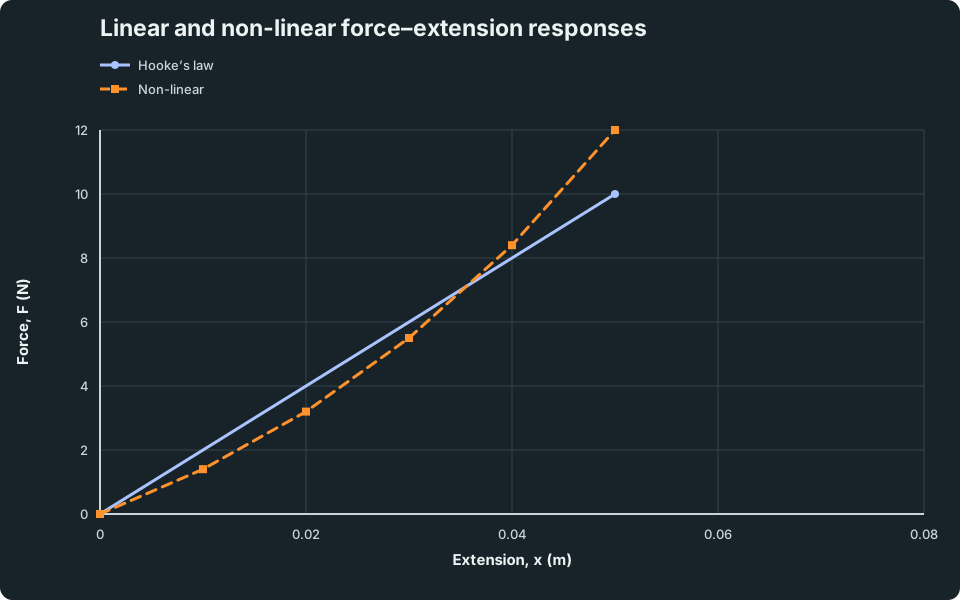
View figure data
| Series | Extension, x (m) | Extension, x uncertainty | Force, F (N) | Force, F uncertainty |
|---|---|---|---|---|
| Hooke’s law | 0 | 0 | ||
| Hooke’s law | 0.05 | 10 | ||
| Non-linear | 0 | 0 | ||
| Non-linear | 0.01 | 1.4 | ||
| Non-linear | 0.02 | 3.2 | ||
| Non-linear | 0.03 | 5.5 | ||
| Non-linear | 0.04 | 8.4 | ||
| Non-linear | 0.05 | 12 |
4. Common Mistakes
- Using the total length instead of the extension.
- Using Fx with F taken at the final extension (a rectangle) instead of the area under the curve.
- Forgetting conversions (e.g.
cm → m). - Forgetting the 1/2 factor when the graph is a straight line from the origin.
5. Exam Tips
- Always write the unit check: N m = J.
- Do not confuse the two limits: a response may be non-linear beyond the proportional limit yet remain elastic until the elastic limit.
- Area under a loading curve is work input. Call it stored elastic energy only when deformation is elastic and dissipative losses are negligible.
6. Worked Examples
Modelled example 1
Use Eₑ = (1/2)kx²
Problem
Study the worked solution
Check the model
Method
Use the Hooke-law triangular-area expression Eₑ = (1/2)kx².Reason
The stated force constant represents a linear force–extension response over this extension.Working
Eₑ = (1/2)kx²Calculate stored energy
Method
Eₑ = 0.45 J.Reason
Extension is already in metres, consistent with the force-constant unit.Working
Eₑ = (1/2)(250)(0.060)² = 0.45 J
Guided practice 2
Use area under a straight-line graph
Problem
Try this before viewing the solution
Hints
Hint 1: identify the graph shape
View solution step by step
Identify the work area
Method
The area is triangular.Reason
Force increases linearly from zero to its final value.Working
Eₑ = (1/2)FxCalculate the area
Method
Eₑ = 0.48 J.Reason
Area under the loading graph equals work input and, under the stated assumptions, stored elastic energy.Working
Eₑ = (1/2)(12)(0.080) = 0.48 J
Common misconception 3
Final force is not the average force
Learner claim
Try this before viewing the solution
View solution step by step
Identify the false constant-force assumption
Method
The force is not 8.0 N throughout loading.Reason
It rises linearly from zero, so Fx draws a rectangle larger than the area under the graph.Working
F_average = (1/2)F_final = 4.0 NCalculate the triangular area
Method
Eₑ = 0.20 J.Reason
Stored energy equals the force–extension area for elastic loading.Working
Eₑ = (1/2)(8.0)(0.050) = 0.20 J
Examiner practice 4
Piecewise graph (triangle + rectangle)
Examination question
Try this before viewing the solution
View solution step by step
Calculate the triangular area
1 markMethod
0.20 J.Reason
Force rises linearly over the first 0.040 m.Working
(1/2)(10)(0.040) = 0.20 JCalculate the rectangular area
1 markMethod
0.20 J.Reason
Force remains constant over the final 0.020 m.Working
(10)(0.060-0.040) = 0.20 JAdd the loading work
1 markMethod
W = 0.40 J.Reason
Total work is the full area under both graph regions.Working
W = 0.20 + 0.20 = 0.40 JState stored energy
1 markMethod
Eₑ = 0.40 J.Reason
The question states elastic deformation and negligible losses.Working
Eₑ = W = 0.40 J
Self-mark with the mark scheme
Compare your response with each mark point. Select a point only when your response contains that evidence.
Self-mark both areas, their sum and the storage condition.
Challenge 5
Find k from the gradient and then find energy
Independent transfer
Try this before viewing the solution
Hints
Hint 1: convert the graph coordinate
View solution step by step
Convert extension
Method
x = 0.060 m.Reason
Force constant is expressed per metre.Working
6.0 cm = 6.0 × 10⁻² mFind the force constant
Method
k = 3.0 × 10² N m⁻¹.Reason
The Hooke-law force–extension gradient is F/x.Working
k = 18/0.060 = 300 N m⁻¹Find stored energy
Method
Eₑ = 0.54 J.Reason
The straight-line graph area is triangular.Working
Eₑ = (1/2)Fx = (1/2)(18)(0.060) = 0.54 J
7. Mind Stretchers
Mind stretcher 1: Estimate energy from a non-linear graph (trapezium rule)Extension
The table gives force vs extension:
| x (m) | 0.00 | 0.02 | 0.04 | 0.06 |
|---|---|---|---|---|
| F (N) | 0 | 4 | 9 | 15 |
Estimate the elastic potential energy stored at x = 0.06 m.
Show Answer
Use trapezia of width Δ x = 0.02 m:
Eₑ ≈ ∑ ((F₁ + F₂)/2)Δ x; = [(0 + 4)/2 + (4 + 9)/2 + (9 + 15)/2](0.02); = (2 + 6.5 + 12)(0.02); = 0.41 J
Mind stretcher 2: Energy lost in loading/unloading (hysteresis idea)Extension
A spring is stretched and then released. The area under the loading F–x curve is 0.80 J, but the area under the unloading curve is 0.65 J.
- How much energy is dissipated in one load–unload cycle?
- Where does that energy go?
Show Answer
-
Energy dissipated: Eₗₒₛₜ = 0.80 - 0.65 = 0.15 J
-
It is transferred mainly to internal energy (heating) of the spring and surroundings, and sometimes sound.
Continue with the next resource in this course.
Course and syllabus information
- Course
- GCE A-Level H2 Physics
- Edition
- GCE A-Level H2 Physics 2027