Work & Kinetic Energy
Key idea: Define work using the force component along displacement, derive kinetic energy from work and constant-acceleration equations, and apply the work–energy theorem.
Continue where you stopped
The core idea
On this page
Learning objectives
- Define work and derive and apply the kinetic-energy relationship.
- Derive Eₖ = ½mv² from the definition of work done by a force and the uniformly accelerated motion equations.
1. Definitions (Must Know)
A. Work done, W (J)
Work done, W, is energy transferred by a force acting through a displacement in the direction of the force.
For a constant force at angle θ to the displacement:
W = Fs cos θ
Work is positive when the force component is along the displacement, negative when it is opposite, and zero when force and displacement are perpendicular.
B. Kinetic energy, Eₖ (J)
Kinetic energy, Eₖ, is energy a body has due to motion: Eₖ = (1/2)mv²
C. Work–energy theorem
The net work done on a body equals the change in kinetic energy: Wₙₑₜ = Δ Eₖ
2. Key Ideas (What Earns Marks)
- Use the resultant force when linking net work to acceleration; use an individual force when asked for the work done by that force.
- For straight-line motion with constant mass:
- Wₙₑₜ = Fs
- F = ma
- v² = u² + 2as (uniform acceleration)
- Combine them to get:
- Wₙₑₜ = (1/2)m(v²-u²) = Δ Eₖ
- so Eₖ = (1/2)mv²
- Sign matters:
- if the resultant force is opposite the displacement, work is negative and kinetic energy decreases.
Choose the displacement direction, then use the force component along it. Do not attach a vector arrow to work or kinetic energy.
3. Detailed Explanations
A. Derivation of Eₖ = (1/2)mv² (exam-ready)
Assume straight-line motion under a constant resultant force (so acceleration is constant).
So,
This implies the kinetic energy of a body moving at speed v is:
B. How to use the work–energy theorem
- Write Wₙₑₜ = Δ Eₖ.
- Express Wₙₑₜ using the forces that do work (often Fs along the motion).
- Solve for the unknown (speed, distance, force, etc).
C. Visual: negative work (braking / friction)
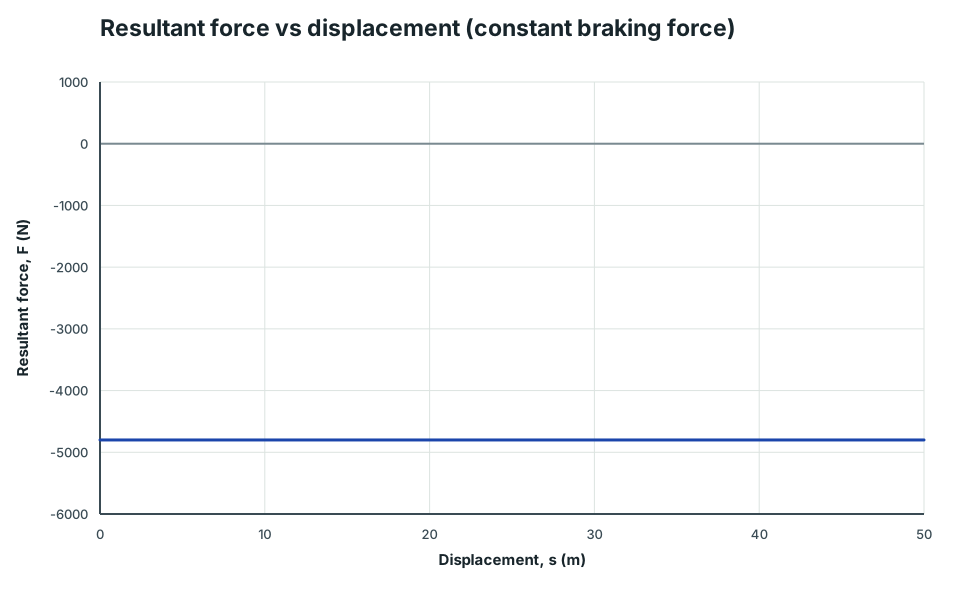
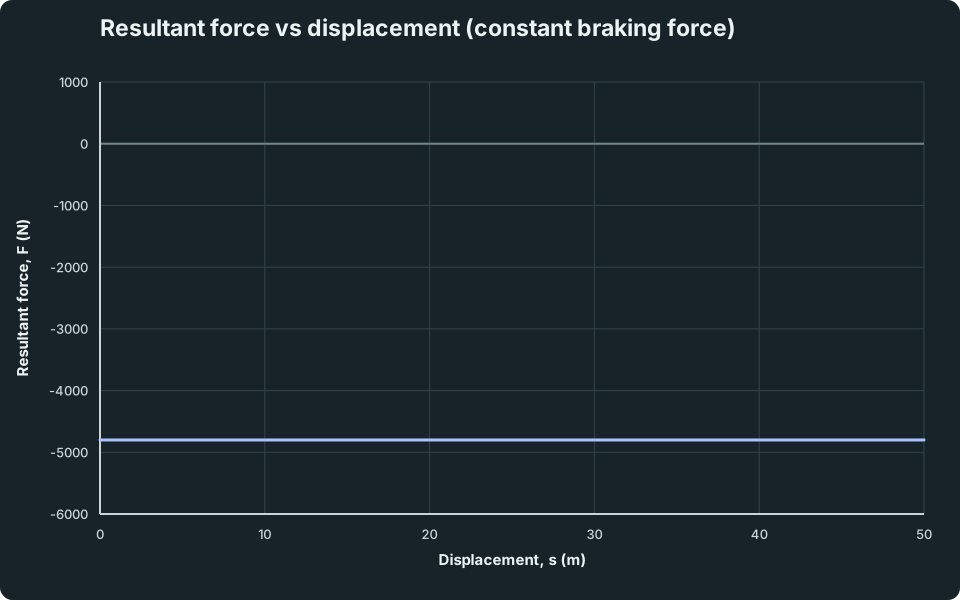
If the resultant force is opposite the displacement, the force–displacement graph lies below the axis and the work done is negative (kinetic energy decreases).
Resultant force vs displacement (constant braking force)
A constant resistive force acts opposite to the motion. The rectangular area under the line is the (negative) work done.
Scroll across the graph to read all labels.
View figure data
| Displacement, s (m) | Braking force |
|---|---|
| 0 | -4800 |
| 50 | -4800 |
4. Common Mistakes
- Using the applied force instead of the resultant force in Wₙₑₜ.
- Using distance travelled when the displacement in the force direction is required.
- Forgetting unit conversions (e.g.
cm → m,kN → N). - Using a SUVAT equation without checking the condition of constant acceleration.
5. Exam Tips
- Use Wₙₑₜ = (1/2)m(v²-u²) when the question gives distance and asks for speed (or vice versa).
- If the object stops, set v = 0 and solve for the stopping distance or braking force.
- Keep signs consistent: work by a resistive force is negative.
6. Worked Examples
Modelled example 1
Net work from a change in speed
Problem
Study the worked solution
Choose the work–energy relation
Method
Wₙₑₜ = Δ Eₖ.Reason
The question asks for net work and supplies initial and final speeds, so no force or time is needed.Working
Wₙₑₜ = E_(k,f)-E_(k,i)Calculate the energy change
Method
Wₙₑₜ = 40 J.Reason
Kinetic energy depends on speed squared.Working
Wₙₑₜ = (1/2)(2.0)(7.0²-3.0²) = 40 J
Guided practice 2
Speed from work done
Problem
Try this before viewing the solution
Hints
Hint 1: transfer work into kinetic energy
View solution step by step
Calculate net work
Method
Wₙₑₜ = 30 J.Reason
The resultant force is along the displacement and constant.Working
Wₙₑₜ = Fs = (6.0)(5.0) = 30 JSet the kinetic-energy gain
Method
30 = (1/2)(3.0)v².Reason
The initial kinetic energy is zero.Working
Wₙₑₜ = Δ Eₖ = (1/2)mv²Calculate final speed
Method
v = 4.47 m s⁻¹.Reason
Speed is the positive square root of 2W/m.Working
v = square root of (2(30)/3.0) = 4.47 m s⁻¹
Common misconception 3
Braking force from stopping distance
Learner claim
Try this before viewing the solution
View solution step by step
Determine the energy change
Method
Δ Eₖ = -2.4 × 10⁵ J.Reason
The car loses all its initial kinetic energy.Working
Δ Eₖ = (1/2)(1200)(0²-20²) = -2.4 × 10⁵ JGive braking work its sign
Method
W_brake = -F(50).Reason
The force direction is opposite to the car’s displacement.Working
W = Fs cos 180° = -FsFind the force magnitude
Method
F = 4.8 × 10³ N.Reason
Negative braking work equals the negative kinetic-energy change.Working
-50F = -2.4 × 10⁵ ⇒ F = 4.8 × 10³ N
Examiner practice 4
Stopping distance from a constant resistive force
Examination question
Try this before viewing the solution
View solution step by step
Write the signed work–energy equation
2 marksMethod
-Fs = 0-(1/2)mu².Reason
The car stops and the resistive force acts opposite its displacement.Working
-Fs = Δ Eₖ = (1/2)m(0²-u²)Rearrange for distance
1 markMethod
s = mu²/(2F).Reason
Both sides of the signed equation are negative, leaving a positive distance.Working
s = (1/2)mu²/FCalculate the stopping distance
1 markMethod
s = 56.3 m, about 56 m.Reason
Substitute the initial speed and constant resistive-force magnitude.Working
s = ((1/2)(900)(25²))/(5.0 × 10³) = 56.25 m
Self-mark with the mark scheme
Compare your response with each mark point. Select a point only when your response contains that evidence.
Self-mark the signed energy model, rearrangement and result.
Challenge 5
Given frictional force on a horizontal surface
Independent transfer
Try this before viewing the solution
Hints
Hint 1: connect the negative work to stopping
View solution step by step
Calculate frictional work
Method
W_f = -29.5 J.Reason
Friction acts at 180° to displacement.Working
W_f = -fs = -(11.8)(2.5) = -29.5 JRelate work to the energy loss
Method
-29.5 = -(1/2)(4.0)u².Reason
The block’s final kinetic energy is zero and friction is the only force doing work.Working
Wₙₑₜ = 0-(1/2)mu²Find the initial speed
Method
u = 3.84 m s⁻¹.Reason
Speed is the positive root of twice the removed energy divided by mass.Working
u = square root of (2(29.5)/4.0) = 3.84 m s⁻¹
7. Mind Stretchers
Mind stretcher 1: Derive a stopping distance expressionExtension
Show that if a constant resistive force of magnitude F stops a mass m moving initially at speed u, the stopping distance is s = mu²/2F.
Show Answer
Using Wₙₑₜ = Δ Eₖ and v = 0: -Fs = (1/2)m(0²-u²); Fs = (1/2)mu²; s = mu²/2F
Mind stretcher 2: When does the work–energy method beat SUVAT?Extension
Give one example situation where Wₙₑₜ = Δ Eₖ is safer/faster than SUVAT, and explain why.
Show Answer
Example: “a car stops over a known distance with an unknown braking force” (or “a block slides to rest under friction over a distance”).
Energy is faster because it relates forces and distance directly: Wₙₑₜ = -Fs = Δ Eₖ without needing time. SUVAT would require finding/using time or constant acceleration assumptions explicitly; the energy method is direct and often less algebra.
Mind stretcher 3: Optional (Enrichment)Extension
A. Why you can feel tired when W = 0
In Physics, work done on an object depends on displacement in the direction of the force. So an object can have zero work done on it even though your body uses energy.
Show Explanation
Scenario A (pushing a wall/tree): The object does not move, so displacement is zero and the work done on the object is zero. But your muscles still use chemical energy to maintain tension, and much of that energy ends up as internal energy (heat) in your body.
Scenario B (carrying a load horizontally at constant speed): Your force on the load is mainly upward (to balance its weight) while the displacement is horizontal, so your force does zero work on the load. You can still feel tired because your muscles continuously contract to support the load and keep your posture stable.
Continue with the next resource in this course.
Course and syllabus information
- Course
- GCE A-Level H2 Physics
- Edition
- GCE A-Level H2 Physics 2027