Geostationary orbits and their uses
Key idea: A geostationary orbit is circular, equatorial and turns with Earth in the same direction and period. It shares Earth's angular velocity, so it stays above one point.
Offline pages
Saved on this device only. Connect at least once every 30 days to confirm Premium. Sign-out or a change of account removes saved copies.
Loading guide controls…
Guided lessons · coming soon
Guided lesson
Guided steps
- Read the four conditions for staying above one ground point.
- Decide whether a polar orbit can stay above one ground point.
- Read why the period fixes the orbital radius.
- Find the radius from the centre, then the height above Earth.
- Find the radius and height, then compare angular velocities.
- Compare angular velocity with linear speed at different radii.
- Find the speed ratio and compare angular velocities.
- Find the change in longitude, taking east as positive.
- Read how height and orbital plane affect satellite use.
- Find which condition the tilted orbit fails.
- Find the planet’s rotation period in seconds, then hours.
- Explain which orbit suits each observing job.
On this page
You stopped at:
ContinueA satellite dish on a roof points at one fixed spot in the sky and never needs to move, because the satellite it receives from stays above the same place on the Earth. Such a geostationary orbit has to meet four conditions, and those conditions, through Kepler’s third law, fix exactly how far out it is.
Conditions for a geostationary orbit
A geostationary satellite stays above the same point on the Earth’s surface. To do that, it must turn with the Earth:
- its period equals the Earth’s period of rotation, about 24 hours;
- it moves in the same direction as the Earth rotates, from west to east;
- its orbit is circular, so its angular velocity is constant;
- its orbit is in the plane of the equator, so it stays above the equator.
All four are needed.
Check your understanding 1 A 24-hour polar orbit
Can a satellite in a circular orbit over the poles, with a period of 24 hours, stay above one point on the Earth?
Show answer
No. It moves from pole to pole, so the latitude below it keeps changing. A geostationary orbit must also be above the equator.
The radius of a geostationary orbit
The period is fixed, so Kepler’s third law fixes the radius. Every geostationary satellite, whatever its mass, is at the same distance from the Earth’s centre.
Worked example 1
Radius and height of a geostationary orbit
Problem
Find the radius of a geostationary orbit and its height above the Earth’s surface. Take the period as 24.0 h, GM = 3.99 × 10¹⁴ N m² kg⁻¹ for the Earth and the Earth’s radius as 6.37 × 10⁶ m.
Show full solution
Period in seconds
Method
Convert hours to seconds.Reason
GM is in SI units.Working
Answer
T = 24.0 × 3600 = 86 400 s
Radius
Reason
Rearrange T² = (4π²/GM)r³ for r.Working
Answer
r = (GMT²/4π²)^(1/3) = ((3.99 × 10¹⁴(86 400)²)/4π²)^(1/3) = 4.23 × 10⁷ m
Height above the surface
Working
Answer
h = r-R = 4.23 × 10⁷-6.37 × 10⁶ = 3.59 × 10⁷ m, about 36 000 km
Quick check
The radius is about 6.6 times the Earth’s radius, much further out than the low orbits of the previous lesson, as a 24-hour period needs.
Guided practice 2
Using a sidereal day
Problem
The Earth turns once relative to the stars in 86 164 s. Use GM = 3.99 × 10¹⁴ N m² kg⁻¹ and Earth’s radius R = 6.37 × 10⁶ m. Find the radius and height of a geostationary orbit. Give each result in metres, and decide which angular quantity it shares with the ground below it.
Find the radius and height
Show the steps Optional working
Hints
Hint 1
same method
Which distance does Kepler’s third law use: centre distance or height above the surface?
Show full solution
Radius and height
Working
Answer
r = ((3.99 × 10¹⁴(86 164)²)/4π²)^(1/3) = 4.22 × 10⁷ m and h = 4.22 × 10⁷-6.37 × 10⁶ = 3.58 × 10⁷ m. The slightly shorter period gives a slightly smaller orbit, since r ∝ T^(2/3). The satellite and the equatorial ground point share angular velocity, not linear speed or centripetal acceleration.
Matching angular velocity, not speed
A geostationary satellite and a point on the equator below it have the same angular velocity: both turn once a day. Their speeds are very different, because v = rω and the satellite is 6.6 times further from the Earth’s axis.
A satellite with a different period drifts relative to the ground. In one rotation of the Earth, a satellite with half the period goes round twice and gains 360° eastwards; one with twice the period goes only halfway round and falls 180° behind.
Longitude drift relative to Earth
After one Earth rotation, an orbit with half the rotation period has gained 360 degrees east; a matching-period orbit has no drift; a double-period orbit has drifted 180 degrees west.
Scroll across the figure to read all labels.
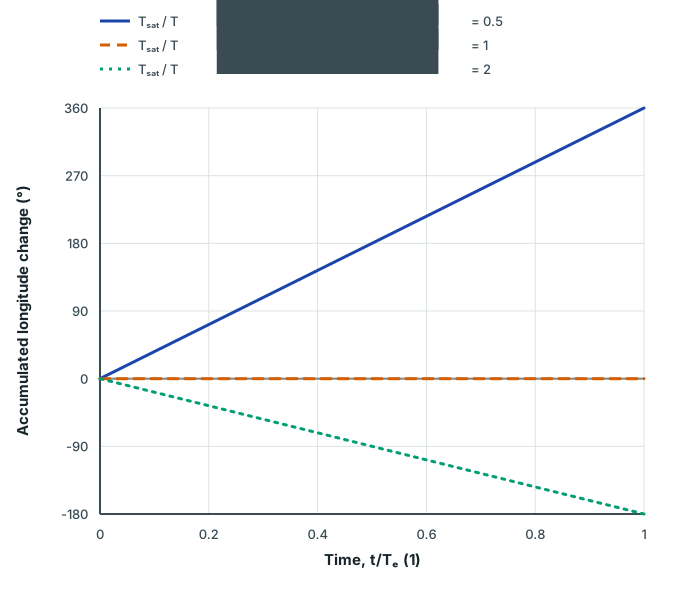
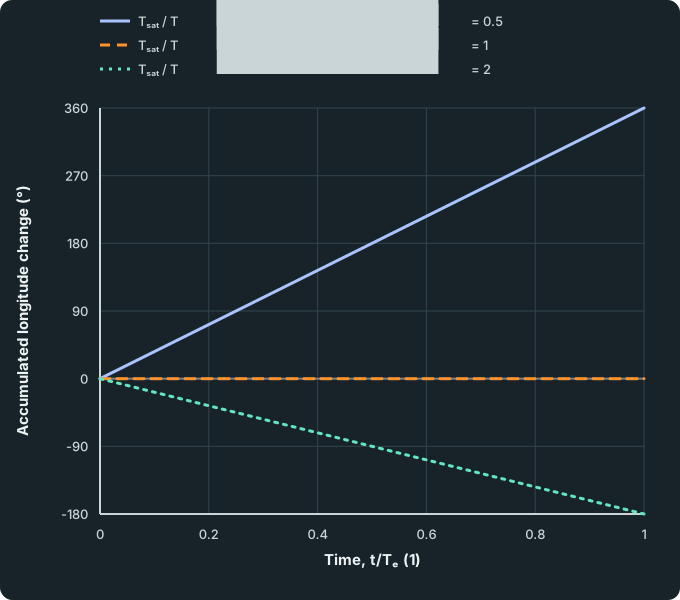
View figure data
| Time, t/Tₑ (1) | Tₛₐₜ / TE = 0.5 | Tₛₐₜ / TE = 1 | Tₛₐₜ / TE = 2 |
|---|---|---|---|
| 0.00 | 0.0 | 0 | 0.0 |
| 0.01 | 3.6 | 0 | -1.8 |
| 0.02 | 7.2 | 0 | -3.6 |
| 0.03 | 10.8 | 0 | -5.4 |
| 0.04 | 14.4 | 0 | -7.2 |
| 0.05 | 18.0 | 0 | -9.0 |
| 0.06 | 21.6 | 0 | -10.8 |
| 0.07 | 25.2 | 0 | -12.6 |
| 0.08 | 28.8 | 0 | -14.4 |
| 0.09 | 32.4 | 0 | -16.2 |
| 0.10 | 36.0 | 0 | -18.0 |
| 0.11 | 39.6 | 0 | -19.8 |
| 0.12 | 43.2 | 0 | -21.6 |
| 0.13 | 46.8 | 0 | -23.4 |
| 0.14 | 50.4 | 0 | -25.2 |
| 0.15 | 54.0 | 0 | -27.0 |
| 0.16 | 57.6 | 0 | -28.8 |
| 0.17 | 61.2 | 0 | -30.6 |
| 0.18 | 64.8 | 0 | -32.4 |
| 0.19 | 68.4 | 0 | -34.2 |
| 0.20 | 72.0 | 0 | -36.0 |
| 0.21 | 75.6 | 0 | -37.8 |
| 0.22 | 79.2 | 0 | -39.6 |
| 0.23 | 82.8 | 0 | -41.4 |
| 0.24 | 86.4 | 0 | -43.2 |
| 0.25 | 90.0 | 0 | -45.0 |
| 0.26 | 93.6 | 0 | -46.8 |
| 0.27 | 97.2 | 0 | -48.6 |
| 0.28 | 100.8 | 0 | -50.4 |
| 0.29 | 104.4 | 0 | -52.2 |
| 0.30 | 108.0 | 0 | -54.0 |
| 0.31 | 111.6 | 0 | -55.8 |
| 0.32 | 115.2 | 0 | -57.6 |
| 0.33 | 118.8 | 0 | -59.4 |
| 0.34 | 122.4 | 0 | -61.2 |
| 0.35 | 126.0 | 0 | -63.0 |
| 0.36 | 129.6 | 0 | -64.8 |
| 0.37 | 133.2 | 0 | -66.6 |
| 0.38 | 136.8 | 0 | -68.4 |
| 0.39 | 140.4 | 0 | -70.2 |
| 0.40 | 144.0 | 0 | -72.0 |
| 0.41 | 147.6 | 0 | -73.8 |
| 0.42 | 151.2 | 0 | -75.6 |
| 0.43 | 154.8 | 0 | -77.4 |
| 0.44 | 158.4 | 0 | -79.2 |
| 0.45 | 162.0 | 0 | -81.0 |
| 0.46 | 165.6 | 0 | -82.8 |
| 0.47 | 169.2 | 0 | -84.6 |
| 0.48 | 172.8 | 0 | -86.4 |
| 0.49 | 176.4 | 0 | -88.2 |
| 0.50 | 180.0 | 0 | -90.0 |
| 0.51 | 183.6 | 0 | -91.8 |
| 0.52 | 187.2 | 0 | -93.6 |
| 0.53 | 190.8 | 0 | -95.4 |
| 0.54 | 194.4 | 0 | -97.2 |
| 0.55 | 198.0 | 0 | -99.0 |
| 0.56 | 201.6 | 0 | -100.8 |
| 0.57 | 205.2 | 0 | -102.6 |
| 0.58 | 208.8 | 0 | -104.4 |
| 0.59 | 212.4 | 0 | -106.2 |
| 0.60 | 216.0 | 0 | -108.0 |
| 0.61 | 219.6 | 0 | -109.8 |
| 0.62 | 223.2 | 0 | -111.6 |
| 0.63 | 226.8 | 0 | -113.4 |
| 0.64 | 230.4 | 0 | -115.2 |
| 0.65 | 234.0 | 0 | -117.0 |
| 0.66 | 237.6 | 0 | -118.8 |
| 0.67 | 241.2 | 0 | -120.6 |
| 0.68 | 244.8 | 0 | -122.4 |
| 0.69 | 248.4 | 0 | -124.2 |
| 0.70 | 252.0 | 0 | -126.0 |
| 0.71 | 255.6 | 0 | -127.8 |
| 0.72 | 259.2 | 0 | -129.6 |
| 0.73 | 262.8 | 0 | -131.4 |
| 0.74 | 266.4 | 0 | -133.2 |
| 0.75 | 270.0 | 0 | -135.0 |
| 0.76 | 273.6 | 0 | -136.8 |
| 0.77 | 277.2 | 0 | -138.6 |
| 0.78 | 280.8 | 0 | -140.4 |
| 0.79 | 284.4 | 0 | -142.2 |
| 0.80 | 288.0 | 0 | -144.0 |
| 0.81 | 291.6 | 0 | -145.8 |
| 0.82 | 295.2 | 0 | -147.6 |
| 0.83 | 298.8 | 0 | -149.4 |
| 0.84 | 302.4 | 0 | -151.2 |
| 0.85 | 306.0 | 0 | -153.0 |
| 0.86 | 309.6 | 0 | -154.8 |
| 0.87 | 313.2 | 0 | -156.6 |
| 0.88 | 316.8 | 0 | -158.4 |
| 0.89 | 320.4 | 0 | -160.2 |
| 0.90 | 324.0 | 0 | -162.0 |
| 0.91 | 327.6 | 0 | -163.8 |
| 0.92 | 331.2 | 0 | -165.6 |
| 0.93 | 334.8 | 0 | -167.4 |
| 0.94 | 338.4 | 0 | -169.2 |
| 0.95 | 342.0 | 0 | -171.0 |
| 0.96 | 345.6 | 0 | -172.8 |
| 0.97 | 349.2 | 0 | -174.6 |
| 0.98 | 352.8 | 0 | -176.4 |
| 0.99 | 356.4 | 0 | -178.2 |
| 1.00 | 360.0 | 0 | -180.0 |
Check your understanding 2 Speed at a larger radius
Use r = 4.22 × 10⁷ m and R = 6.37 × 10⁶ m for a geostationary satellite and the equatorial point below it. Calculate satellite speed divided by ground speed. Compare their angular velocities.
Show answer
vₛₐₜₑₗₗᵢₜₑ/v_ground = r/R = 4.22 × 10⁷/(6.37 × 10⁶) = 6.62. Their angular velocities match; the larger radius accounts for the greater linear speed.
Try it yourself 3
A satellite that drifts
Problem
A satellite in a circular orbit above the equator, moving west to east, has a period of 1.5 times the Earth’s rotation period. After one rotation of the Earth, by how many degrees has it drifted relative to the ground below it? Take east as positive.
Find the drift
Show the steps Optional working
Hints
Hint 1
angles turned
Does a longer period make the satellite turn further or less far during one Earth rotation?
Show full solution
Drift
Working
Answer
The satellite turns through 360°/1.5 = 240° while the Earth turns 360°, so it drifts 240°-360° = -120°: 120° westwards. A fixed dish could not keep pointing at it.
Uses of geostationary satellites
Because a geostationary satellite stays in one place in the sky:
- communications and satellite television: dishes on the ground can be fixed, pointing at the satellite all the time;
- weather monitoring: the satellite watches the same large region continuously, so storms can be tracked as they develop.
There are drawbacks. At 36 000 km up, signals take about a quarter of a second to go up and back, and images show less detail than those from low orbits. Being above the equator, they cannot see the polar regions well.
Guided practice 4
A tilted 24-hour orbit
Problem
A satellite has a circular orbit with a period of 24 hours, moving west to east, but its orbit is tilted to the equator. A learner plans to receive it with a fixed dish. Which condition for a geostationary orbit is not met? Use the approximately 24-hour rotation period in this model.
Choose the missing condition
Hints
Hint 1
four conditions
Check the period, the direction, the shape and the plane of the orbit.
Show full solution
The plane of the orbit
Working
Answer
The orbit is not in the equatorial plane. The satellite moves north and south of the equator during each day, so a fixed dish would lose it.
Check your understanding 3 A planet’s stationary satellite
A spherical planet has GM = 8.00 × 10¹³ N m² kg⁻¹. A satellite follows a circular, equatorial orbit at centre distance 2.00 × 10⁷ m, in the planet’s rotation direction. It stays above one surface point. Find the orbital period in seconds, then the planet’s rotation period in hours.
Show the steps Optional working
Show answer
T = 2π square root of (r³/(GM)) = 6.28 × 10⁴ s = 17.5 h to three significant figures. The satellite stays over one surface point, so the planet rotates once in the same period. Earth’s 24-hour value does not apply to another planet.
Check your understanding 4 Choose an orbit for the job
A service needs continuous images of storms over the equator; another needs detailed images near a pole. Explain why a geostationary orbit suits the first job and why it is a poor choice for the second. Include the orbital plane and height in your reasoning.
Show answer
Compare three links: a geostationary satellite keeps viewing the same region, so it can follow storms continuously; its equatorial position gives poor views of polar regions; its high altitude reduces image detail for a given camera compared with a low orbit. A low polar orbit offers closer polar observations, but a single satellite passes over each region rather than staying above it.
Common mistakes
- Thinking any 24-hour orbit is geostationary; it must also be circular, equatorial and west to east.
- Giving the orbital radius when the question asks for the height above the surface, or the other way round.
- Leaving the period in hours when using GM in SI units.
- Thinking a geostationary satellite is not moving, or moves at the same speed as the ground below it.
Spotted an error? Report a correction
Syllabus and review details
- GCE A-Level H2 Physics 2027 · 2027
Content Overview, PDF pages 9–10; Subject Content, PDF pages 11–30
Last reviewed: