Coefficient of Friction (Optional Extension)
Key idea: Optional extension on static and kinetic friction coefficients, limiting friction and the angle-of-repose model; coefficients are not required in H2 Physics 9478.
Continue where you stopped
The core idea
On this page
Learning objectives
- Explore friction coefficients, variable-mass systems and the fundamental interactions beyond the H2 syllabus.
1. Definitions (Must Know)
Static vs kinetic friction
- Static friction fₛ: friction when there is no sliding (can vary in size).
- Kinetic friction fₖ: friction when the object is sliding (approximately constant in many models).
Coefficient of friction
For a simple model:
fₛ ≤ μₛ N
fₖ = μₖ N
where:
- N is the normal contact force,
- μₛ is the coefficient of static friction,
- μₖ is the coefficient of kinetic friction (often smaller than μₛ).
The current H2 syllabus requires a qualitative understanding of friction and explicitly states that knowledge of coefficients of friction is not required. Use this lesson only after completing the core force and equilibrium route.
2. Key Ideas (What Earns Marks)
- Static friction adjusts up to a maximum value.
- At the point of slipping (“limiting equilibrium”), fₛ = μₛ N.
- Kinetic friction is usually taken as fₖ = μₖ N.
3. Detailed Explanations
A. Incline method (angle of repose)
Increase the angle of an inclined plane until the block is just about to slip. At that point:
- the friction is at its maximum static value
- the system is in limiting equilibrium.
In the simplest model, you can show:
μₛ = tan θ_c
where θ_c is the critical angle at which slipping begins.
B. Static-to-kinetic friction model
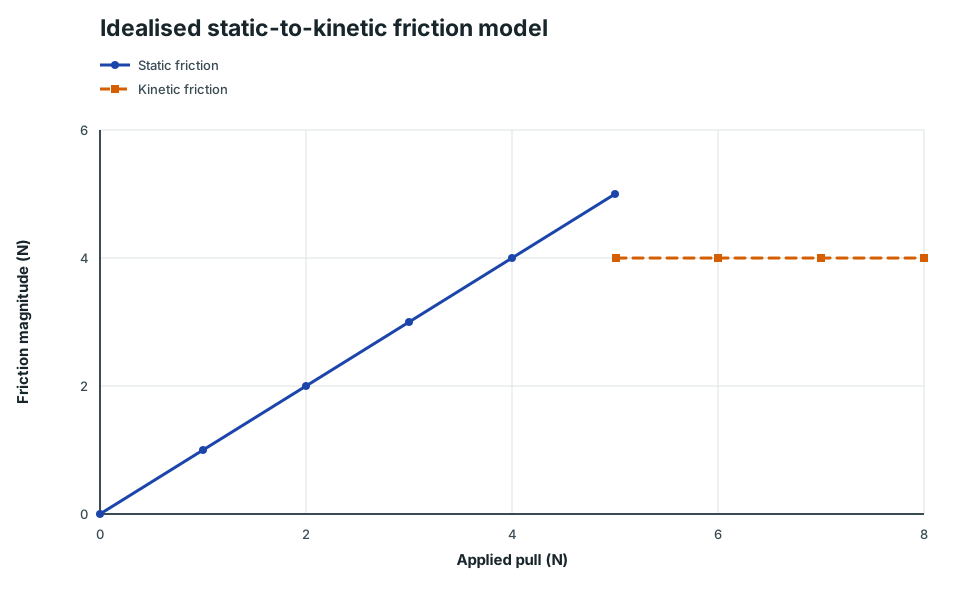
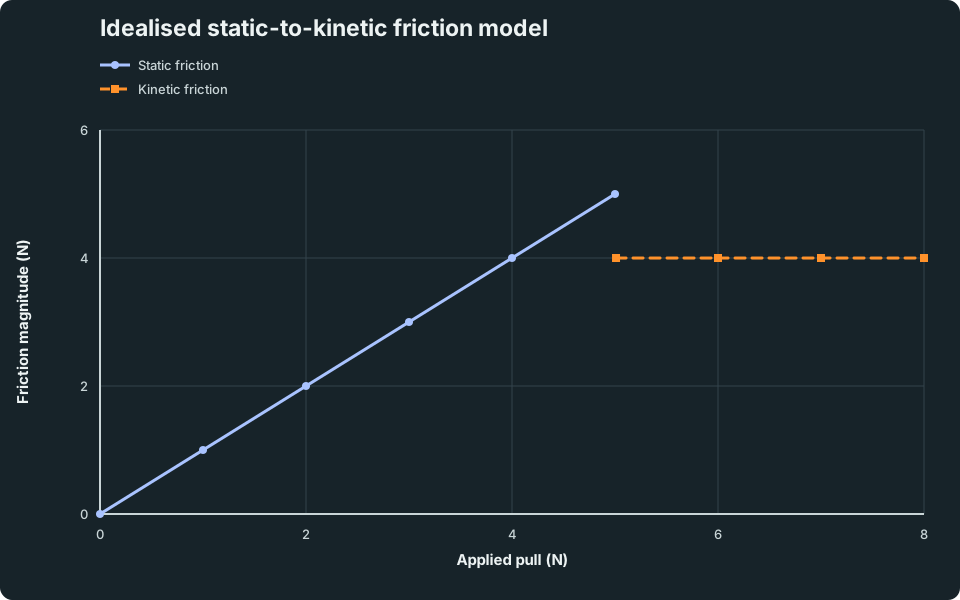
If you pull a block with a spring balance / force gauge and slowly increase the pull:
- while the block is still at rest, static friction adjusts to match the applied force (up to a maximum)
- when the block starts moving, the friction often drops to a lower, roughly constant kinetic friction
Idealised static-to-kinetic friction model
Static friction matches the applied pull until a five-newton limiting value. Once sliding starts, kinetic friction is modelled as a lower constant value of four newtons.
Scroll across the graph to read all labels.
View figure data
| Series | Applied pull (N) | Applied pull uncertainty | Friction magnitude (N) | Friction magnitude uncertainty |
|---|---|---|---|---|
| Static friction | 0 | 0 | ||
| Static friction | 1 | 1 | ||
| Static friction | 2 | 2 | ||
| Static friction | 3 | 3 | ||
| Static friction | 4 | 4 | ||
| Static friction | 5 | 5 | ||
| Kinetic friction | 5.01 | 4 | ||
| Kinetic friction | 6 | 4 | ||
| Kinetic friction | 7 | 4 | ||
| Kinetic friction | 8 | 4 |
4. Common Mistakes
- Using f = μ N even when the friction is not at its maximum.
- Confusing μₛ and μₖ (static is usually larger).
- Treating μ as a required 9478 formula instead of optional modelling.
6. Worked Examples
Modelled example 1
Angle of repose
Problem
Study the worked solution
Use limiting equilibrium
Method
At impending motion, friction has reached fₛ = μₛN.Reason
The block is at the threshold of sliding rather than at an arbitrary static state.Working
mg sin θ = μₛNResolve perpendicular to the plane
Method
N = mg cos θ.Reason
There is no acceleration normal to the surface.Working
N-mg cos θ = 0Eliminate mass and calculate
Method
μₛ = 0.445.Reason
Dividing the parallel equation by the perpendicular equation gives the angle-of-repose relation.Working
μₛ = (mg sin θ)/(mg cos θ) = tan 24.0° = 0.445
7. Mind Stretchers
Mind stretcher 1: Static friction below its limiting valueExtension
A horizontal pull of 6.0 N acts on a block that remains at rest. Its maximum possible static friction is 10 N. State the actual friction magnitude and explain why it is not 10 N.
Show answer
Because the block remains at rest, the horizontal resultant is zero. Static friction adjusts to 6.0 N opposite the pull. The 10 N value is only the maximum available static friction, reached at impending motion.
Continue with the next resource in this course.
Course and syllabus information
- Course
- A-level H2 Physics topic extensions
- Syllabus scope
- Beyond the syllabus
- Edition
- A-level H2 Physics topic extensions