Einstein's Photoelectric Equation
Key idea: Apply Einstein’s photoelectric equation Kmax = hf − Φ and the stopping potential relation Kmax = eVs, including graph interpretation (A Level Physics).
Continue where you stopped
The core idea
On this page
Learning objectives
- Use photon energy and momentum and analyse the photoelectric effect.
- Apply de Broglie wavelength and wave-particle evidence.
- Interpret wavefunctions, probability density and superposition.
- Apply uncertainty and infinite-square-well energy quantisation.
- Analyse atomic energy levels and emission or absorption spectra.
The current 9478 outcome names threshold frequency and photon energy E = hf, but does not explicitly name stopping potential or Einstein’s photoelectric equation. Use this page as supporting method work where your school or an older paper includes it.
1. Definitions (Must Know)
A. Work function, Φ
The work function, Φ, is the minimum energy needed to remove an electron from the metal surface.
B. Einstein’s photoelectric equation
For the most energetic photoelectrons:
Kₘₐₓ = hf-Φ
C. Stopping potential, Vₛ
The stopping potential, Vₛ, is the minimum retarding potential difference needed to reduce the photoelectric current to zero.
It links to maximum kinetic energy:
Kₘₐₓ = eVₛ
2. Key Ideas (What Earns Marks)
- Threshold frequency: Kₘₐₓ = 0 ⇒ hf₀ = Φ ⇒ f₀ = Φ/h
- Combine with stopping potential: eVₛ = hf-Φ ⇒ Vₛ = (h/e)f-Φ/e
- Vₛ vs f is a straight line:
- gradient: h/e
- intercept: -Φ/e
hf and Φ are energies (J). eVₛ is also energy (C·V = J).
3. Detailed Explanations
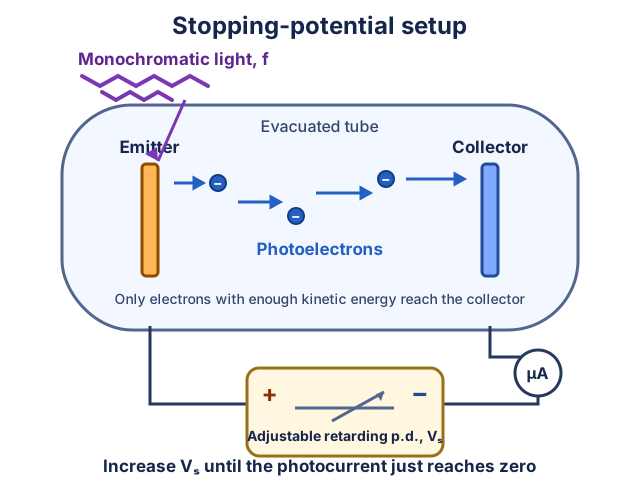
How Vₛ is found (I–V curve)
The stopping potential is found by increasing a retarding potential until the photocurrent just falls to zero.
Photoelectric I–V curves (qualitative)
Qualitative photoelectric current–voltage curves showing saturation current, stopping potential, and how intensity vs frequency affects the graph.
Scroll across the graph to read all labels.
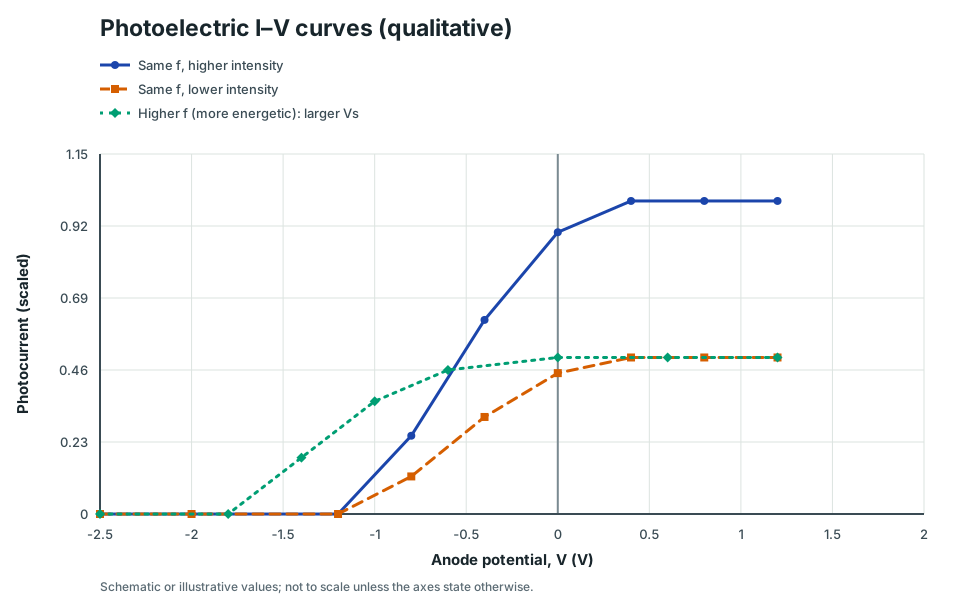
View figure data
| Series | Anode potential, V (V) | Anode potential, V uncertainty | Photocurrent (scaled) | Photocurrent uncertainty |
|---|---|---|---|---|
| Same f, higher intensity | -2.5 | 0 | ||
| Same f, higher intensity | -2 | 0 | ||
| Same f, higher intensity | -1.2 | 0 | ||
| Same f, higher intensity | -0.8 | 0.25 | ||
| Same f, higher intensity | -0.4 | 0.62 | ||
| Same f, higher intensity | 0 | 0.9 | ||
| Same f, higher intensity | 0.4 | 1 | ||
| Same f, higher intensity | 0.8 | 1 | ||
| Same f, higher intensity | 1.2 | 1 | ||
| Same f, lower intensity | -2.5 | 0 | ||
| Same f, lower intensity | -2 | 0 | ||
| Same f, lower intensity | -1.2 | 0 | ||
| Same f, lower intensity | -0.8 | 0.12 | ||
| Same f, lower intensity | -0.4 | 0.31 | ||
| Same f, lower intensity | 0 | 0.45 | ||
| Same f, lower intensity | 0.4 | 0.5 | ||
| Same f, lower intensity | 0.8 | 0.5 | ||
| Same f, lower intensity | 1.2 | 0.5 | ||
| Higher f (more energetic): larger Vs | -2.5 | 0 | ||
| Higher f (more energetic): larger Vs | -1.8 | 0 | ||
| Higher f (more energetic): larger Vs | -1.4 | 0.18 | ||
| Higher f (more energetic): larger Vs | -1 | 0.36 | ||
| Higher f (more energetic): larger Vs | -0.6 | 0.46 | ||
| Higher f (more energetic): larger Vs | 0 | 0.5 | ||
| Higher f (more energetic): larger Vs | 0.6 | 0.5 | ||
| Higher f (more energetic): larger Vs | 1.2 | 0.5 |
A. Why only the maximum matters
Electrons come from different depths in the metal and can lose energy in collisions before escaping.
So emitted electrons have a range of kinetic energies. The equation uses Kₘₐₓ for the most energetic electrons (often those that escape with minimal loss).
B. From Kₘₐₓ to stopping potential
Stopping potential is defined so that even the most energetic electrons are just stopped:
Kₘₐₓ = eVₛ
Combine with Einstein’s equation:
eVₛ = hf-Φ
4. Common Mistakes
- Treating Φ as a “force” (it is an energy).
- Using Vₛ when the question is about a different potential in the circuit.
- Using f₀ formula but forgetting to use the same units (Hz, J, J·s).
5. Exam Tips
- If asked for a “threshold wavelength”, use f = c/λ: f₀ = Φ/h ⇒ λ₀ = c/f₀ = hc/Φ
- If given a Vₛ vs f graph, read:
- gradient → h/e,
- x-intercept → f₀.
6. Worked Examples
Modelled example 1
Find Kₘₐₓ
Problem
Study the worked solution
Check the energy balance
Method
One photon supplies energy hf; the work function is the minimum removal energy.Reason
Only the remaining energy can become maximum electron kinetic energy.Working
Kₘₐₓ = hf-ΦCalculate photon energy
Method
Multiply Planck’s constant by frequency.Reason
J s multiplied by s⁻¹ gives joules.Working
hf = (6.63 × 10⁻³⁴)(8.0 × 10¹⁴) = 5.304 × 10⁻¹⁹ JSubtract the work function
Method
Use unrounded energy before the final rounding.Reason
The emitted electron retains the surplus.Working
Kₘₐₓ = 5.304 × 10⁻¹⁹-2.4 × 10⁻¹⁹ = 2.9 × 10⁻¹⁹ J
Guided practice 2
Find stopping potential
Problem
Try this before viewing the solution
Hints
Hint 1: match energy to electric work
View solution step by step
Select relation
Method
Set maximum kinetic energy equal to electric stopping work.Reason
The fastest photoelectrons are just prevented from reaching the collector.Working
Kₘₐₓ = eVₛCalculate
Method
Divide by the elementary charge.Reason
One joule per coulomb is one volt.Working
Vₛ = (2.9 × 10⁻¹⁹)/(1.60 × 10⁻¹⁹) = 1.8 V
Common misconception 3
Find threshold frequency
Learner claim
Try this before viewing the solution
View solution step by step
State threshold condition
Method
At threshold, the most energetic emitted electron has zero kinetic energy.Reason
One photon just supplies the removal energy.Working
0 = hf₀-ΦSeparate intensity
Method
Intensity changes photon arrival rate, not energy per photon.Reason
Photon energy is hf, controlled by frequency.Working
E_γ = hfCalculate
Method
Divide the work function by h.Reason
The quotient has units s⁻¹.Working
f₀ = (3.0 × 10⁻¹⁹)/(6.63 × 10⁻³⁴) = 4.5 × 10¹⁴ Hz
Examiner practice 4
Find h and Φ from two data points
Examination question
Try this before viewing the solution
View solution step by step
Find gradient
1 markMethod
Use changes in stopping potential and frequency.Reason
The two points define the line’s gradient.Working
m = (1.20-0.40)/((7.0-5.0) × 10¹⁴) = 4.0 × 10⁻¹⁵ V sInterpret gradient
1 markMethod
Set m = h/e.Reason
This follows from the coefficient of f.Working
h = meCalculate h
1 markMethod
Multiply by the elementary charge.Reason
V s times C gives J s.Working
h = (4.0 × 10⁻¹⁵)(1.60 × 10⁻¹⁹) = 6.4 × 10⁻³⁴ J sFind work function
2 marksMethod
Substitute either point into Φ = hf-eVₛ.Reason
The intercept energy is the photon energy not retained as kinetic energy.Working
Φ = (6.4 × 10⁻³⁴)(5.0 × 10¹⁴)-(1.60 × 10⁻¹⁹)(0.40) = 2.56 × 10⁻¹⁹ J
Self-mark with the mark scheme
Compare your response with each mark point. Select a point only when your response contains that evidence.
Self-mark gradient, interpretation, Planck constant and the two-part work-function method.
Challenge 5
Threshold wavelength from work function (eV form)
Independent transfer
Try this before viewing the solution
Hints
Hint 1: use the threshold equality
View solution step by step
Rearrange
Method
Use the photon-energy form at threshold.Reason
E = hc/λ equals the work function when Kₘₐₓ = 0.Working
λ₀ = hc/ΦCalculate
Method
Keep eV and nm units paired.Reason
The supplied hc avoids an unnecessary joule conversion.Working
λ₀ = 1240/2.5 = 496 nm ≈ 5.0 × 10² nmInterpret boundary
Method
Longer wavelengths do not eject electrons in this model.Reason
Their lower-frequency photons have E < Φ.Working
λ > λ₀ ⇒ f < f₀
7. Mind Stretchers
Mind stretcher 1: Explain the straight-line graphExtension
Explain why a plot of Vₛ against f is a straight line.
Show Answer
From eVₛ = hf-Φ: Vₛ = (h/e)f-Φ/e
This is of the form y = mx + c, so the graph is a straight line with constant gradient h/e.
Mind stretcher 2: Meaning of the interceptsExtension
In Vₛ = (h/e)f-Φ/e, what do the x-intercept and y-intercept represent physically?
Show Answer
The x-intercept occurs when Vₛ = 0, so f = f₀ = Φ/h (the threshold frequency).
The y-intercept is -Φ/e, a negative voltage value; it encodes the work function (how much energy per electron must be supplied before any kinetic energy remains).
8. Optional (Enrichment)
A. Threshold wavelength
Sometimes the threshold is quoted as a wavelength λ₀: λ₀ = hc/Φ
Use this only if the question explicitly gives wavelength instead of frequency.
Continue with the next resource in this course.
Course and syllabus information
- Course
- GCE A-Level H2 Physics
- Edition
- GCE A-Level H2 Physics 2027