Energy Level Diagram For Hydrogen
Key idea: Read a hydrogen energy level diagram, interpret negative energies and ionisation energy, and use ΔE = hf = hc/λ for photon emission/absorption (A Level Physics).
Continue where you stopped
The core idea
On this page
Learning objectives
- Analyse atomic energy levels and emission or absorption spectra.
1. Definitions (Must Know)
A. Principal quantum number, n
n labels the energy level, with allowed values:
n = 1,2,3,…
B. Ground state and excited state
- Ground state: the lowest energy state (n = 1).
- Excited state: any state above the ground state (n ≥ 2).
C. Ionisation and ionisation energy
- Ionisation means the electron is no longer bound to the atom.
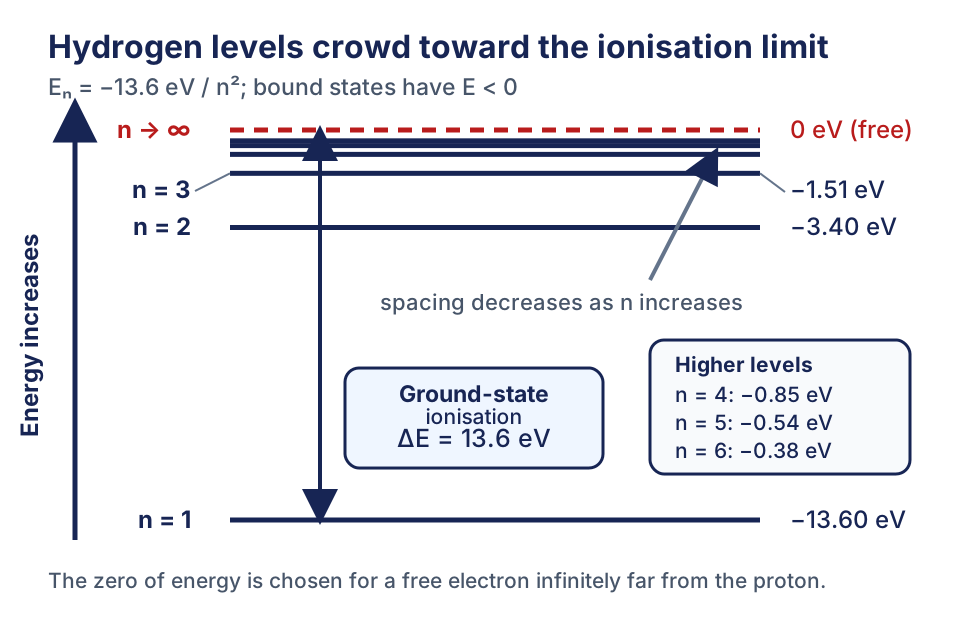
- For hydrogen, the ionisation limit corresponds to n → ∞ and is defined as E = 0 eV.
The ionisation energy from the ground state is 13.6 eV.
D. Photon energy in a transition
For a transition between two levels:
Δ E = hf = hc/λ
2. Key Ideas (What Earns Marks)
- Energy levels in hydrogen are discrete.
- Energies are often negative because we define E = 0 for a free electron at infinity; bound states lie below that reference.
- Level spacing gets smaller as n increases (levels “crowd” near E = 0).
- Emission vs absorption:
- emission: electron drops to a lower level and emits a photon,
- absorption: electron rises to a higher level by absorbing a photon of the exact energy gap.
A downward arrow means emission (photon out). An upward arrow means absorption (photon in).
3. Detailed Explanations
A. Why energies are negative
We set the reference E = 0 as:
- electron completely free from the atom (at infinity).
Bound states have less energy than a free electron, so their energies are negative relative to this reference.
B. Using ΔE to find photon frequency or wavelength
If the electron transitions from E_high to E_low, then the photon energy is:
Δ E = E_high-E_low
For emission, Δ E is carried away by the photon:
Δ E = hf = hc/λ
For absorption, the photon must have exactly that energy to raise the electron to the higher level.
4. Common Mistakes
- Mixing sign: use the energy difference between the two levels (a positive photon energy).
- Using “n = 0” as a level (not used; n = 1 is the ground state).
- Forgetting that λ must be in metres in E = hc/λ.
5. Exam Tips
- Convert eV to J only if needed: 1 eV = 1.60 × 10⁻¹⁹ J
- If the question gives energies in eV, stay in eV until the last step.
- Always show: Δ E → f or λ.
6. Worked Examples
Modelled example 1
Photon wavelength from a transition
Problem
Study the worked solution
Find the positive energy gap
Method
Δ E = 1.89 eV.Reason
The photon carries the amount by which the atom’s energy decreases, so use higher minus lower level.Working
Δ E = (-1.51)-(-3.40) = 1.89 eVConvert gap to wavelength
Method
λ = 656 nm.Reason
The supplied hc value is already in compatible eV–nanometre units.Working
λ = hc/(Δ E) = 1240/1.89 nm = 656 nm
Common misconception 2
Ionisation energy from n = 2
Learner claim
Try this before viewing the solution
View solution step by step
Identify the final state
Method
The ionisation limit is 0 eV.Reason
Zero is defined as a free electron at infinity.Working
initial: -3.40 eV; final: 0 eVFind required energy
Method
The ionisation energy is + 3.40 eV.Reason
Energy must be supplied to raise the bound electron to the free-electron reference.Working
Δ E = 0-(-3.40) = 3.40 eV
7. Mind Stretchers
Mind stretcher 1: Crowding of levelsExtension
Explain why many spectral lines can get very close together near the ionisation limit.
Show Answer
As n increases, energy levels get closer together (smaller energy gaps).
So the photon energies for transitions between high-n states are very similar, producing closely spaced spectral lines.
8. Optional (Enrichment)
A. Spectral series names
For hydrogen, transitions ending at:
- n = 1 are in the ultraviolet (Lyman series),
- n = 2 are in the visible (Balmer series),
- n = 3 are in the infrared (Paschen series).
Continue with the next resource in this course.
Course and syllabus information
- Course
- GCE A-Level H2 Physics
- Edition
- GCE A-Level H2 Physics 2027