Rolling Motion
Key idea: Learn rolling without slipping (no-slip condition), split kinetic energy into translation + rotation, and check friction conditions for no slip.
Continue where you stopped
The core idea
On this page
Learning objectives
- show an understanding of and use the terms angular displacement, angular velocity, and angular acceleration of a rigid body with respect to a fixed axis
- solve problems using the equations of motion for uniform angular acceleration that are analogous to the equations of motion for uniform linear acceleration
- show an understanding of and use the terms angular momentum and moment of inertia of a rotating rigid body
- calculate the moment of inertia about an axis for simple bodies by using calculus, the parallel-axis theorem or otherwise (knowledge of the perpendicular-axis theorem and mathematical derivation of the moment of inertia for spheres are not required)
- show an understanding of torque produced by a force relative to a reference point, and apply the principle that torque is related to the rate of change of angular momentum to solve problems, such as those involving point masses, rigid bodies, or bodies with a variable moment of inertia e.g. an ice-skater
- Apply Eₖ,rot = ½Iω² to the rotational kinetic energy of a rigid body.
- Derive Eₖ,rot = ½Iω² for a rigid body from the equations of motion.
- recall and apply the result that the motion of a rigid body can be regarded as translational motion of its centre of mass with rotational motion about an axis through the centre of mass to solve problems, including the use of F ⩽ µN for solid surfaces in no-slip contact (no distinction is made between the coefficient of static and kinetic friction)
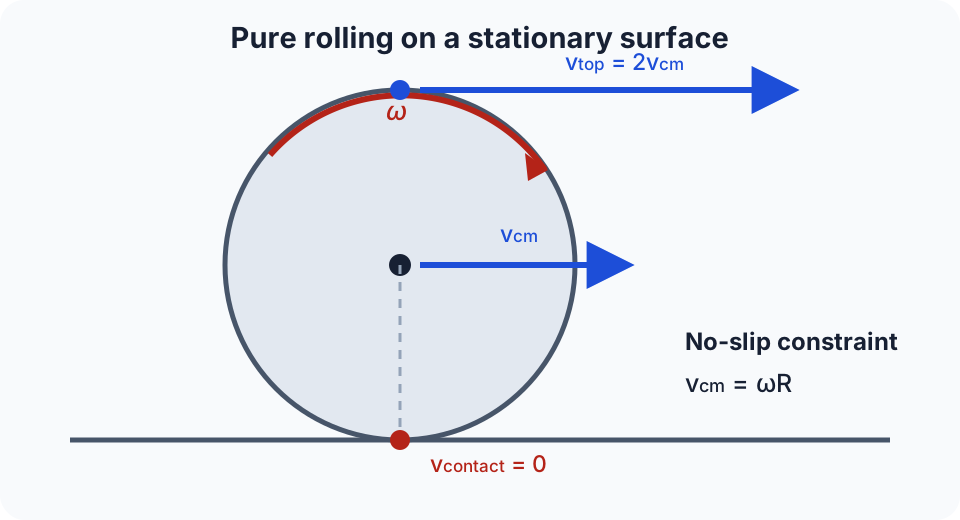
Rolling motion combines translation of the centre of mass with rotation about the centre of mass. For rolling without slipping, the key constraint is: v_cm = ω R When a contact-force limit is relevant, the 9814 syllabus uses: F ≤ μ N
1. Definitions (Must Know)
- Pure rolling (no slip): the point of contact with the ground has zero velocity relative to the ground at the instant of contact.
- Rolling with slipping: the contact point slides; friction does kinetic-energy dissipation and v_cm ≠ ω R in general.
- No-slip condition (pure rolling): in magnitude, v_cm = ω R and, for the tangential acceleration components, a_cm = α R. Signed equations depend on the chosen angular convention.
- Kinetic energy split (about CM): Eₖ = 1/2 Mv_cm² + 1/2 I_cmω²
- Syllabus contact-force test: F ≤ μ N. The official 2027 H3 Physics syllabus does not distinguish static and kinetic coefficients in this model.
- Symbols used in this lesson: v_cm (m s⁻¹), a_cm (m s⁻²), ω (rad s⁻¹), α (rad s⁻²), R (m), M (kg), I_cm (kg m²), F friction (N), N normal reaction (N), μ coefficient of friction (dimensionless).
2. Key Ideas (What Earns Marks)
- Model rolling as: translation of CM + rotation about CM (H3 syllabus statement).
- For pure rolling:
- Use the constraint v_cm = ω R early to reduce unknowns.
- Use a_cm = α R for dynamics problems with acceleration.
- A contact force may be needed to enforce no slip, but it can be zero for uniform rolling on a horizontal surface. When the problem supplies μ, check whether the required force exceeds μ N.
Quick comparison:
| Case | Key condition | Contact state | Energy note |
|---|---|---|---|
| Rolling without slipping | v_cm = ω R | no relative sliding | no energy loss from sliding |
| Rolling with slipping | v_cm ≠ ω R | surfaces slide at contact | mechanical energy is dissipated by friction |
3. Detailed Explanations
A. Why “translation + rotation about CM” is the right picture
Any rigid body motion can be decomposed into:
- motion of the centre of mass, plus
- rotation about an axis through the centre of mass.
For rolling problems, this decomposition helps you:
- write linear equations for the CM (e.g. ∑ F = Ma_cm), and
- write rotational equations about the CM (e.g. ∑ τ_cm = I_cmα).
B. Deriving the no-slip constraint
For a wheel of radius R rolling without slipping:
- the contact point’s speed relative to the ground is zero.
The contact point’s velocity is the vector sum of:
- translational CM velocity v_cm (to the right, say), and
- rotational velocity about the CM of magnitude ω R (to the left at the bottom point).
So they cancel: v_cm - ω R = 0 ⇒ v_cm = ω R
Differentiating gives: a_cm = α R
C. Contact force and the condition F ≤ μ N
In a more detailed contact model, no relative sliding corresponds to static friction. For this H3 syllabus, however, no distinction is made between static and kinetic coefficients: calculate the required contact-force magnitude F and test F ≤ μ N
If the required force exceeds μ N, the assumed no-slip motion is not possible. If the required force is zero, pure rolling can continue without a frictional force.
4. Common Mistakes
- Assuming friction must be non-zero or must remove energy in every rolling problem.
- Applying v_cm = ω R even when the question implies slipping.
- Using I about the wrong axis (use I_cm when taking moments about the centre of mass).
- Forgetting to check the no-slip condition with F ≤ μ N when μ is given.
5. Exam Tips
- If the phrase “rolls without slipping” appears, write v_cm = ω R immediately.
- If μ is given (or “rough surface” is emphasised), expect a slip check:
- solve assuming no slip,
- compute required F,
- compare with μ N.
- Use separate equations for translation and rotation:
- ∑ F = Ma_cm
- ∑ τ_cm = I_cmα plus a_cm = α R for no slip.
6. Worked Examples
Modelled example 1
Pure rolling kinematics (no slip)
Problem
Study the worked solution
Use no slip
Method
v_cm = ω R.Reason
The contact point is instantaneously at rest relative to the ground.Working
v_cm = ω REvaluate
Method
v_cm = 3.0 m s⁻¹.Reason
Multiply angular speed by radius.Working
(15)(0.20) = 3.0 m s⁻¹
Guided practice 2
Energy split for rolling (given v_cm)
Problem
Try this before viewing the solution
Hints
Hint 1: replace angular speed
View solution step by step
Write both contributions
Method
Eₖ = (1/2)Mv_cm² + (1/2)I_cmω².Reason
Rolling combines translation of the centre and rotation about it.Working
E = Eₜᵣₐₙₛ + EᵣₒₜSubstitute no slip and inertia
Method
The rotational term is (1/4)Mv_cm².Reason
R² cancels after ω = v_cm/R.Working
(1/2)((1/2)MR²)(v_cm/R)²Add
Method
Eₖ = (3/4)Mv_cm².Reason
1/2 + 1/4 = 3/4.Working
Eₖ = (3/4)Mv_cm²
Common misconception 3
No-slip check (friction limit)
Learner claim
Try this before viewing the solution
View solution step by step
Find the limit
Method
Fₗᵢₘᵢₜ = 8 N.Reason
The syllabus model gives μ N.Working
(0.20)(40) = 8 NCompare with requirement
Method
12 N exceeds 8 N.Reason
The contact cannot supply enough static friction.Working
F_required > FₗᵢₘᵢₜConclude
Method
Pure rolling is impossible; the wheel slips.Reason
The no-slip constraint cannot be maintained.Working
v_cm ≠ ω R during slip
Examiner practice 4
Speed of the top point (ground frame)
Examination question
Try this before viewing the solution
View solution step by step
Use no slip
1 markMethod
ω R = v_cm.Reason
The bottom point is instantaneously at rest.Working
ω R = 2.5 m s⁻¹Translation contribution
1 markMethod
The centre motion contributes 2.5 m s⁻¹ rightward.Reason
Every point shares the centre’s translational velocity.Working
+ v_cmRotation contribution
1 markMethod
Rotation contributes another 2.5 m s⁻¹ rightward at the top.Reason
The top point’s rotational velocity is rightward.Working
+ ω RAdd
1 markMethod
vₜₒₚ = 5.0 m s⁻¹.Reason
The two vectors align.Working
2v_cm = 5.0 m s⁻¹
Self-mark with the mark scheme
Compare your response with each mark point. Select a point only when your response contains that evidence.
Self-mark no-slip relation, both contributions and resultant.
Challenge 5
Rolling down an incline (solid cylinder) + minimum μ
Independent transfer
Try this before viewing the solution
Hints
Hint 1: use the rolling acceleration form
View solution step by step
Find acceleration
Method
a_cm = (2/3)g sin θ = 3.27 m s⁻².Reason
I/(MR²) = 1/2 for a solid cylinder.Working
a = 9.81(0.5)/(1.5) = 3.27Find required friction
Method
f = (1/2)Ma_cm upslope.Reason
fR = Iα and α = a_cm/R.Working
f = (I/R²)a = (1/2)MaApply limiting condition
Method
μₘᵢₙ = a_cm/(2g cos θ).Reason
No slip requires f ≤ μ Mg cos θ.Working
μₘᵢₙ = 1/3 tan θEvaluate
Method
μₘᵢₙ = 0.192.Reason
tan 30° = 0.577.Working
(1/3)(0.577) = 0.192
7. Mind Stretchers
Mind stretcher 1: Where is the instantaneous “pivot” point?Extension
For pure rolling without slipping, which point on the wheel has zero instantaneous velocity, and why does that make some torque/energy arguments easier?
Answer
The contact point has zero instantaneous velocity relative to the ground. You can treat the wheel as rotating instantaneously about that point, which can simplify certain kinematics or energy comparisons (when used carefully).
Mind stretcher 2: Does the contact force do work in pure rolling?Extension
In pure rolling without slipping on a stationary rigid surface, must the frictional contact force transfer energy to the wheel? Explain briefly.
Answer
No. In the ideal rigid-body model, the instantaneous contact point is at rest in the ground frame, so the instantaneous power vector F · vector v_contact is zero. The contact force can still supply a torque and change how translational and rotational energy are partitioned. This statement is scoped to a stationary, non-deforming surface; a moving or deforming contact requires separate analysis.
8. Optional/Enrichment: Rolling as Instantaneous Rotation
In pure rolling, the wheel’s motion can be seen as instantaneous rotation about the contact point. This viewpoint can be helpful, but the CM-decomposition method (translation + rotation about CM) is usually the most robust for exam problems.
Next step
Return to the Rotational Motion hub, or continue to Electric and Magnetic Fields, the next maintained H3 topic.
Continue with the next resource in this course.
Course and syllabus information
- Course
- GCE A-Level H3 Physics
- Edition
- GCE A-Level H3 Physics 2027