The Twin Paradox
Key idea: Resolve the twin paradox using proper time: compute who ages less on an out-and-back relativistic trip and explain why the situation is not symmetric.
Continue where you stopped
The core idea
On this page
Learning objectives
- discuss qualitatively the results of the Michelson–Morley interferometer experiment and its implications on the ether theory (knowledge of the details of the experiment is not required)
- state the postulates of the special theory of relativity, that in all inertial frames, the laws of physics are the same and the speed of light in free space is the same regardless of the motion of the light source or observer
- appreciate the failure of Galilean transformation equations when applied to a moving source of light
- discuss the concept of simultaneity
- show an understanding of the terms proper time and proper length
- apply the Lorentz transformation equations to solve one-dimensional problems
- Derive the time dilation formula and the length contraction formula, making use of the Lorentz factor.
- apply the time dilation formula and the length contraction formula in related situations (e.g. the lifetime of fast-moving muons) or to solve problems
- use the one-dimensional relativistic velocity addition formula to calculate velocities in different inertial frames or to solve problems
- Apply the relativistic energy–momentum relation E² = (pc)² + (mc²)² to solve problems, including selecting its limiting form.
- Show that E² = (pc)² + (mc²)² reduces to E = pc for massless particles and to E = mc² + ½mv² at low speeds.
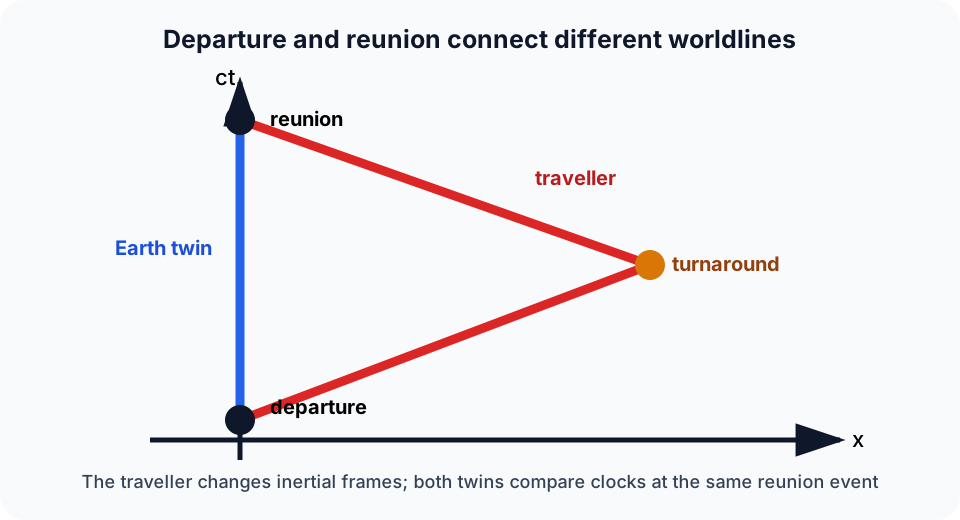
The twin paradox is a classic special-relativity scenario that tests whether you really understand proper time. The “paradox” disappears once you notice the trip is not symmetric: the travelling twin changes inertial frames at the turnaround.
Use this as an interpretation check after energy-momentum so your calculations and physical meaning stay aligned.
1. Definitions (Must Know)
- Proper time, Δτ: the time measured by a clock along its own worldline (events occur at the same position in that clock’s instantaneous rest frame).
- Time dilation: for two events, if one frame measures proper time Δτ, another inertial frame measures Δ t = γΔτ.
- Lorentz factor: γ = 1/(square root of (1-v²/c²))
- Lightyear (ly): distance light travels in 1 year.
2. Key Ideas (What Earns Marks)
- The travelling twin is not in a single inertial frame for the whole trip (turnaround requires acceleration).
- Proper time depends on the path through spacetime. Different worldlines between the same departure/arrival events can have different proper times.
- Both twins agree on “who is younger” when they reunite because that is a single event they can both compare at the same place.
Quick workflow (out-and-back at constant speed, brief turnaround):
| Step | Earth frame | Traveller proper time |
|---|---|---|
| Find Earth time | Δ t = distance/v | — |
| Find Lorentz factor | γ = 1/(square root of (1-v²/c²)) | — |
| Convert to traveller ageing | — | Δτ = Δ t/γ |
3. Detailed Explanations
A. The standard twin scenario
Two twins start together on Earth.
One twin stays on Earth. The other travels to a distant planet and returns at constant speed v for most of the trip, with a turnaround (acceleration) at the planet.
It can sound symmetric (“each sees the other moving”), but it isn’t: only the traveller switches inertial frames.
B. Worked numbers (the usual 20 ly, 0.95c example)
Distance to planet (Earth frame): 20 ly, so round trip is 40 ly.
Earth-frame travel time: Δ t = (40 ly)/0.95c = 40/0.95 years ≈ 42.1 years
Lorentz factor at 0.95c: γ = 1/(square root of (1-0.95²)) = 1/(square root of 0.0975) = 3.20
Traveller’s proper time (how much the travelling twin ages, ignoring brief acceleration phases): Δτ = (Δ t)/γ ≈ 42.1/3.20 = 13.2 years
So the traveller ages about 13 years while the stay-at-home twin ages about 42 years.
C. Why there is no contradiction
During the outward leg, the traveller can use an inertial frame where Earth is moving away. During the return leg, the traveller must use a different inertial frame (because the direction of motion reverses).
The “who is running slow” statement from time dilation applies cleanly within a single inertial frame; you cannot apply it across the whole journey for the traveller using one frame throughout, because the traveller does not stay inertial throughout.
4. Common Mistakes
- Treating the situation as symmetric even though only one twin turns around.
- Thinking the result depends on “signal delay” (it doesn’t; this is about proper time, not what is seen).
- Trying to explain it with time dilation alone without mentioning the frame change / acceleration.
5. Exam Tips
- Always state: “The travelling twin changes inertial frames at the turnaround, so the trip is not symmetric.”
- If numbers are given, compute:
- Earth-frame time Δ t, then
- γ, then
- traveller proper time Δτ = Δ t/γ.
- If asked “who is younger?”, answer: the travelling twin.
6. Worked Examples
Modelled example 1
Who is younger?
Problem
Study the worked solution
Compare paths
Method
The stay-at-home twin follows one inertial worldline; the traveller follows outbound and inbound segments.Reason
The traveller changes inertial frames at turnaround.Working
straight worldline ≠ out-and-back worldlineCompare clocks
Method
The travelling twin records less proper time.Reason
Proper time depends on the spacetime path between departure and reunion.Working
Δτₜᵣₐᵥₑₗₗₑᵣ < Δτ_EarthConclude
Method
The travelling twin is younger at reunion.Reason
Reunion is one shared event where both clocks can be compared directly.Working
age difference is frame-agreed
Guided practice 2
A symmetric out-and-back (numerical)
Problem
Try this before viewing the solution
Hints
Hint 1: double the Earth distance
Hint 2: convert to proper time
View solution step by step
Earth time
Method
Use the Earth-frame round-trip distance and speed.Reason
One lightyear divided by c is one year.Working
Δ t = (16 ly)/0.80c = 20 yLorentz factor
Method
At 0.80c, γ = 1.67.Reason
Both constant-speed legs have the same magnitude.Working
γ = 1/square root of (1-0.80²)Traveller time
Method
Divide by γ.Reason
The traveller clock measures proper time along each leg.Working
Δτ = 20/1.67 = 12 y
Common misconception 3
One-way trip (compare clocks)
Learner claim
Try this before viewing the solution
View solution step by step
Earth interval
Method
Earth uses distance divided by speed.Reason
The star separation is given in Earth’s rest frame.Working
Δ t = 4.0/0.60 = 6.7 yProper-time condition
Method
The traveller clock is present at departure and arrival.Reason
The two events occur at one position on that clock’s worldline.Working
Δτ is traveller timeCalculate proper time
Method
Use γ = 1.25.Reason
Δ t = γΔτ.Working
Δτ = 6.67/1.25 = 5.3 y
Examiner practice 4
Two different speeds (who ages less?)
Examination question
Try this before viewing the solution
View solution step by step
0.60c Earth time
1 markMethod
The Earth interval is 20 y.Reason
12.0/0.60 = 20.Working
Δ t_(0.60) = 20 y0.60c proper time
1 markMethod
With γ = 1.25, the traveller records 16 y.Reason
20/1.25 = 16.Working
Δτ_(0.60) = 16 y0.80c proper time
1 markMethod
Earth time is 15 y and γ = 1.67, giving 9.0 y.Reason
15/1.67 ≈ 9.0.Working
Δτ_(0.80) = 9.0 yCompare
1 markMethod
The 0.80c traveller ages less on their respective trip.Reason
Their accumulated proper time is smaller.Working
9.0 y < 16 y
Self-mark with the mark scheme
Compare your response with each mark point. Select a point only when your response contains that evidence.
Self-mark both Earth/proper-time chains and the comparison.
Challenge 5
Piecewise speeds (proper time adds)
Independent transfer
Try this before viewing the solution
Hints
Hint 1: treat each inertial leg separately
View solution step by step
Outbound leg
Method
At 0.60c, γ₁ = 1.25 and Δτ₁ = 4.0 y.Reason
5.0/1.25 = 4.0.Working
Δτ₁ = 4.0 yReturn leg
Method
Earth return time is 3.75 y; at 0.80c, γ₂ = 1.67 and Δτ₂ = 2.25 y.Reason
3.0/0.80 = 3.75 and 3.75/1.67 = 2.25.Working
Δτ₂ = 2.25 yAccumulate
Method
Add proper time along consecutive worldline segments.Reason
The traveller’s clock accumulates both legs.Working
Δτ = 4.0 + 2.25 = 6.3 y
7. Mind Stretchers
Mind stretcher 1: Is acceleration the “cause” of the ageing difference?Extension
If the turnaround acceleration is very brief, can it still be true that the traveller ages less? What does that suggest?
Answer
Yes. The main ageing difference comes from the different inertial segments (different worldline path), not from spending a long time accelerating. Acceleration is the indicator that the traveller switches frames, breaking the symmetry.
Mind stretcher 2: Can the stay-at-home twin ever be younger?Extension
Is it possible for the Earth twin to be younger at reunion if the traveller leaves Earth and returns? Explain qualitatively.
Answer
For the standard “leave and return” setup, the Earth twin follows a single inertial worldline between departure and reunion events, which maximizes proper time. Any out-and-back path with high-speed segments for the traveller gives a smaller proper time, so the traveller is younger on return.
8. Optional/Enrichment: Visualising With Spacetime Diagrams
On a spacetime diagram, the Earth twin’s worldline is “straighter” (stays in one inertial frame), and the traveller’s is a “V” shape (out and back). The proper time along these worldlines differs, giving the ageing difference.
Next in the maintained sequence: Confirming Relativity.
Continue with the next resource in this course.
Course and syllabus information
- Course
- GCE A-Level H3 Physics
- Edition
- GCE A-Level H3 Physics 2027