Wave–Particle Nature and Matter Waves
Key idea: Explain electron-diffraction evidence and apply de Broglie wavelength using momentum, kinetic energy, accelerating potential, and relativistic corrections.
Continue where you stopped
The core idea
On this page
Learning objectives
- Extend wave-particle reasoning through de Broglie wavelength, wave packets, and matter-wave evidence.
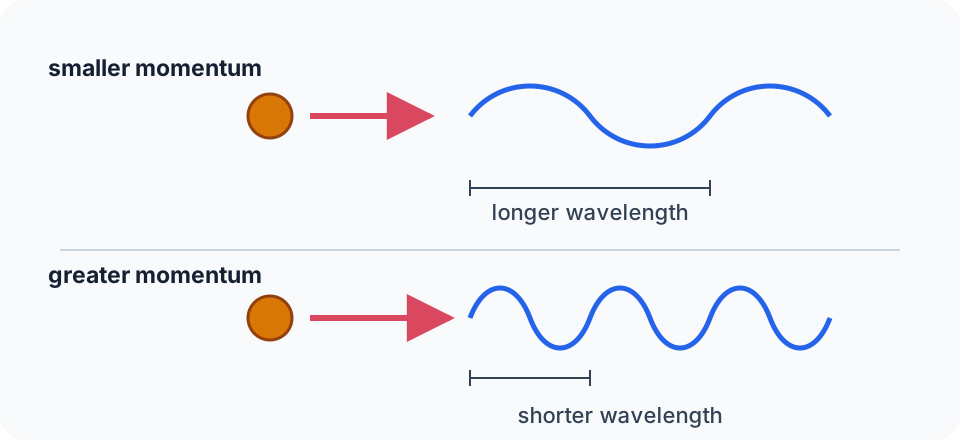
Matter waves are not ripples of material in the classical sense. A quantum state propagates and produces diffraction or interference, while each particle is detected in one localised event. The de Broglie relation connects the wavelength governing that wave-like behaviour to the particle’s momentum.
This lesson extends the quantum content inherited from H2 Physics. It is useful preparation for university quantum mechanics, but it is not an additional content topic in the 2027 H3 Physics 9814 syllabus.
1. Definitions and model
-
Wave–particle behaviour: quantum objects can produce wave phenomena such as diffraction and interference, yet transfer energy and momentum in localised detection events.
-
de Broglie wavelength:
λ = h/p
where λ is in metres, h = 6.63 × 10⁻³⁴ J s, and p is the magnitude of momentum in kg m s⁻¹.
-
Non-relativistic regime: v≪ c, or equivalently K≪ mc², so p = mv and K = p²/(2m) are suitable approximations.
-
Relativistic regime: use the total-energy relation
(pc)² = E²-(mc²)²
rather than p = mv.
2. What the evidence shows
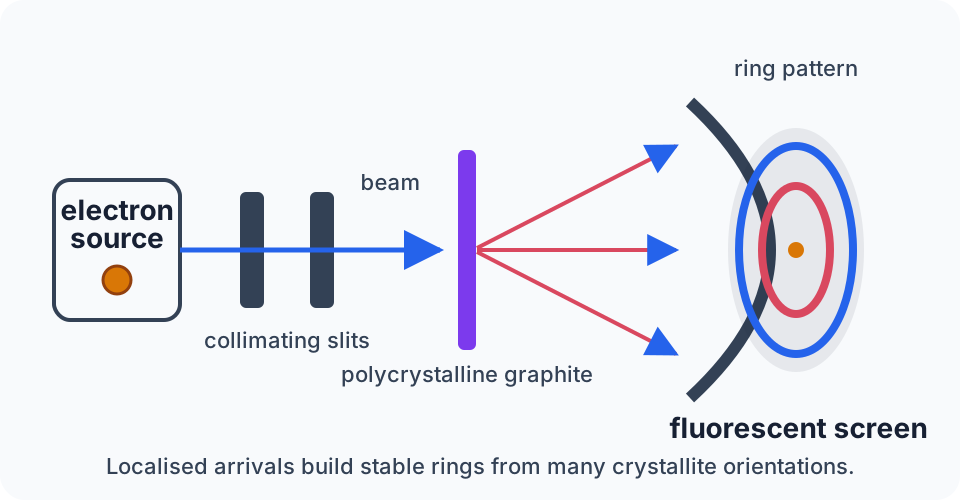
When a beam of electrons passes through thin polycrystalline graphite, the regularly spaced atomic planes act as diffraction structures. If the electron wavelength is comparable with the plane spacing, constructive interference occurs at particular angles. Because the small crystallites have many orientations, the diffracted directions form cones; those cones intersect the fluorescent screen as rings.
The two observations must be stated together:
- each electron arrives as a localised detection event;
- many detections build a reproducible diffraction pattern.
Diffraction is evidence for wave-like propagation. Localised arrival is particle-like. The pattern does not require electrons to collide with one another: it can build when only one electron is inside the apparatus at a time.
3. Choosing the momentum model
A. Given speed at low energy
For v≪ c,
p = mv
and therefore
λ = h/mv
B. Given kinetic energy at low energy
Starting from K = p²/(2m),
p = square root of 2mK
so
λ = h/(square root of 2mK)
C. Accelerated from rest through a potential difference
A particle of charge magnitude |q| gains kinetic energy
K = |q|V
if other energy transfers are negligible. In the non-relativistic regime,
λ = h/(square root of 2m|q|V)
For an electron, use |q| = e; the kinetic-energy gain is positive even though the electron’s charge is negative.
D. Relativistic correction
Write total energy as E = K + mc². Substitution into the energy–momentum relation gives
pc = square root of (K(K + 2mc²))
and hence
λ = hc/(square root of (K(K + 2mc²)))
This expression approaches the non-relativistic result when K≪ mc².
4. Common mistakes
- Saying the particle follows a visible sinusoidal path. The drawn wave represents phase or probability-amplitude behaviour, not a classical trajectory.
- Using p = mv without checking whether K is small compared with mc².
- Substituting electronvolts into an SI formula without converting units, unless every energy term is kept consistently in electronvolts.
- Concluding that large momentum produces strong diffraction. Large momentum produces a shorter wavelength, so a smaller lattice spacing is needed for comparable diffraction.
- Calling the ring brightness a path taken by one electron. It represents the distribution of many localised detections.
5. Exam and data skills
- For evidence questions, name the observation and inference: “electrons produce diffraction, a wave phenomenon; therefore their propagation has wave-like behaviour.”
- For calculations, state the regime before selecting momentum: “Since K≪ mc², use the non-relativistic expression.”
- Compare λ with the relevant spacing d. Diffraction becomes prominent when they are of similar order.
- Use limits as checks: increasing V increases momentum and decreases wavelength; as K/(mc²) → 0, the relativistic expression must recover the classical one.
6. Worked examples
Modelled example 1
Electron wavelength from speed
Problem
Study the worked solution
Choose the momentum model
Method
Use p = mₑv.Reason
The speed is much smaller than c, so the non-relativistic model is suitable.Working
v/c ≈ 0.0067≪1Calculate momentum
Method
p = 1.82 × 10⁻²⁴ kg m s⁻¹.Reason
Momentum is mass multiplied by speed in this regime.Working
p = (9.11 × 10⁻³¹)(2.0 × 10⁶) = 1.82 × 10⁻²⁴Find wavelength
Method
λ = 3.6 × 10⁻¹⁰ m.Reason
The de Broglie wavelength is h/p.Working
λ = (6.63 × 10⁻³⁴)/(1.82 × 10⁻²⁴) = 3.6 × 10⁻¹⁰ m
Guided practice 2
Electron accelerated through 150 V
Problem
Try this before viewing the solution
Hints
Hint 1: convert voltage to energy
Hint 2: link energy to momentum
View solution step by step
Find kinetic energy
Method
K = 2.40 × 10⁻¹⁷ J.Reason
An electron accelerated from rest gains energy eV.Working
K = (1.60 × 10⁻¹⁹)(150) = 2.40 × 10⁻¹⁷ JFind momentum
Method
p = 6.61 × 10⁻²⁴ kg m s⁻¹.Reason
For non-relativistic motion, K = p²/(2mₑ).Working
p = square root of 2mₑK = 6.61 × 10⁻²⁴Find wavelength and check regime
Method
λ = 1.00 × 10⁻¹⁰ m.Reason
K/(mₑc²) ≈ 2.9 × 10⁻⁴, so the approximation is well justified.Working
λ = h/p = 1.00 × 10⁻¹⁰ m
Common misconception 3
Relativistic correction at 100 kV
Learner claim
Try this before viewing the solution
View solution step by step
Set the kinetic energy
Method
K = 100 keV.Reason
An electron crossing 100 kV gains 100 keV.Working
K = eV = 100 keVUse relativistic momentum
Method
pc = 335 keV.Reason
K/(mₑc²) ≈ 0.196 is not negligible.Working
pc = square root of (K(K + 2mₑc²)) = square root of (100(100 + 2 × 511)) = 335 keVCalculate wavelength
Method
λ = 3.70 pm.Reason
λ = hc/(pc) with consistent keV units.Working
λ = 1.240/335 nm = 3.70 × 10⁻³ nm = 3.70 pmAssess the shortcut
Method
The non-relativistic 3.88 pm result is about 4.9% too large.Reason
The classical model underestimates momentum at this energy.Working
percentage error ≈ 4.9%
Examiner practice 4
Electron and proton at the same kinetic energy
Examination question
Try this before viewing the solution
View solution step by step
Express mass dependence
1 markMethod
λ ∝ 1/square root of m at fixed K.Reason
p = square root of 2mK and λ = h/p.Working
λ = h/(square root of 2mK)Compare particles
1 markMethod
The electron has the longer wavelength.Reason
Its mass is smaller.Working
mₑ < mₚ ⇒ λₑ > λₚFind the ratio
1 markMethod
λₑ/λₚ ≈ 42.8.Reason
The common kinetic energy cancels.Working
λₑ/λₚ = square root of (mₚ/mₑ) ≈ 42.8
Self-mark with the mark scheme
Compare your response with each mark point. Select a point only when your response contains that evidence.
Self-mark the dependence, comparison and ratio.
Challenge 5
Deciding whether diffraction is plausible
Independent transfer
Try this before viewing the solution
Hints
Hint 1: compare orders of magnitude
View solution step by step
Compare scales
Method
The wavelength and plane spacing are both of order 10⁻¹⁰ m.Reason
Their ratio is 2.0/2.5 = 0.80, so neither scale is negligible relative to the other.Working
λ/d = 0.80Infer the wave effect
Method
Significant diffraction is plausible.Reason
Path differences from neighbouring planes can be comparable with a wavelength, allowing constructive and destructive interference.Working
λ∼ d ⇒ measurable diffraction structure
7. Mind stretchers
Mind stretcher 1: One particle at a timeExtension
Why does reducing the beam intensity until only one electron is present not eliminate the eventual diffraction pattern?
Answer
The pattern is not created by forces between different electrons. Each electron’s quantum state evolves through the apparatus and gives a probability distribution for its detection position. One trial produces one point; many independent trials sample the same distribution and reveal the diffraction pattern.
Mind stretcher 2: Why a moving ball does not visibly diffractExtension
A 0.10 kg ball moves at 10 m s⁻¹. Estimate its wavelength and explain the classical limit.
Answer
Its momentum is 1.0 kg m s⁻¹, so
λ = h/p = 6.6 × 10⁻³⁴ m
No practical aperture or environmental isolation can resolve interference on this scale. For macroscopic objects, the de Broglie wavelength is therefore far too small for wave effects to be observable in ordinary conditions.
8. Optional extension: crystal planes
For scattering from parallel crystal planes separated by d, constructive interference can be described by Bragg’s condition,
nλ = 2d sin θ
where θ is the glancing angle to the planes. This connects a measured diffraction angle with the particle wavelength, but always check how an experimental diagram defines its angle.
Next: return to the Matter Waves Hub, or continue to Quantum Theory of Light.
Continue with the next resource in this course.
Course and syllabus information
- Course
- Advanced Physics
- Edition
- Advanced Physics