Force on a wire and current-balance measurements
Key idea: A straight current-carrying wire feels force BIℓ sin θ in a uniform magnetic field. A current balance measures this force through a change in weight reading to find B.
Loading guide controls…
Guided lessons · coming soon
More
Offline pages
Saved on this device only. Connect at least once every 30 days to confirm Premium. Sign-out or a change of account removes saved copies.
Guided steps
- Predict the force before and after turning the wire.
- Find force size from the angle and direction using your hand.
- Find both forces and apply the left-hand rule.
- Find the force after turning the wire.
- Follow the forces on the wire and the magnets.
- Find the force from half the reversed-current reading difference.
- Correct the angle calculation, then find the field from the balance.
- Predict both balance readings from the forces on the magnets.
- Explain the force direction and calculate the magnetic flux density.
On this page
You stopped at:
ContinueRevision Mode is on. Questions and activities are hidden.
Every electric motor turns because a wire carrying a current in a magnetic field feels a force. The same force gives the precise definition of magnetic flux density, and a current balance uses it to measure the strength of a magnetic field.
Check your understanding 1 Will the wire move?
A straight wire carries a current in a strong uniform magnetic field. Predict the force when the wire is parallel to the field. If you turn it through 90° without changing the current or the length in the field, what happens to the force magnitude?
Show answer
The parallel wire feels no magnetic force: sin 0° = 0. Turning it to 90° makes the force magnitude BIl, its maximum for this current and length. A strong field alone is not enough; the angle matters too.
Force on a current-carrying conductor
A current-carrying conductor placed in a magnetic field may experience a force. For a straight length l of wire carrying a current I in a uniform field of flux density B,
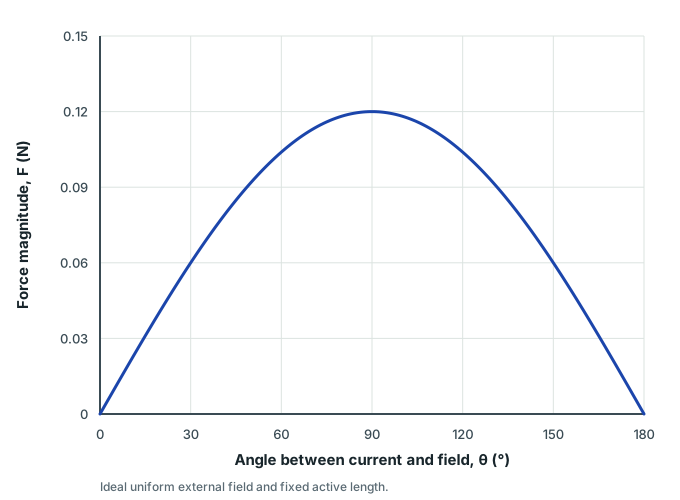
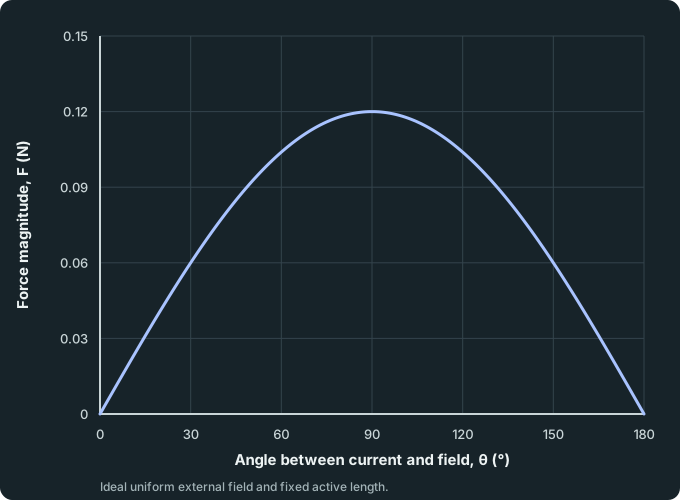
where θ is the angle between the current and the field. The force is greatest when the wire is at right angles to the field, and zero when the wire is parallel to it, however strong the field.
The direction is given by Fleming’s left-hand rule. Hold the first finger, second finger and thumb of your left hand at right angles to each other: First finger along the Field, seCond finger along the conventional Current, and the thuMb gives the direction of the force (Motion). The force is always at right angles to both the wire and the field. Reversing either the current or the field reverses the force.
Wire force depends on the angle to the field
A sine curve gives force on a straight active wire segment from 0° parallel through a maximum at 90° to zero at 180° antiparallel.
If the figure is wider than its frame, scroll across to read all labels.
View figure data
This table is included in print while it is open.
| Angle between current and field, θ (°) | F = BIℓ sin θ |
|---|---|
| 0 | 0.000000 |
| 1 | 0.002094 |
| 2 | 0.004188 |
| 3 | 0.006280 |
| 4 | 0.008371 |
| 5 | 0.010459 |
| 6 | 0.012543 |
| 7 | 0.014624 |
| 8 | 0.016701 |
| 9 | 0.018772 |
| 10 | 0.020838 |
| 11 | 0.022897 |
| 12 | 0.024949 |
| 13 | 0.026994 |
| 14 | 0.029031 |
| 15 | 0.031058 |
| 16 | 0.033076 |
| 17 | 0.035085 |
| 18 | 0.037082 |
| 19 | 0.039068 |
| 20 | 0.041042 |
| 21 | 0.043004 |
| 22 | 0.044953 |
| 23 | 0.046888 |
| 24 | 0.048808 |
| 25 | 0.050714 |
| 26 | 0.052605 |
| 27 | 0.054479 |
| 28 | 0.056337 |
| 29 | 0.058177 |
| 30 | 0.060000 |
| 31 | 0.061805 |
| 32 | 0.063590 |
| 33 | 0.065357 |
| 34 | 0.067103 |
| 35 | 0.068829 |
| 36 | 0.070534 |
| 37 | 0.072218 |
| 38 | 0.073879 |
| 39 | 0.075518 |
| 40 | 0.077135 |
| 41 | 0.078727 |
| 42 | 0.080296 |
| 43 | 0.081840 |
| 44 | 0.083359 |
| 45 | 0.084853 |
| 46 | 0.086321 |
| 47 | 0.087762 |
| 48 | 0.089177 |
| 49 | 0.090565 |
| 50 | 0.091925 |
| 51 | 0.093258 |
| 52 | 0.094561 |
| 53 | 0.095836 |
| 54 | 0.097082 |
| 55 | 0.098298 |
| 56 | 0.099485 |
| 57 | 0.100640 |
| 58 | 0.101766 |
| 59 | 0.102860 |
| 60 | 0.103923 |
| 61 | 0.104954 |
| 62 | 0.105954 |
| 63 | 0.106921 |
| 64 | 0.107855 |
| 65 | 0.108757 |
| 66 | 0.109625 |
| 67 | 0.110461 |
| 68 | 0.111262 |
| 69 | 0.112030 |
| 70 | 0.112763 |
| 71 | 0.113462 |
| 72 | 0.114127 |
| 73 | 0.114757 |
| 74 | 0.115351 |
| 75 | 0.115911 |
| 76 | 0.116435 |
| 77 | 0.116924 |
| 78 | 0.117378 |
| 79 | 0.117795 |
| 80 | 0.118177 |
| 81 | 0.118523 |
| 82 | 0.118832 |
| 83 | 0.119106 |
| 84 | 0.119343 |
| 85 | 0.119543 |
| 86 | 0.119708 |
| 87 | 0.119836 |
| 88 | 0.119927 |
| 89 | 0.119982 |
| 90 | 0.120000 |
| 91 | 0.119982 |
| 92 | 0.119927 |
| 93 | 0.119836 |
| 94 | 0.119708 |
| 95 | 0.119543 |
| 96 | 0.119343 |
| 97 | 0.119106 |
| 98 | 0.118832 |
| 99 | 0.118523 |
| 100 | 0.118177 |
| 101 | 0.117795 |
| 102 | 0.117378 |
| 103 | 0.116924 |
| 104 | 0.116435 |
| 105 | 0.115911 |
| 106 | 0.115351 |
| 107 | 0.114757 |
| 108 | 0.114127 |
| 109 | 0.113462 |
| 110 | 0.112763 |
| 111 | 0.112030 |
| 112 | 0.111262 |
| 113 | 0.110461 |
| 114 | 0.109625 |
| 115 | 0.108757 |
| 116 | 0.107855 |
| 117 | 0.106921 |
| 118 | 0.105954 |
| 119 | 0.104954 |
| 120 | 0.103923 |
| 121 | 0.102860 |
| 122 | 0.101766 |
| 123 | 0.100640 |
| 124 | 0.099485 |
| 125 | 0.098298 |
| 126 | 0.097082 |
| 127 | 0.095836 |
| 128 | 0.094561 |
| 129 | 0.093258 |
| 130 | 0.091925 |
| 131 | 0.090565 |
| 132 | 0.089177 |
| 133 | 0.087762 |
| 134 | 0.086321 |
| 135 | 0.084853 |
| 136 | 0.083359 |
| 137 | 0.081840 |
| 138 | 0.080296 |
| 139 | 0.078727 |
| 140 | 0.077135 |
| 141 | 0.075518 |
| 142 | 0.073879 |
| 143 | 0.072218 |
| 144 | 0.070534 |
| 145 | 0.068829 |
| 146 | 0.067103 |
| 147 | 0.065357 |
| 148 | 0.063590 |
| 149 | 0.061805 |
| 150 | 0.060000 |
| 151 | 0.058177 |
| 152 | 0.056337 |
| 153 | 0.054479 |
| 154 | 0.052605 |
| 155 | 0.050714 |
| 156 | 0.048808 |
| 157 | 0.046888 |
| 158 | 0.044953 |
| 159 | 0.043004 |
| 160 | 0.041042 |
| 161 | 0.039068 |
| 162 | 0.037082 |
| 163 | 0.035085 |
| 164 | 0.033076 |
| 165 | 0.031058 |
| 166 | 0.029031 |
| 167 | 0.026994 |
| 168 | 0.024949 |
| 169 | 0.022897 |
| 170 | 0.020838 |
| 171 | 0.018772 |
| 172 | 0.016701 |
| 173 | 0.014624 |
| 174 | 0.012543 |
| 175 | 0.010459 |
| 176 | 0.008371 |
| 177 | 0.006280 |
| 178 | 0.004188 |
| 179 | 0.002094 |
| 180 | 0.000000 |
Magnetic flux density
With the wire at right angles to the field, F = BIl, so B = F/(Il). This gives the definition: magnetic flux density is the force acting per unit current per unit length on a conductor placed perpendicular to the magnetic field. Its unit, the tesla, is therefore 1 T = 1 N A⁻¹ m⁻¹.
Worked example 1
A wire in a field
Problem
A 0.12 m length of wire carries a current of 2.0 A to the right, in a uniform field of 0.30 T directed into the page. Find the size and direction of the force on it. What is the force if the wire is turned to 30° to the field, with the same length in the field?
Show full solution
Size
Method
Use F = BIl sin θ with θ = 90°.Reason
A current along the page is at right angles to a field into the page.Working
Answer
F = (0.30)(2.0)(0.12) sin 90° = 0.072 N
Direction
Method
Apply Fleming’s left-hand rule.Reason
First finger into the page (field), second finger to the right (current).Working
Answer
The thumb points up the page: the force is upwards.
At 30° to the field
Working
Answer
F = (0.30)(2.0)(0.12) sin 30° = 0.036 N
Quick check
sin 30° = 0.5, so turning the wire to 30° halves the force. At 0° it would be zero.
Guided practice 1
Turning the wire
Problem
The force on a wire at 30° to a magnetic field is 0.040 N. The wire is turned until it is at right angles to the field, with the same current and the same length in the field. What is the force now?
Find the new force
Hints
Hint 1
sine factor
Only sin θ changes. Compare sin 30° with sin 90°.
Show full solution
New force
Working
Answer
sin θ rises from 0.5 to 1, so the force doubles to 0.080 N.
Quick check
F = BIL sin θ is largest at 90°, so 0.080 N is the most force this wire can feel in this field.
Measuring B with a current balance
A current balance measures the magnetic force through a change in balance reading. In the arrangement below, the magnets sit on a top-pan balance and the wire passes between their poles, held by a separate stand. When a current flows, the field pushes the wire one way and, by Newton’s third law, the wire pushes the magnets equally the other way. If the force on the wire is upwards, the magnets are pushed down and the balance reading increases.
The magnitude of the change Δ m in the reading, in kilograms, corresponds to a force magnitude F = Δ m g. With the wire at right angles to the field, B = F/(Il).
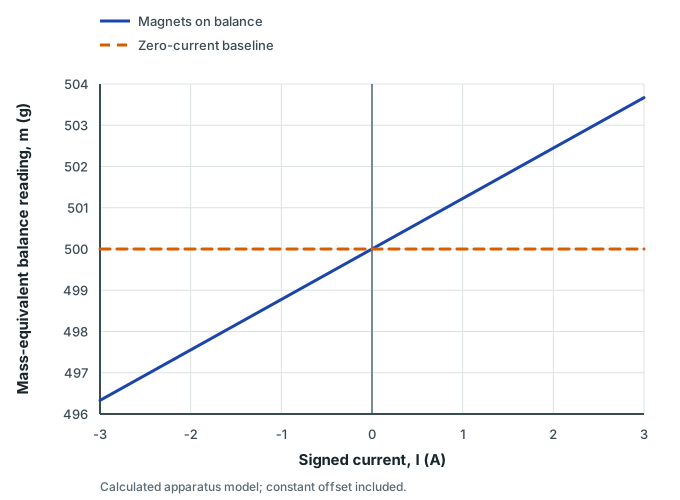
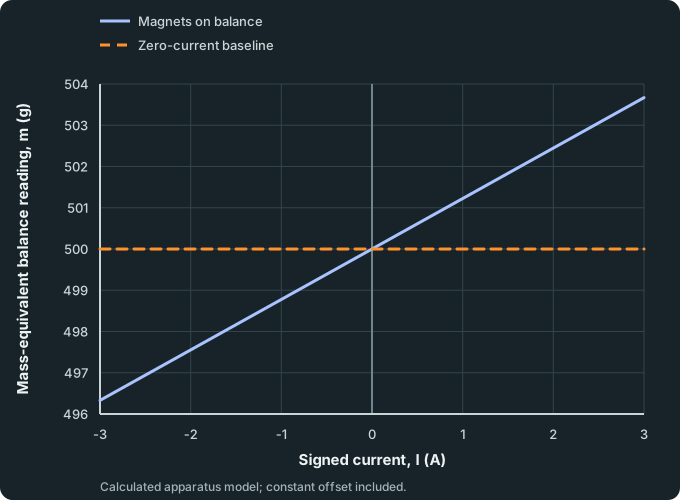
Reversing the current reverses the force, so the reading moves the other way. Taking readings with equal currents in both directions and using half their difference gives the force more reliably, because any constant offset in the readings cancels.
Current reversal separates force from a constant offset
Ideal magnet-balance readings increase linearly with signed current. Equal opposite currents give equal opposite deviations from a constant zero-current baseline.
If the figure is wider than its frame, scroll across to read all labels.
View figure data
This table is included in print while it is open.
| Series | Signed current, I (A) | Mass-equivalent balance reading, m (g) |
|---|---|---|
| Magnets on balance | -3.00 | 496.3 |
| Magnets on balance | -2.95 | 496.4 |
| Magnets on balance | -2.90 | 496.5 |
| Magnets on balance | -2.85 | 496.5 |
| Magnets on balance | -2.80 | 496.6 |
| Magnets on balance | -2.75 | 496.6 |
| Magnets on balance | -2.70 | 496.7 |
| Magnets on balance | -2.65 | 496.8 |
| Magnets on balance | -2.60 | 496.8 |
| Magnets on balance | -2.55 | 496.9 |
| Magnets on balance | -2.50 | 496.9 |
| Magnets on balance | -2.45 | 497.0 |
| Magnets on balance | -2.40 | 497.1 |
| Magnets on balance | -2.35 | 497.1 |
| Magnets on balance | -2.30 | 497.2 |
| Magnets on balance | -2.25 | 497.2 |
| Magnets on balance | -2.20 | 497.3 |
| Magnets on balance | -2.15 | 497.4 |
| Magnets on balance | -2.10 | 497.4 |
| Magnets on balance | -2.05 | 497.5 |
| Magnets on balance | -2.00 | 497.6 |
| Magnets on balance | -1.95 | 497.6 |
| Magnets on balance | -1.90 | 497.7 |
| Magnets on balance | -1.85 | 497.7 |
| Magnets on balance | -1.80 | 497.8 |
| Magnets on balance | -1.75 | 497.9 |
| Magnets on balance | -1.70 | 497.9 |
| Magnets on balance | -1.65 | 498.0 |
| Magnets on balance | -1.60 | 498.0 |
| Magnets on balance | -1.55 | 498.1 |
| Magnets on balance | -1.50 | 498.2 |
| Magnets on balance | -1.45 | 498.2 |
| Magnets on balance | -1.40 | 498.3 |
| Magnets on balance | -1.35 | 498.3 |
| Magnets on balance | -1.30 | 498.4 |
| Magnets on balance | -1.25 | 498.5 |
| Magnets on balance | -1.20 | 498.5 |
| Magnets on balance | -1.15 | 498.6 |
| Magnets on balance | -1.10 | 498.7 |
| Magnets on balance | -1.05 | 498.7 |
| Magnets on balance | -1.00 | 498.8 |
| Magnets on balance | -0.95 | 498.8 |
| Magnets on balance | -0.90 | 498.9 |
| Magnets on balance | -0.85 | 499.0 |
| Magnets on balance | -0.80 | 499.0 |
| Magnets on balance | -0.75 | 499.1 |
| Magnets on balance | -0.70 | 499.1 |
| Magnets on balance | -0.65 | 499.2 |
| Magnets on balance | -0.60 | 499.3 |
| Magnets on balance | -0.55 | 499.3 |
| Magnets on balance | -0.50 | 499.4 |
| Magnets on balance | -0.45 | 499.4 |
| Magnets on balance | -0.40 | 499.5 |
| Magnets on balance | -0.35 | 499.6 |
| Magnets on balance | -0.30 | 499.6 |
| Magnets on balance | -0.25 | 499.7 |
| Magnets on balance | -0.20 | 499.8 |
| Magnets on balance | -0.15 | 499.8 |
| Magnets on balance | -0.10 | 499.9 |
| Magnets on balance | -0.05 | 499.9 |
| Magnets on balance | 0.00 | 500.0 |
| Magnets on balance | 0.05 | 500.1 |
| Magnets on balance | 0.10 | 500.1 |
| Magnets on balance | 0.15 | 500.2 |
| Magnets on balance | 0.20 | 500.2 |
| Magnets on balance | 0.25 | 500.3 |
| Magnets on balance | 0.30 | 500.4 |
| Magnets on balance | 0.35 | 500.4 |
| Magnets on balance | 0.40 | 500.5 |
| Magnets on balance | 0.45 | 500.6 |
| Magnets on balance | 0.50 | 500.6 |
| Magnets on balance | 0.55 | 500.7 |
| Magnets on balance | 0.60 | 500.7 |
| Magnets on balance | 0.65 | 500.8 |
| Magnets on balance | 0.70 | 500.9 |
| Magnets on balance | 0.75 | 500.9 |
| Magnets on balance | 0.80 | 501.0 |
| Magnets on balance | 0.85 | 501.0 |
| Magnets on balance | 0.90 | 501.1 |
| Magnets on balance | 0.95 | 501.2 |
| Magnets on balance | 1.00 | 501.2 |
| Magnets on balance | 1.05 | 501.3 |
| Magnets on balance | 1.10 | 501.3 |
| Magnets on balance | 1.15 | 501.4 |
| Magnets on balance | 1.20 | 501.5 |
| Magnets on balance | 1.25 | 501.5 |
| Magnets on balance | 1.30 | 501.6 |
| Magnets on balance | 1.35 | 501.7 |
| Magnets on balance | 1.40 | 501.7 |
| Magnets on balance | 1.45 | 501.8 |
| Magnets on balance | 1.50 | 501.8 |
| Magnets on balance | 1.55 | 501.9 |
| Magnets on balance | 1.60 | 502.0 |
| Magnets on balance | 1.65 | 502.0 |
| Magnets on balance | 1.70 | 502.1 |
| Magnets on balance | 1.75 | 502.1 |
| Magnets on balance | 1.80 | 502.2 |
| Magnets on balance | 1.85 | 502.3 |
| Magnets on balance | 1.90 | 502.3 |
| Magnets on balance | 1.95 | 502.4 |
| Magnets on balance | 2.00 | 502.4 |
| Magnets on balance | 2.05 | 502.5 |
| Magnets on balance | 2.10 | 502.6 |
| Magnets on balance | 2.15 | 502.6 |
| Magnets on balance | 2.20 | 502.7 |
| Magnets on balance | 2.25 | 502.8 |
| Magnets on balance | 2.30 | 502.8 |
| Magnets on balance | 2.35 | 502.9 |
| Magnets on balance | 2.40 | 502.9 |
| Magnets on balance | 2.45 | 503.0 |
| Magnets on balance | 2.50 | 503.1 |
| Magnets on balance | 2.55 | 503.1 |
| Magnets on balance | 2.60 | 503.2 |
| Magnets on balance | 2.65 | 503.2 |
| Magnets on balance | 2.70 | 503.3 |
| Magnets on balance | 2.75 | 503.4 |
| Magnets on balance | 2.80 | 503.4 |
| Magnets on balance | 2.85 | 503.5 |
| Magnets on balance | 2.90 | 503.5 |
| Magnets on balance | 2.95 | 503.6 |
| Magnets on balance | 3.00 | 503.7 |
| Zero-current baseline | -3.00 | 500.0 |
| Zero-current baseline | 3.00 | 500.0 |
Worked example 2
Flux density from reversed currents
Problem
With a current of 4.0 A one way, the balance reads 0.523 kg; with 4.0 A the other way, it reads 0.517 kg. The wire is at right angles to the field, and 0.15 m of it is in the field. Find B.
Show full solution
Force
Method
Take half the difference between the readings.Reason
The reading goes up by F/g for one direction and down by F/g for the other, so the full difference is 2F/g.Working
Answer
F = ((0.523-0.517)(9.81))/2 = 0.0294 N
Flux density
Working
Answer
B = F/(Il) = 0.0294/((4.0)(0.15)) = 0.049 T
Quick check
Using the full difference would double the answer.
Check your understanding 2 Two slips
A wire has BIl = 0.10 N and makes 30° with the field. A student uses cosine and obtains 0.087 N. Find the correct force. In a separate perpendicular-wire experiment, reversed 2.0 A currents give readings differing by 8.0 g for a 0.10 m active length. Find the magnitude of the reading change from the zero-current value in kilograms, then find B.
Show the steps Optional working
Show answer
The correct force is 0.10 sin 30° = 0.050 N. For the balance, the change from the zero-current reading has magnitude Δ m = (8.0 × 10⁻³)/2 = 4.0 × 10⁻³ kg. The force magnitude in either direction is F = Δ m g = (4.0 × 10⁻³)(9.81) = 0.0392 N. Hence B = F/(Il) = 0.0392/(2.0 × 0.10) = 0.20 T to two significant figures.
Try it yourself 1
What the balance weighs
Problem
In the current balance, the magnetic force on the wire is downwards. Does the balance reading go up or down when the current is switched on? What happens to the reading when the current is reversed?
Predict the readings
Hints
Hint 1
which object
Which object rests on the balance, and what forces act on it?
Show solution step by step
Forces on the magnets
Reason
The force on the wire and the force on the magnets are a Newton’s third law pair.Working
Answer
If the field pushes the wire down, the wire pushes the magnets up.
Readings
Working
Answer
The reading decreases. Reversing the current makes the force on the magnets downwards, so the reading rises above its zero-current value.
Quick check
The force on the wire and the force on the magnets are equal and opposite, so the balance measures the wire’s force indirectly.
Exam-style question 1
Flux density from a balance reading
Examination question
In a current balance, the magnets rest on a top-pan balance and a horizontal wire is held between their poles, at right angles to the field. The length of wire in the field is 0.060 m. When a current of 3.0 A is switched on, the balance reading increases by 4.04 g.
(a) State and explain the direction of the magnetic force on the wire. [2 marks]
(b) Calculate the magnetic flux density between the poles. [3 marks]
Write your answer before viewing the mark scheme
Show solution step by step
(a) Direction
2 marksMethod
Work back from the force on the magnets.Reason
The reading increases, so the magnets are pushed down; the force on the wire is the other half of a third-law pair.Working
Answer
The force on the wire is upwards.
Force
1 markReason
The reading changed from its zero-current value, so the whole change is due to the magnetic force.Working
Answer
F = Δ m g = (4.04 × 10⁻³)(9.81) = 0.0396 N
(b) Flux density
2 marksWorking
Answer
B = F/(Il) = 0.0396/((3.0)(0.060)) = 0.22 T
Self-mark with the mark scheme
Tick each mark point that your answer includes.
Tick each point only if your answer states it clearly.
Common mistake
Using the mass change in grams, 4.04, gives a force a thousand times too large.
Common mistakes
- Using cos θ instead of sin θ, or measuring θ from the wrong line.
- Using the right hand, or the electron flow, in Fleming’s left-hand rule.
- Thinking a wire parallel to a strong field must feel a force.
- Forgetting that the balance weighs the magnets, so the reading shows the reaction to the force on the wire.
- Leaving a balance reading in grams, or not halving the difference of reversed-current readings.
Loading reading progress…
Spotted an error? Report a correction