Electromotive Force & Potential Difference
Key idea: Understand electromotive force (e.m.f.) and potential difference, use V = W/Q and W = QV, and know when to apply each in O Level questions.
Continue where you stopped
The core idea
On this page
Learning objectives
- State current as rate of charge flow measured in amperes
- Distinguish conventional current from electron flow
- Apply charge equals current multiplied by time
- Define source e.m.f. as work done per unit charge around a circuit
- Calculate total e.m.f. for sources in series
- Define component potential difference as work done per unit charge
- State resistance as potential difference divided by current
- Apply resistance equals potential difference divided by current
- Apply wire-resistance proportionalities for length and cross-sectional area
- Describe the effect of temperature on metallic resistance
- Sketch and interpret required current–voltage characteristics
1. Definition
A. Electromotive force (e.m.f.)
The electromotive force, ε (V), of a source is the work done per unit charge by the source in driving charge around a complete circuit (energy supplied per coulomb).
B. Potential difference (p.d.)
The potential difference, V (V), across a component is the work done per unit charge in driving charge through the component (energy transferred per coulomb).
You should be able to define e.m.f. and p.d. as energy transferred per unit charge, in volts, and distinguish the two ideas.
2. Key Ideas
- Unit: 1 V = 1 J C⁻¹.
- Relationship: V = W/Q, so W = QV.
- For a source, we often write: ε = W/Q (same unit: V).
| Quantity | Where you use it | Meaning (energy per coulomb) |
|---|---|---|
| e.m.f. ε | source (cell/battery/power supply) | energy supplied to charges |
| p.d. V | component (lamp/resistor/motor) | energy transferred by charges |
3. Detailed Explanations
A. What does “work done per unit charge” mean?
If 1 C of charge gains (or transfers) 1 J of energy, the voltage is:
V = W/Q = 1/1 = 1 V
So a higher voltage means more energy per coulomb.
B. “Energy story” around a circuit
- The source supplies electrical energy to charges (this is the e.m.f.).
- Components (lamp, motor, resistor) transfer electrical energy into other forms (this is the p.d. across the component).
At O Level, you can write:
- e.m.f. = “energy per coulomb given by the source”
- p.d. = “energy per coulomb used/transferred by the component”
C. Measuring voltage (voltmeter)
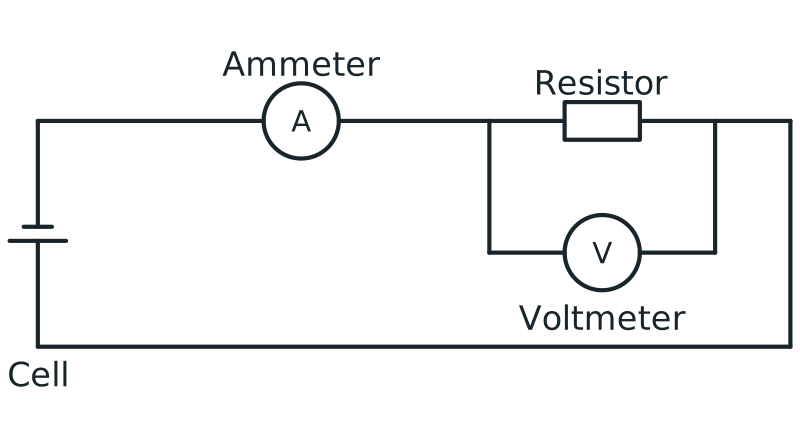
To measure p.d., connect a voltmeter in parallel across the component.
Voltmeter connection in parallel
Circuit with ammeter in series and voltmeter connected in parallel across a resistor to measure potential difference.
View figure data
| Part | Connection |
|---|---|
| Ammeter | In series in the main loop |
| Voltmeter | In parallel across the resistor |
| Resistor | In the conducting loop with the cell and ammeter |
A voltmeter goes in parallel. If you connect it in series, you won’t measure the correct p.d.
Voltage is like a “height difference” for charges: larger voltage means more energy per coulomb.
4. Common Mistakes
- Saying “e.m.f. is a force” (it is not a force; it is energy per charge).
- Mixing up where they apply: e.m.f. is for the source, p.d. is for a component.
- Writing the unit wrongly: use 1 V = 1 J C⁻¹.
- Forgetting that a voltmeter must be in parallel.
5. Exam Tips
- If the question says “energy supplied per coulomb by the source”, use e.m.f..
- If it says “energy transferred per coulomb in a component”, use p.d..
- For calculations, use V = W/Q or W = QV (with J, C, V).
- For measurements, state: “voltmeter in parallel”.
6. Worked Examples
Modelled example 1
Voltage from energy and charge
Problem
Study the worked solution
Calculate energy supplied per coulomb
Method
Divide the source’s work done by the charge passing through it.Reason
E.m.f. is energy supplied per unit charge by the source.Working
ε = W/Q = 6.0/2.0 = 3.0 VInterpret the voltage
Method
State that the source supplies 3.0 J to each coulomb.Reason
1 V = 1 J C⁻¹.Working
3.0 V = 3.0 J C⁻¹.
Guided practice 2
Energy transferred in a component
Problem
Scale energy per coulomb by total charge
Hints
Hint 1: interpret the p.d.
Hint 2: use all the charge
View solution step by step
Calculate transferred energy
Method
Multiply charge by potential difference.Reason
Potential difference gives energy transferred per coulomb in the component.Working
W = QV = (2.0)(6.0) = 12 J
Common misconception 3
Using current to find charge first
Learner response
Bridge current and time to charge
View solution step by step
Find the passing charge
Method
Multiply current by elapsed time.Reason
Current is charge flow per second, not an amount of charge.Working
Q = It = (2.0)(5.0) = 10 CFind the transferred energy
Method
Multiply the charge by the lamp’s p.d.Reason
Each coulomb transfers 5.0 J in the lamp.Working
W = QV = (10)(5.0) = 50 J
Examiner practice 4
Choosing e.m.f. vs p.d.
Examination question
Name each quantity and include its energy role
View solution step by step
Define source e.m.f.
2 marksMethod
Name e.m.f. and state work done or energy supplied per unit charge by the source around the complete circuit.Reason
The battery raises the electrical energy carried by each coulomb.Working
ε = W_supplied/QDefine component p.d.
2 marksMethod
Name potential difference and state work done or energy transferred per unit charge through the component.Reason
The lamp transfers electrical energy from each coulomb to other forms.Working
V = W_transferred/Q
Self-mark with the mark scheme
Compare your response with each mark point. Select a point only when your response contains that evidence.
Self-mark each name and its work-per-charge meaning.
Challenge 5
Energy supplied by a source
Source-energy transfer
Reverse the energy-per-charge definition
Hints
Hint 1: interpret the e.m.f.
Hint 2: scale by charge
View solution step by step
Calculate source work
Method
Multiply charge by source e.m.f.Reason
E.m.f. gives the energy supplied to each coulomb.Working
W = Qε = (3.0)(1.5) = 4.5 J
7. Mind Stretchers
Mind stretcher 1: Open circuit vs closed circuitExtension
A voltmeter reads 1.5 V across the terminals of a cell even when nothing is connected. Does this mean charges are flowing? Explain.
Show Answer
No. A voltmeter measures potential difference (energy per charge) between two points. A p.d. can exist without current. Current needs a closed circuit for charges to flow around the circuit.
Mind stretcher 2: “Voltage is used up?”Extension
Students sometimes say “voltage is used up in a lamp”. What is a better statement using p.d. and energy?
Show Answer
The potential difference across the lamp means charges transfer electrical energy to other forms (light/heat). The charges are not “used up”; energy is transferred per coulomb as charge passes through the lamp.
8. Practice and next step
Use the Current Electricity Quiz to distinguish source e.m.f. from component p.d., then complete the energy-per-charge questions in Structured Current Electricity. Continue to sources in series to combine source e.m.f.s with the correct orientation.
Continue with the next resource in this course.
Course and syllabus information
- Course
- SEC G3 Physics
- Edition
- SEC G3 Physics 2027