Equilibrium, Rotational Equilibrium & Translational Equilibrium
Key idea: Learn the conditions for equilibrium (resultant force = 0 and resultant moment = 0) and how to apply the principle of moments (O Level Physics 6091).
Continue where you stopped
The core idea
On this page
Learning objectives
- Distinguish contact forces from non-contact forces
- State that mass measures the amount of matter in a body
- Describe a gravitational field as a region where a mass experiences gravitational force
- Define gravitational field strength as gravitational force per unit mass
- Apply weight = mass × gravitational field strength
- Distinguish mass from weight
- Describe the effect of balanced and unbalanced forces on a body
- Describe ways a force may change motion
- Identify action–reaction pairs on interacting bodies
- Draw free-body diagrams for force systems in at most two dimensions
- Solve three-force static equilibrium graphically
- Apply resultant force = mass × acceleration
- Relate mass to resistance to change in motion
- Explain the effects of friction on motion
- Describe falling with and without air resistance, including terminal velocity
- Describe a moment as a force's turning effect in everyday examples
- Apply moment = force × perpendicular distance from the pivot
- State the principle of moments for a body in equilibrium
- apply the principle of moments to new situations or to solve related problems
- show an understanding that the weight of a body may be taken as acting at a single point known as its centre of gravity
- Explain qualitatively how centre-of-gravity position affects stability
1. Definition
A. Equilibrium (rigid body)
A rigid body is in equilibrium if:
- the resultant force is zero (no linear acceleration), and
- the resultant moment about any point is zero (no angular acceleration).
B. Translational equilibrium
Translational equilibrium means the resultant force is zero:
Fᵣₑₛᵤₗₜₐₙₜ = 0
C. Rotational equilibrium (principle of moments)
Rotational equilibrium means the total clockwise moment equals the total anticlockwise moment about the same pivot. Equivalently:
∑ M = 0
2. Key Ideas
- Use both equilibrium conditions for a rigid body:
- Fᵣₑₛᵤₗₜₐₙₜ = 0
- ∑ M = 0 (sum of moments is zero)
- Moment of a force about a pivot:
- M = F × d
- d is the perpendicular distance from the pivot to the line of action (see Moment Of A Force).
- Units:
- force in N
- distance in m
- moment in N m
- When an object is in equilibrium, it can be:
- at rest, or
- moving at constant velocity (but most turning-effect questions are static equilibrium).
Balancing moments: heavier force needs smaller distance
Distance needed for balance versus weight, for a fixed moment (W × d constant), showing an inverse relationship.
Scroll across the graph to read all labels.


View figure data
| Weight on other side (N) | W d = constant |
|---|---|
| 200 | 1.2 |
| 240 | 1 |
| 300 | 0.8 |
| 400 | 0.6 |
| 600 | 0.4 |
3. Detailed Explanations
A. Two conditions, two types of equilibrium
- Translational equilibrium (no change in velocity): resultant force is zero.
- Rotational equilibrium (no turning): resultant moment is zero.
For a rigid body to be “fully balanced”, it must satisfy both.
B. How to solve equilibrium questions (O Level workflow)
- Draw a clear diagram and mark the pivot.
- Draw an FBD if needed: Free Body Diagrams (FBD).
- Label forces and perpendicular distances (convert
cm → m). - Use the principle of moments:
- total clockwise moments = total anticlockwise moments
- Use force balance if needed:
- up forces = down forces (vertical equilibrium)
- left forces = right forces (horizontal equilibrium)
You can use either method:
- no signs: total clockwise moments = total anticlockwise moments, or
- with signs: choose clockwise positive, then write ∑ M = 0.
4. Common Mistakes
- Using the distance along a rod instead of the perpendicular distance to the force’s line of action.
- Forgetting to convert cm to m, giving moments in the wrong unit.
- Taking moments about the wrong pivot (or changing pivot mid-solution).
- Using mass (kg) instead of weight (N) when the force is due to gravity.
- Using the principle of moments when the object is not in equilibrium.
5. Exam Tips
- Pick the pivot to simplify the math (often choose the pivot where an unknown force acts, so its moment is zero).
- Write the equation in words first:
- “clockwise moments = anticlockwise moments”
- Show units clearly and give final answers in N or N m.
- If the question says “balanced” or “level” or “not rotating”, that is a strong hint to use the principle of moments.
6. Worked Examples
- Equilibrium means both: Fᵣₑₛᵤₗₜₐₙₜ = 0 and ∑ M = 0.
- “uniform beam/rule”: weight acts at the centre.
- Use perpendicular distances and convert
cm → mfor moments in N m. - Use the value of g given (or 10 N kg⁻¹ if not stated).
Modelled example 1
Balanced beam (find an unknown force)
Problem
In a diagram, a beam is supported at a pivot.
- A downward force of 120 N acts 6.0 m to the left of the pivot.
- A downward force F acts 8.0 m to the right of the pivot.
The beam is balanced. Find F.
Study the worked solution
Choose the pivot and turning directions
Method
Take moments about the support and separate the anticlockwise and clockwise effects.Reason
The support force then has zero moment, and equilibrium requires the opposing moments to balance.Working
The 120 N force acts anticlockwise; F acts clockwise.Calculate the known moment
Reason
The 6.0 m distance is perpendicular to the vertical force’s line of action.Working
M_ACW = (120)(6.0) = 720 N mBalance the moments and solve
Reason
A balanced beam has zero resultant moment about the pivot.Working
720 = 8.0F ⇒ F = 90 N
Guided practice 2
Find the balancing distance (principle of moments)
Problem
A boy of weight 400 N sits 0.60 m from the pivot of a seesaw. A girl of weight 300 N sits on the other side.
How far from the pivot should the girl sit for the seesaw to balance?
Complete the balancing calculation
Hints
Hint 1: identify what equilibrium requires
Hint 2: set up the moment equation
View solution step by step
Set up the equilibrium condition
Method
Equate the clockwise and anticlockwise moments about the pivot.Reason
The seesaw is balanced, so its resultant moment is zero.Working
400(0.60) = 300dSolve for the distance
Reason
Dividing the boy’s moment by the girl’s weight gives the moment arm she needs.Working
d = (400 × 0.60)/300 = 0.80 m
Common misconception 3
Translational equilibrium is not the only condition
Learner response
A book rests on a table. Its normal contact force N is upwards and its weight W is downwards along the same vertical line. A student writes:
The student’s claim is: Because N = W, checking the resultant force is always enough to prove that a rigid body is fully in equilibrium.
Locate the first error and correct the argument for this book.
Diagnose the argument before viewing the correction
View solution step by step
Locate the first error
Method
Reject the claim that force balance is always sufficient.Reason
A rigid body can have zero resultant force but a non-zero resultant moment if equal opposing forces act along different lines.Working
Full equilibrium requires both Fᵣₑₛᵤₗₜₐₙₜ = 0 and ∑ M = 0.Correct the argument for this book
Reason
Here N and W are equal, opposite and act along the same vertical line, so neither a resultant force nor a resultant moment remains.Working
N-W = 0, ∑ M = 0
Examiner practice 4
Supported at both ends (use moments and force balance)
Examination question
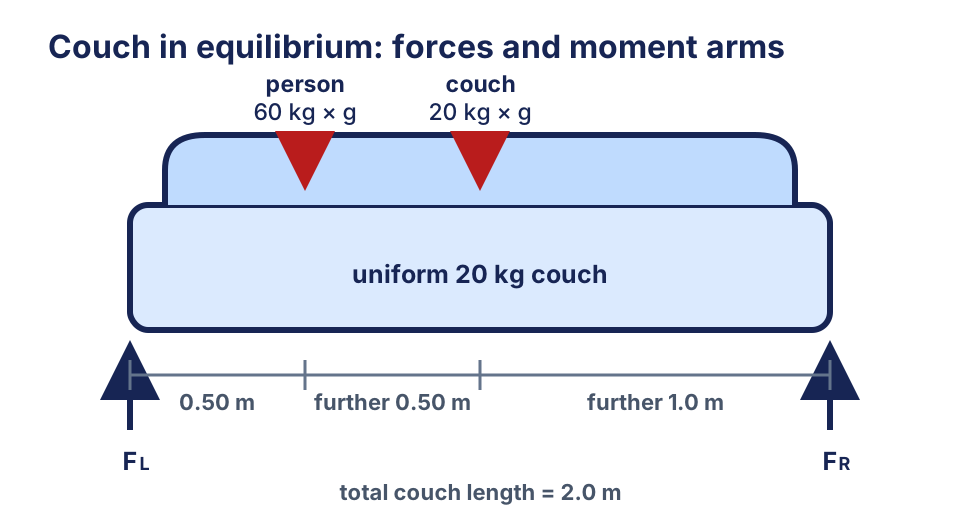
A 2.0 m couch of mass 20 kg is carried level by two people lifting at the ends. A person of mass 60 kg sits 0.50 m from the left end. The couch’s centre of gravity is at the middle.
Take g = 10 N kg⁻¹. Calculate the upward force at each end. [5 marks]
Write your solution before viewing the mark scheme
View solution step by step
Convert both masses to weights
1 markMethod
Find the two downward forces and locate their lines of action.Reason
Moments and force balance use forces in newtons, not masses in kilograms.Working
W_c = (20)(10) = 200 N at 1.0 m; Wₚ = (60)(10) = 600 N at 0.50 m from the left end.Write the moment equation about the left end
1 markMethod
Take moments about the left support.Reason
The unknown left support force then has zero moment, leaving one support force to determine.Working
F_R(2.0) = (600)(0.50) + (200)(1.0)Find the right support force
1 markReason
The couch is rotationally balanced, so the clockwise and anticlockwise moments are equal.Working
F_R = (300 + 200)/2.0 = 250 NApply vertical force balance
1 markReason
The couch has no vertical acceleration, so total upward force equals total downward force.Working
F_L + F_R = 600 + 200 = 800 NFind the left support force
1 markWorking
F_L = 800-250 = 550 N
Self-mark with the mark scheme
Compare your response with each mark point. Select a point only when your response contains that evidence.
Self-mark the force conversion, moment method and force balance separately.
Challenge 5
Seesaw balancing (different weights)
Symbolic transfer
Two people sit on opposite sides of a seesaw. Person A has weight W_A and person B has weight W_B, where W_A > W_B.
Without choosing numerical values, explain how they can balance the seesaw and compare their distances d_A and d_B from the pivot.
Commit to the comparison before viewing the reasoning
Hints
Hint 1: write the symbolic balance condition
Hint 2: compare the distances
View solution step by step
Express the balance symbolically
Method
Equate the opposing moments about the pivot.Reason
A balanced seesaw has zero resultant moment even when the two weights differ.Working
W_A d_A = W_B d_BInfer the distance comparison
Reason
Since W_A > W_B, equality is possible only if A’s moment arm is the smaller one.Working
d_A < d_BState the physical arrangement
Working
The heavier person A sits closer to the pivot, while the lighter person B sits farther away.
7. Mind Stretchers
Mind stretcher 1: Choosing the pivot to eliminate an unknownExtension
A uniform beam is supported at a pivot. There is an unknown reaction force at the pivot.
Why is it often best to take moments about the pivot?
Show Answer
If you take moments about the pivot, the perpendicular distance for the pivot’s reaction force is zero.
So its moment is zero and it disappears from the moment equation, making the calculation simpler.
Mind stretcher 2: When “balanced” does not mean “no forces”Extension
A sign is hanging from two wires and is not moving.
Explain why the forces are not zero even though the sign is in equilibrium.
Show Answer
The sign is in equilibrium because the resultant force is zero, not because all forces are zero.
The weight acts downwards, and the tensions in the wires act upwards. These forces balance so the vector sum is zero.
Continue with the next resource in this course.
Course and syllabus information
- Course
- SEC G3 Physics
- Edition
- SEC G3 Physics 2027