Equations of Motion
Key idea: Use the SUVAT equations of motion to solve constant-acceleration problems, with step-by-step worked examples and exam tips (O Level Physics).
Continue where you stopped
The core idea
On this page
Learning objectives
- Solve straight-line constant-acceleration problems with the equations of uniformly accelerated motion
1. Definition
The equations of motion (also called the SUVAT equations) are equations you can use to solve straight-line motion with constant (uniform) acceleration.
They relate these 5 quantities:
- s = displacement (m)
- u = initial velocity (m s⁻¹)
- v = final velocity (m s⁻¹)
- a = acceleration (m s⁻²)
- t = time taken (s)
2. Key Ideas
- The SUVAT equations work only if acceleration is constant (uniform acceleration).
- Choose a positive direction and keep signs consistent (velocity and acceleration can be negative).
- These equations are for one-dimensional motion (motion in a straight line).
- Always write down the known values with units before choosing an equation.
- Near Earth, for free-fall questions at O Level, use g ≈ 10 m s⁻² unless the question states another value.
3. Detailed Explanations
A. The four SUVAT equations
Each equation “avoids” one of the 5 quantities. So you choose the one that uses what you know.
- (no s)
v = u + at
- (no a)
s = (1/2)(u + v)t
- (no v)
s = ut + (1/2)at²
- (no t)
v² = u² + 2as
B. How to choose an equation (exam workflow)
- Choose a positive direction (e.g. “to the right is +” or “upwards is +”).
- Write down what you know: s, u, v, a, t (with units and signs).
- Circle the unknown.
- Choose an equation that includes the unknown but does not include the variable you do not have.
- Substitute, solve, and state the unit.
Mini-example (find acceleration):
If u = 2.0 m s⁻¹, v = 10 m s⁻¹, and t = 4.0 s, then:
a = (v-u)/t = (10-2.0)/4.0 = 2.0 m s⁻²
C. Why equation (2) makes sense (average velocity idea)
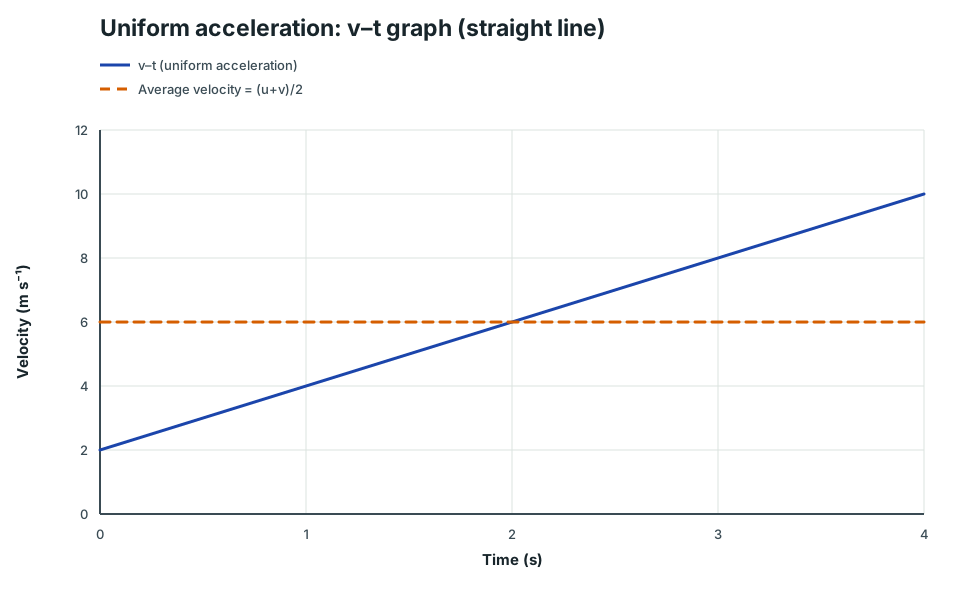
For uniform acceleration, velocity changes steadily from u to v, so the average velocity is:
v_avg = (1/2)(u + v)
Uniform acceleration: v–t graph (straight line)
A straight-line velocity–time graph for uniform acceleration from u to v. A horizontal line shows the average velocity (u+v)/2.
Scroll across the graph to read all labels.
View figure data
| Time (s) | v–t (uniform acceleration) | Average velocity = (u+v)/2 |
|---|---|---|
| 0 | 2 | 6 |
| 4 | 10 | 6 |
Displacement is:
s = v_avgt = (1/2)(u + v)t
The SUVAT equations are for straight-line motion. For projectile motion (2D), you treat horizontal and vertical motion separately: Projectile Motion.
4. Common Mistakes
- Using SUVAT when acceleration is not constant (e.g. a curved v–t graph).
- Mixing up distance and displacement (sign matters for displacement).
- Sign mistakes (e.g. taking a as positive when the object is slowing down in the positive direction).
- Unit mistakes (e.g. using minutes instead of seconds, or km/h instead of m/s).
5. Exam Tips
- Always write “SUVAT only if constant acceleration” before you start.
- If an object is slowing down, acceleration is opposite in direction to velocity (so a has the opposite sign to v).
- For “comes to rest” questions, set v = 0.
- For free-fall at O Level, use g ≈ 10 m s⁻² unless told otherwise, and state your sign convention.
- Do a quick reasonableness check (e.g. if you are braking, the stopping distance should be positive and v should decrease to 0).
6. Worked Examples
Modelled example 1
Accelerating from rest (find v and s)
Problem
Study the worked solution
List the data
Method
Translate “starts from rest” and record the constant-acceleration quantities.Reason
A data list prevents equation and sign mistakes.Working
u = 0, a = 2.0 m s⁻², t = 6.0 sFind final velocity
Method
Use the equation without displacement.Reason
v = u + at contains the known data and target v.Working
v = 0 + (2.0)(6.0) = 12 m s⁻¹Find displacement
Method
Use the equation without final velocity.Reason
s = ut + (1/2)at² uses the original data directly.Working
s = 0 + (1/2)(2.0)(6.0²) = 36 m
Guided practice 2
Braking to rest (find deceleration and stopping distance)
Problem
Try this before viewing the solution
Hints
Hint 1: translate comes to rest
Hint 2: use average velocity for distance
View solution step by step
Find acceleration
Method
Use the signed velocity change per unit time.Reason
The negative result means acceleration opposes the chosen positive direction.Working
a = (0-8.0)/4.0 = -2.0 m s⁻²Find displacement
Method
Multiply average velocity by time.Reason
Velocity changes uniformly from 8.0 to 0.Working
s = (1/2)(8.0 + 0)(4.0) = 16 m
Common misconception 3
Free fall (drop from rest)
Learner claim
Try this before viewing the solution
View solution step by step
State the convention
Method
Take downward as positive.Reason
Both the motion and gravity point in that direction.Working
u = 0, s = +45 m, a = +10 m s⁻²Select the equation
Method
Use the equation without final velocity.Reason
u,s,a are known and t is required.Working
45 = 0 + (1/2)(10)t²Solve
Method
Choose the non-negative elapsed time.Reason
Time taken is a duration.Working
t² = 9 ⇒ t = 3.0 s
Examiner practice 4
Find acceleration without time (use v² = u² + 2as)
Examination question
Try this before viewing the solution
View solution step by step
List the data
1 markMethod
Record u,v,s and note that time is absent.Reason
The missing quantity determines the efficient equation.Working
u = 5.0, v = 25, s = 60 in SI unitsSelect equation
1 markMethod
Use v² = u² + 2as.Reason
It contains the target a but not t.Working
v² = u² + 2asRearrange and substitute
1 markMethod
Make a the subject before evaluating.Reason
This exposes the squared velocities clearly.Working
a = (25²-5.0²)/2(60)Calculate
1 markMethod
The acceleration is positive.Reason
The car speeds up in the positive direction.Working
a = 5.0 m s⁻²
Self-mark with the mark scheme
Compare your response with each mark point. Select a point only when your response contains that evidence.
Self-mark data selection, equation, rearrangement and result.
Challenge 5
Find time and displacement (given u, v, and a)
Independent transfer
Try this before viewing the solution
Hints
Hint 1: find the shared time first
View solution step by step
Find time
Method
Rearrange the velocity equation.Reason
u,v,a are known.Working
t = (16-4.0)/3.0 = 4.0 sFind displacement
Method
Use average velocity for constant acceleration.Reason
The straight-line velocity change has mean (1/2)(u + v).Working
s = (1/2)(4.0 + 16)(4.0) = 40 mCheck graphically
Method
Use the area under the straight velocity–time line.Reason
The trapezium area is displacement.Working
s = (1/2)(4.0 + 16)(4.0) = 40 m
7. Mind Stretchers
Mind stretcher 1: Split the motion into stagesExtension
A bus starts from rest and accelerates uniformly at 1.5 m s⁻² for 8.0 s. It then continues at constant speed for 20 s.
Find the total displacement.
Show Answer
Stage 1 (accelerating):
v = u + at = 0 + (1.5)(8.0) = 12 m s⁻¹
s₁ = (1/2)at² = (1/2)(1.5)(8.0²) = 48 m
Stage 2 (constant speed at 12 m s⁻¹ for 20 s):
s₂ = vt = (12)(20) = 240 m
Total displacement:
s = s₁ + s₂ = 48 + 240 = 288 m
Mind stretcher 2: Thrown upwards (choose signs carefully)Extension
A ball is thrown vertically upwards with speed 20 m s⁻¹. Ignore air resistance and use g = 10 m s⁻².
Find:
- the maximum height reached
- the total time taken to return to the starting point
Show Answer
Take upward as positive. Then u = +20 m s⁻¹, a = -10 m s⁻².
At the highest point, v = 0.
Maximum height:
v² = u² + 2as ⇒ 0 = 20² + 2(-10)s ⇒ s = 20 m
Time to reach the top:
v = u + at ⇒ 0 = 20 - 10t ⇒ t = 2.0 s
Going up and coming back down takes twice the time:
tₜₒₜₐₗ = 2(2.0) = 4.0 s
Continue with the next resource in this course.
Course and syllabus information
- Course
- G3 Physics topic extensions
- Syllabus scope
- Beyond the syllabus
- Edition
- G3 Physics topic extensions