Measuring Specific Heat Capacity
Measure a metal block’s specific heat capacity using an electric heater, interpret a temperature–time gradient, and explain sources of experimental error.
On this page
Start with the energy model
You already know that Q = mcΔθ. An electric heater supplies energy at a measured rate, but some energy may warm the apparatus or reach the surroundings. The experiment tests how well we can estimate the part that warms the block.
If the heater’s power is P, its energy input in time t is E = Pt. If electrical measurements are used, P = VI, where V is the potential difference across the heater and I is the current through it. A watt is one joule per second.
Under the ideal assumption that all input energy raises the block’s temperature,
Use this model only when the block does not change state and its specific heat capacity is approximately constant over the temperature interval.
Collect the measurements
- Measure the block’s mass m with a balance, in kilograms.
- Insert the heater and temperature probe into their holes. Follow the apparatus instructions for improving thermal contact; trapped air slows energy transfer.
- Insulate the block. Keep the probe clear of the heater so that it measures the block, rather than a local hot spot.
- Record the initial temperature. Connect the ammeter in series and the voltmeter across the heater, as shown.
- Switch on the heater and start the timer together. Record V, I and temperature at regular times; check that the power remains approximately constant.
- Use the temperature rise and heating time to estimate c. Repeat under comparable conditions to check consistency.
Use good thermal contact and a modest heating rate so that the block has a fairly uniform temperature. Heater and probe response lag can distort the first readings. A steady reading alone does not prove that every part of a heated block has the same temperature.
Using a temperature–time graph
A sequence of readings shows the trend more clearly than one start–finish pair. For a nearly straight section, find the gradient from two well-separated points on a suitable best-fit line, rather than from two neighbouring readings.
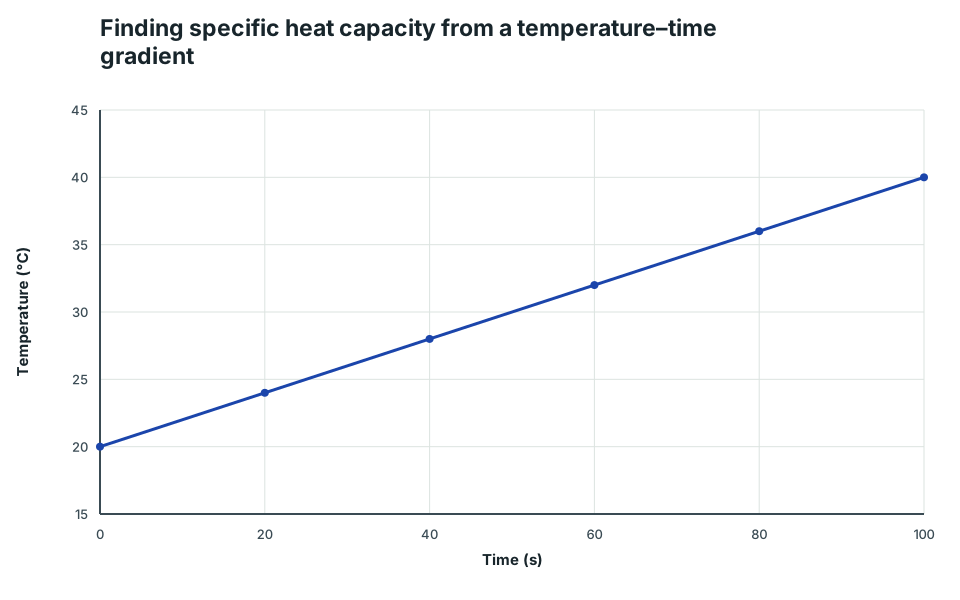
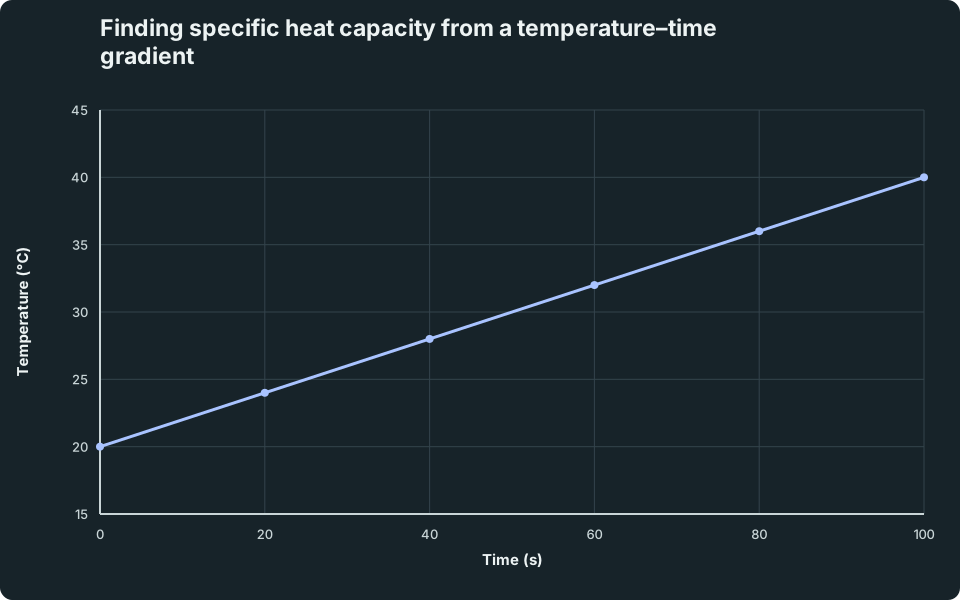
Finding specific heat capacity from a temperature–time gradient
A straight temperature–time line with six points rises from 20 °C at 0 s to 40 °C at 100 s. Temperature rises by equal amounts over equal time intervals.
Scroll across the figure to read all labels.
View figure data
| Time (s) | Illustrative block temperature |
|---|---|
| 0 | 20 |
| 20 | 24 |
| 40 | 28 |
| 60 | 32 |
| 80 | 36 |
| 100 | 40 |
The example uses a 0.50 kg block and a constant 50 W heater. Use the graph and its table to find the gradient, then estimate the specific heat capacity using
Show the graph calculation
The temperature rises from 20 °C to 40 °C over 100 s. The gradient is 0.20 K s⁻¹ and the ideal estimate is 500 J kg⁻¹ K⁻¹.
These are constructed example values, not measurements of a real material. A non-zero starting temperature is expected: gradient uses a change in temperature, rather than the temperature itself.
Do not automatically choose the earliest interval. Avoid an initial response lag, and inspect whether later readings curve as energy transfer to the surroundings grows. A straight section makes the gradient easier to estimate, but it does not prove that all heater energy reaches the block.
Evaluate the estimate
If some input energy warms the heater or probe, or leaves for the surroundings, the block’s temperature rise is smaller than the ideal model predicts. Treating all Pt as energy absorbed by the block then tends to overestimate c.
- Insulation reduces energy transfer out of the block; it does not eliminate it.
- Good thermal contact and a suitable heating rate reduce temperature differences within the apparatus.
- A clear temperature rise reduces the relative effect of temperature-reading uncertainty. Heating much farther above room temperature can also increase unwanted transfer, so a larger rise is not automatically better.
- Repeated readings and runs reveal scatter and inconsistent results. Repetition alone does not remove a systematic energy error.
The error direction depends on the energy path. If an initially colder block also receives energy from its warmer surroundings, assuming heater energy is the only input can instead underestimate c.
Worked calculation
Exam-style question 1
Find specific heat capacity using Q = Pt
Examination question
An insulated block is heated using a constant-power heater. A 50 W heater warms a 0.60 kg metal block from 20°C to 45°C in 90 s. Find its specific heat capacity using the ideal energy model, and state its assumption. [5 marks]
Show energy, temperature change, calculation and assumption
Show solution step by step
Find supplied energy
1 markMethod
Multiply power by heating time.Reason
One watt is one joule per second.Working
E = Pt = (50)(90) = 4500 JFind temperature change
1 markMethod
Subtract the initial reading.Reason
Q = mcΔθ uses temperature rise.Working
Δθ = 45-20 = 25 KCalculate and qualify the result
3 marksMethod
Calculate c and assume all supplied energy raises the block’s temperature.Reason
Energy transferred to the surroundings or apparatus would invalidate the ideal equality.Working
c = 4500/(0.60)(25) = 300 J kg⁻¹ K⁻¹
Self-mark with the mark scheme
Compare your response with each mark point. Select a point only when your response contains that evidence.
Self-mark energy, temperature rise, substitution, result and assumption.
Practise the reasoning
An estimate of c is larger than an accepted value. Explain why “the heater was on for too long” is not enough to diagnose the error.
Show an explanation
Time is part of both the energy input and the measured temperature change. Identify an energy path or a measurement problem: for example, energy transferred to the surroundings reduces the block’s temperature rise, so using all Pt overestimates c. Compare the apparatus conditions before choosing a correction.
Syllabus and review details
- SEC G3 Physics 2027 · 2027
Content Structure, PDF page 9; Subject Content, PDF pages 10–28