Ultrasound
Key idea: O Level ultrasound: define ultrasound, use echo timing d = vt/2, and explain applications in medical scanning and sonar.
Continue where you stopped
The core idea
On this page
Learning objectives
- Describe wave generation by vibrating sources, ropes and springs
- Describe ripple-tank waves using wavefronts
- Explain that waves transfer energy
- Explain that wave energy transfer does not transfer matter
- Use amplitude, frequency and wavelength to describe wave motion
- Define and use wave speed and period and interpret wave graphs
- Recall and apply wave speed = frequency × wavelength
- Compare transverse and longitudinal waves and give examples
- Explain sound production by vibration and the need for a medium
- Describe sound using compressions and rarefactions
- Relate sound loudness to amplitude and pitch to frequency
- Explain reflected-sound echoes and use them to measure distance
- Explain ultrasound use in sonar and soft-tissue scanning
- Use the normal, angle of incidence and angle of reflection
- Apply the law of reflection in constructions, measurements and calculations
- Use the normal, angle of incidence and angle of refraction
- Apply sin i divided by sin r as a constant for a fixed pair of media
- Define refractive index as vacuum light speed divided by medium light speed
- Explain the critical angle
- Explain the conditions for total internal reflection
- Apply total internal reflection to optical fibres and state advantages
- Describe how a thin converging lens acts on a light beam
- Define the focal length of a converging lens
- Construct real and virtual image ray diagrams for a thin converging lens
- Describe lens images as real or virtual, magnified or diminished, and upright or inverted
1. Definition
A. Ultrasound
Ultrasound is sound with frequency greater than 20 000 Hz (20 kHz).
2. Key Ideas
- Ultrasound is a sound wave (mechanical, needs a medium) but with very high frequency.
- Ultrasound is used for echo methods: send a pulse, detect the echo, and use the time taken to find distance.
- Higher frequency → shorter wavelength → can give better detail (useful for imaging).
3. Detailed Explanations
A. Sonar (echo sounding)
- A transmitter sends out a short ultrasound pulse.
- The pulse reflects from an object (e.g. seabed, a shoal of fish).
- A receiver detects the echo after time t.
Because the pulse travels to the object and back, the one-way distance is:
d = vt/2
where v is the speed of sound in that medium (e.g. water).
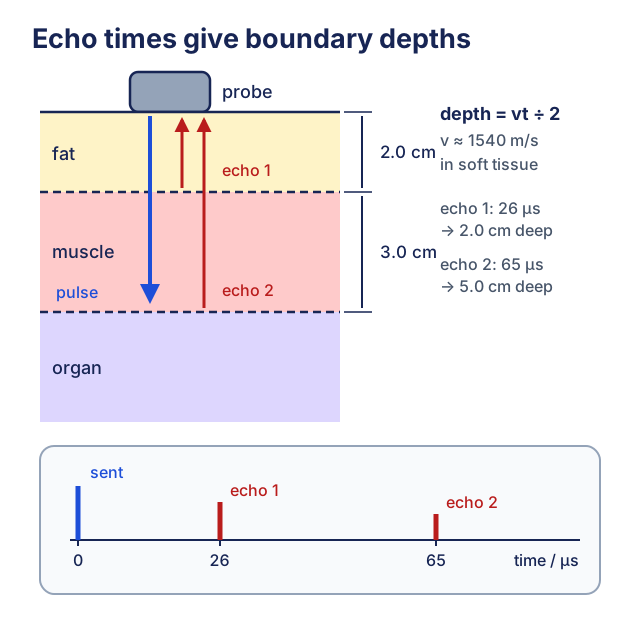
B. Medical scanning (soft tissue)
Ultrasound imaging uses reflections at boundaries between different tissues:
- Short ultrasound pulses are sent into the body.
- Echoes occur where tissues change (e.g. muscle–fat boundary).
- A computer uses the echo times to build an image.
C. Why ultrasound is useful for imaging
- Short wavelength can detect smaller features (better detail).
- Pulses give “time-of-flight” information, so distance can be calculated.
4. Common Mistakes
- Forgetting the factor of 2 in echo questions (round trip).
- Using the wrong speed value (speed depends on the medium; water is not the same as air).
- Confusing ultrasound (high frequency sound) with electromagnetic waves (they are different).
5. Exam Tips
- Use keywords: pulse, echo, reflection, time taken, distance = vt/2.
- State clearly: “the pulse travels to the object and back”.
- If asked why ultrasound (not ordinary audible sound) is used for scanning: mention short wavelength → better detail.
6. Worked Examples
Modelled example 1
Depth from echo time
Problem
Study the worked solution
Interpret the echo time
Method
Use 0.80 s for the downward and upward journey together.Reason
The receiver detects the pulse only after reflection from the seabed.Working
Total path = vt = (1500)(0.80) = 1200 m.Calculate the depth
Method
Halve the total path length.Reason
Depth is the one-way distance to the seabed.Working
d = vt/2 = 1200/2 = 600 m
Guided practice 2
Distance to a foetus boundary
Problem
Convert time before using the echo equation
Hints
Hint 1: convert milliseconds
Hint 2: use the round trip
View solution step by step
Convert the time
Method
Express the echo delay in seconds.Reason
The speed is given in metres per second.Working
0.10 ms = 1.0 × 10⁻⁴ sCalculate the boundary depth
Method
Use half the distance travelled during the echo delay.Reason
The pulse travels to the boundary and back.Working
d = ((1500)(1.0 × 10⁻⁴))/2 = 0.075 m = 7.5 cm
Common misconception 3
Speed from echo time
Learner response
Identify the distance travelled during the measured time
View solution step by step
Correct the path length
Method
Double the seabed depth to obtain 150 m.Reason
The echo time includes both the outward and return journeys.Working
2d = 2(75) = 150 mCalculate wave speed
Method
Divide total path length by echo time.Reason
Speed uses the distance travelled during the measured interval.Working
v = 2d/t = 150/0.10 = 1500 m s⁻¹
Examiner practice 4
Depth from microseconds
Examination question
Show unit conversion, echo method and final unit
View solution step by step
Convert the delay
1 markMethod
Convert microseconds to seconds.Reason
The supplied speed uses seconds.Working
60 μs = 6.0 × 10⁻⁵ sCalculate and convert depth
3 marksMethod
Use d = vt/2 and express the result in centimetres.Reason
The delay is for the round trip to the tissue boundary and back.Working
d = ((1500)(6.0 × 10⁻⁵))/2 = 4.5 × 10⁻² m = 4.5 cm
Self-mark with the mark scheme
Compare your response with each mark point. Select a point only when your response contains that evidence.
Self-mark time conversion, echo equation, substitution and centimetre result.
Challenge 5
Wavelength of ultrasound
Wave-equation transfer
Switch from echo timing to the wave equation
Hints
Hint 1: convert megahertz
Hint 2: choose the relevant equation
View solution step by step
Convert frequency
Method
Express 2.0 MHz in hertz.Reason
The wave speed is in SI units.Working
2.0 MHz = 2.0 × 10⁶ HzCalculate wavelength
Method
Divide wave speed by frequency and convert metres to millimetres.Reason
One cycle occupies the distance v/f.Working
λ = 1500/(2.0 × 10⁶) = 7.5 × 10⁻⁴ m = 0.75 mm
7. Mind Stretchers
Mind stretcher 1: Detail vs penetrationExtension
Why might a very high frequency ultrasound give better detail but be less useful for imaging deep inside the body?
Show Answer
Higher frequency has shorter wavelength (better detail), but it is absorbed/scattered more strongly in tissue, so it does not penetrate as deeply.
Mind stretcher 2: Why use pulses?Extension
Why do ultrasound scanners use pulses rather than a continuous wave?
Show Answer
Pulses let the scanner measure the time-of-flight for each echo. This allows distances to be calculated and different boundaries to be separated by their echo times.
8. Practice and next step
Explain one sonar and one medical example using pulse, partial reflection, echo time and distance. Then continue to electromagnetic waves, noting that ultrasound is mechanical rather than electromagnetic.
Continue with the next resource in this course.
Course and syllabus information
- Course
- SEC G3 Physics
- Edition
- SEC G3 Physics 2027