Thermal investigations and energy measurements
Key idea: Use measured heater energy, mass and temperature rise to find specific heat capacity. For latent heat, divide energy by the mass that changes state and account for heat exchange.
Offline pages
Saved on this device only. Connect at least once every 30 days to confirm Premium. Sign-out or a change of account removes saved copies.
Loading guide controls…
Guided lessons · coming soon
Guided lesson
Guided steps
- Choose one changed factor and match the starting conditions.
- Find the temperature falls and check the starting conditions.
- Compare heat capacity and specific heat capacity.
- Follow the energy calculation and compare the units.
- Find absorbed energy before comparing the capacity estimates.
- Explain why heat loss changes the result and suggest an improvement.
- Calculate the liquid’s c and explain the effect of container heating.
- Read which energy and mass belong to the phase change.
- Calculate latent heat and explain why temperature stays constant.
- Review starting conditions, absorbed energy and the mass changing state.
On this page
You stopped at:
ContinueThe heater’s electrical input and the sample’s energy gain are related, but they are not automatically equal. Thermal experiments need an energy account as well as a thermometer reading. Some energy heats the apparatus or passes to the surroundings.
Use the teacher-provided heater, stable containers and the specified eye protection. Treat heated equipment as hot after switching it off. Keep water away from electrical connections, handle spills as instructed and do not improvise a boiling or melting procedure.
Make a fair thermal-transfer comparison
Choose one independent variable: for example, insulation thickness. Match water mass, starting temperature, container geometry, lids, room conditions and measurement intervals. Measure temperature over time, then compare changes over the same interval or an appropriate rate. Repeat to judge variation.
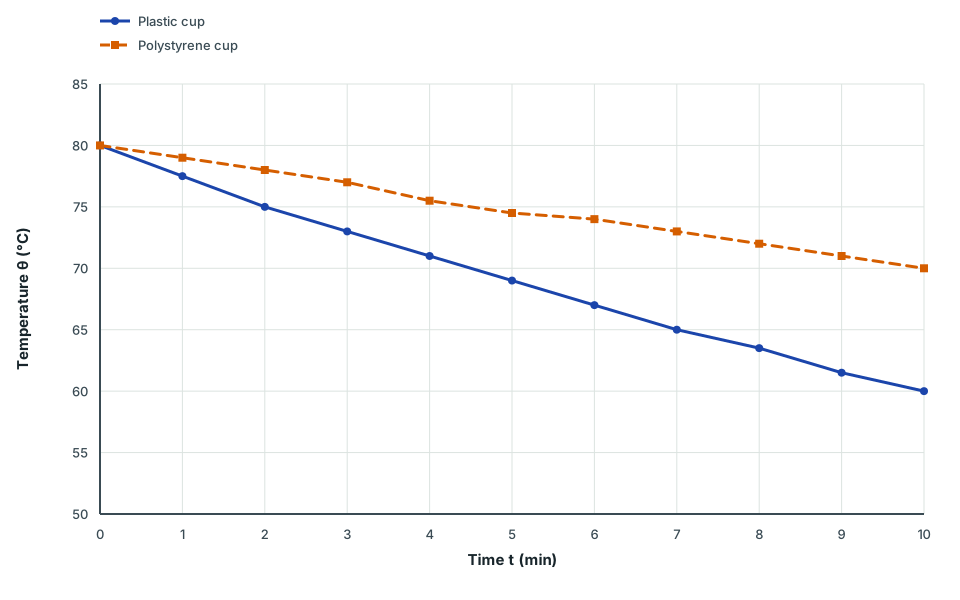
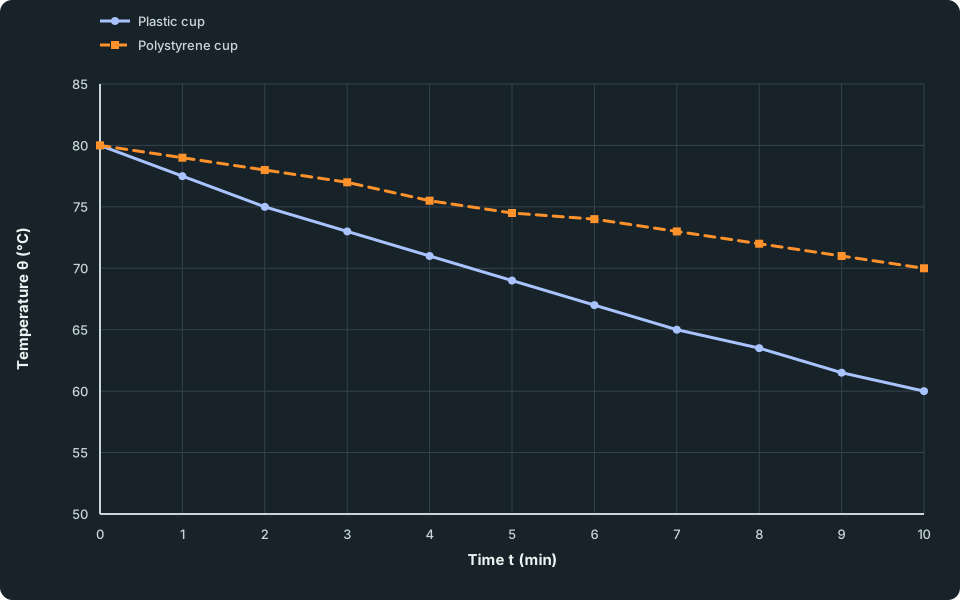
Cooling curves for two cups
Two cooling curves of water temperature in °C against time in minutes from 0 to 10 minutes. Both start at 80.0 °C. The plastic-cup curve, drawn solid with circles, falls more steeply than the polystyrene-cup curve, drawn dashed with squares. The data table lists every reading.
Scroll across the figure to read all labels.
View figure data
| Time t (min) | Plastic cup | Polystyrene cup |
|---|---|---|
| 0 | 80.0 | 80.0 |
| 1 | 77.5 | 79.0 |
| 2 | 75.0 | 78.0 |
| 3 | 73.0 | 77.0 |
| 4 | 71.0 | 75.5 |
| 5 | 69.0 | 74.5 |
| 6 | 67.0 | 74.0 |
| 7 | 65.0 | 73.0 |
| 8 | 63.5 | 72.0 |
| 9 | 61.5 | 71.0 |
| 10 | 60.0 | 70.0 |
The constructed readings compare these two cup designs. Both begin at 80.0 °C. After 10 min the plastic-cup water is 60.0 °C and the polystyrene-cup water is 70.0 °C: drops of 20.0 °C and 10.0 °C. The second design loses thermal energy more slowly under these conditions. A design comparison does not isolate material alone if geometry or thickness differs. The vertical axis begins at 50 °C, so read the scale before judging the size of a change.
Investigation of the factors affecting transfer of energy by thermal processes
Method
Change one factor affecting thermal transfer, such as material, thickness, surface or insulation, while keeping geometry, starting temperature, surroundings and measurement intervals matched. Record temperature against time, repeat, and compare rates or temperature changes.
Why it works
A fair thermal-process comparison needs matched thermal conditions and a defined rate measure. Temperature–time curves reveal both the direction and relative rate of transfer; repeats and uncertainty matter when curves are close.
A mistake to avoid: The best thermal insulator is whichever container finishes at the highest temperature, regardless of its start temperature or size.
Check your understanding
Two insulated cans start at different temperatures. Why would comparing only their final temperatures be unfair?
Show answer
Different starting temperatures mean different initial temperature differences from the room, so the energy-transfer conditions differ. Match starting temperature, water mass, geometry, lids and surroundings, then compare temperature–time data over the same interval and repeat.
Spot the mistake 1
Does the hottest final cup insulate best?
Problem
Cup A starts at 80 °C and finishes at 65 °C. Cup B starts at 60 °C and finishes at 55 °C after the same time. A student declares A the better insulator because 65 °C is higher. Find both temperature falls, decide whether the readings allow a fair ranking and select a better comparison.
Try before revealing the solution
Show solution step by step
Notice the unequal starts
Method
Compare the initial conditions before judging the final temperatures.
Reason
The cups begin with different temperature differences from the room, which affects thermal transfer.
Working
Answer
A falls by 15 °C and B by 5 °C, but even those changes do not isolate the cup design with different starts.
Design a matched comparison
Method
Use equal water masses, the same starting temperature, matched lids and geometry where possible, and the same surroundings.
Reason
Then the temperature–time comparison can address the intended changed factor.
Working
Answer
Record at the same intervals and repeat. Describe a result for the tested cup designs; include any changes in shape or thickness when explaining it.
Common mistake
A fair comparison needs controlled conditions and a clearly stated changed factor. Repeating the unequal-start test does not remove that confounding factor.
Separate whole-sample and specific heat capacity
Heat capacity C is for a whole sample. Specific heat capacity c is per kilogram. Both use a temperature rise, not just the final temperature:
For electrical heating at approximately constant potential difference and current, E = VIt. Insulate the sample, ensure good thermal contact with the sensor and heater, and stir a liquid when appropriate. Decide whether electrical input is a reasonable estimate of absorbed energy, and evaluate remaining heat loss or heating of the container.
Determination of heat capacities of materials
Method
Measure the sample's initial temperature, supply measured electrical energy E = VIt while insulating it, and record the temperature rise. Determine heat capacity from C = E/ΔT. If specific heat capacity is required, also measure mass and use c = C/m = E/(mΔT). Repeat or use a cooling correction to assess heat loss.
Why it works
Heat capacity C describes the whole sample and has unit J/K. Specific heat capacity c is heat capacity per unit mass and has unit J/(kg K). Not all electrical energy heats the sample, so insulation, sensor contact, stirring where suitable and heat-loss evaluation are part of the result.
A mistake to avoid: Heat capacity and specific heat capacity are the same quantity, so the sample's mass is never relevant.
Check your understanding
Which calculation gives the heat capacity of the whole sample, and when must its mass be included?
Show answer
The whole-sample heat capacity is C = E/ΔT. Specific heat capacity is c = E/(mΔT), so its calculation includes the sample mass. Compare the energy absorbed by the sample with the electrical input, some of which heats the apparatus or escapes to the surroundings.
Worked example 2
Whole-sample and per-kilogram heat capacity
Problem
A 0.40 kg block receives 7.2 kJ of energy and warms by 20 °C. Assume this is the energy absorbed by the block. Find its heat capacity and specific heat capacity.
Show full solution
Use the temperature rise
Method
Convert the energy to joules and divide by the rise.
Reason
Heat capacity describes the energy needed for a one-degree rise of the whole sample.
Working
Answer
E = 7200 J; C = E/ΔT = 7200/20 = 360 J/°C.
Include the mass for c
Method
Divide the whole-sample heat capacity by mass.Reason
Specific heat capacity is per kilogram, so C and c have different units.
Working
Answer
c = C/m = 360/0.40 = 900 J/(kg °C), or 9.0 × 10² J/(kg °C). Check: mcΔT = 0.40 × 900 × 20 = 7200 J.
Quick check
A temperature rise of 20 °C is also a rise of 20 K. These answers assume the stated energy heats the block; electrical input alone may include losses and heating of apparatus.
Check your understanding 1 Account for energy before calculating c
A 0.50 kg block receives 9600 J of electrical input, but 1600 J goes to the surroundings. The block rises by 20 °C; ignore heating of other apparatus. Find the energy absorbed by the block. Calculate c once using all input and once using absorbed energy.
Show the steps Optional working
Show the steps Optional working
Show answer
The block absorbs 9600 − 1600 = 8000 J. Using all input gives 9600/(0.50 × 20) = 960 J/(kg °C); using absorbed energy gives 8000/(0.50 × 20) = 800 J/(kg °C). The two calculations use the same sample and temperature rise but different energy numerators.
Try it yourself 3
Trace heat loss to its effect on c
Problem
Use the block’s energy comparison above to explain why ignoring the outward loss overestimates c. Suggest an improvement that addresses the loss and explain why more repeats alone do not remove it.
Try before revealing the solution
Explain the causal chain and improvement on paper or here, then compare them with the model. You don’t need to type up an answer written on paper.
Hints
Hint 1
Choose the relevant evidence
Write an energy account: input = energy absorbed by the block + energy lost. Then compare the two numerators.
Show solution step by step
Separate input from absorption
Method
Subtract the lost energy to find the energy heating the block.
Reason
Electrical input is not automatically equal to the sample’s energy gain.
Working
Answer
Block energy = 9600 − 1600 = 8000 J.Compare the estimates
Method
Use the same mass and temperature rise in each calculation.
Reason
Using too much energy in the numerator makes the estimated specific heat capacity too large.
Working
Answer
Input-based c = 9600/(0.50 × 20) = 960 J/(kg °C). Absorption-based c = 8000/(0.50 × 20) = 800 J/(kg °C).
Address the cause
Method
Insulate the block and evaluate remaining losses; ensure good heater and thermometer contact.
Reason
A larger number of repeats would not remove energy lost in every trial.
Working
Answer
Record temperature against time and follow an appropriate loss-correction method when provided. Do not assume insulation makes all losses zero.
Quick check
Compare your energy account, direction of bias and targeted improvement with the three model steps. The direction stated here follows the specified outward loss. During melting, energy supplied by warm surroundings can affect the estimate in a different direction.
Check your understanding 2 Specific heat capacity from a heater
A heater operates at 12 V and 2.0 A for 100 s. A 0.20 kg liquid sample rises from 20 °C to 26 °C. Find the input energy and temperature rise, then estimate c assuming all input heats the liquid. Choose the effect of some input heating the container instead.
Show the steps Optional working
Show answer
E = VIt = 12 × 2.0 × 100 = 2400 J, and ΔT = 6 °C. The input-based estimate is c = 2400/(0.20 × 6) = 2000 J/(kg °C), about 2 × 10³ J/(kg °C) at the precision of the temperature rise. If some input heats the container, the energy used for the liquid is smaller, so this calculation overestimates its c. Insulation alone does not remove the container’s energy gain.
Separate temperature rise from phase change
During a phase change of a pure substance at fixed pressure, temperature stays near the transition temperature. Energy changes the particle arrangement instead of raising temperature. To find specific latent heat, use the energy associated with the change and the mass that actually changes state:
If only part of the material melts, its whole starting mass is the wrong denominator. The surroundings can supply energy to a cold melting sample or receive energy from a hot sample. Account for the direction in your evaluation.
Latent heat of substances
Method
During a controlled phase change, measure the energy supplied, for example E = VIt, while checking that the temperature stays near the transition temperature. This energy is the latent heat L for the amount that changes state. To find specific latent heat, also measure that mass and use l = E/m. Account for heat exchange with the surroundings.
Why it works
Latent heat L is the energy transferred while the measured sample changes state without a temperature change. Specific latent heat l is that energy per unit mass. The mass in l = E/m must be the amount that actually changes state during the timed input.
A mistake to avoid: Latent heat is calculated from a temperature rise, just like heat capacity.
Check your understanding
What should happen to temperature during the phase change, and which mass belongs in the specific-latent-heat calculation?
Show answer
For a pure substance at fixed pressure, temperature stays near its transition temperature during a phase change. Use the mass that actually changes state in l = E/m. Include or evaluate energy exchanged with the surroundings rather than assuming all electrical input causes the change.
Guided practice 4
Use the mass that changes state
Problem
A heater supplies 12 kJ while 0.050 kg of a substance melts at constant temperature. Assume all this energy causes melting. Find the specific latent heat and the latent energy for this sample. Choose why a temperature-rise calculation is unsuitable here.
Try before revealing the solution
Show the steps Optional working
Hints
Hint 1
Find the decisive relationship
Which quantity gives energy per kilogram of material changing state?
Show solution step by step
Identify the process
Method
Use the energy during the phase change, not a temperature-rise equation.
Reason
At the transition temperature, energy changes the arrangement of particles without raising temperature.
Working
Answer
E = 12 000 J; mass that melts = 0.050 kg.Calculate per kilogram
Method
Divide the latent energy by the mass that changes state.
Reason
Specific latent heat describes energy per kilogram; the sample’s latent heat is the total energy transferred in its change of state.
Working
Answer
l = E/m = 12 000/0.050 = 2.4 × 10⁵ J/kg. The latent heat for this sample is 12 kJ. Check: ml = 0.050 × 2.4 × 10⁵ = 12 000 J.
Quick check
Do not use all the material’s mass if only part melts. In a real experiment evaluate energy from the surroundings and energy absorbed by the container.
Common mistakes
- Ranking insulation from final temperatures or temperature falls when the starting temperatures differ. Match the initial conditions before comparing changes over the same time.
- Confusing the heat capacity of a whole sample with the specific heat capacity of its material.
- Using the total mass instead of the mass that actually changes state in a latent-heat calculation.
- Forgetting that heat lost to the surroundings makes the calculated specific heat capacity too large.
- Expecting repeats to remove a loss that happens in every trial.
Spotted an error? Report a correction
Syllabus and review details
- SEC G3 Physics 2027 · 2027
Content Structure, PDF page 9; Subject Content, PDF pages 10–28
Last reviewed: