Refraction calculations
Key idea: With the same light and materials, the sines of the incident and refracted angles stay in proportion. Refractive index is vacuum light speed divided by speed in the material.
Offline pages
Saved on this device only. Connect at least once every 30 days to confirm Premium. Sign-out or a change of account removes saved copies.
Loading guide controls…
Guided lessons · coming soon
Guided lesson
Guided steps
- Compare the sine graph with the changing angle ratios.
- Calculate the sine ratio and identify the first error.
- Find the sine, then the angle, and check the bend.
- Rearrange the rule and calculate the angle for water.
- Find the angle in air and choose the bend direction.
- Explain how refractive index compares light speeds.
- Calculate the index, then use its unrounded value for speed.
- Find the refractive index from the two light speeds.
- Compare speeds and bends for the same incident angle.
- Find the index, speed and gradient with reversed axes.
On this page
You stopped at:
ContinueKnowing that a ray bends towards the normal as it enters glass is not enough to draw it: you need the angle. A simple rule links the angles on either side of a boundary, and the number in that rule, the refractive index, also tells you how fast light travels in the material. Before you start, set your calculator to degrees and check that sin 30° = 0.5.
The rule for refraction: sin i / sin r = constant
For light of a fixed frequency passing through a fixed pair of transparent materials in the same direction, the sines of the nonzero angles stay in proportion:
The constant depends on the two materials. For air into one kind of glass it is about 1.50; for air into water it is about 1.33. It is the sines of the angles that stay in proportion, not the angles themselves.
Sines stay in proportion; angles do not
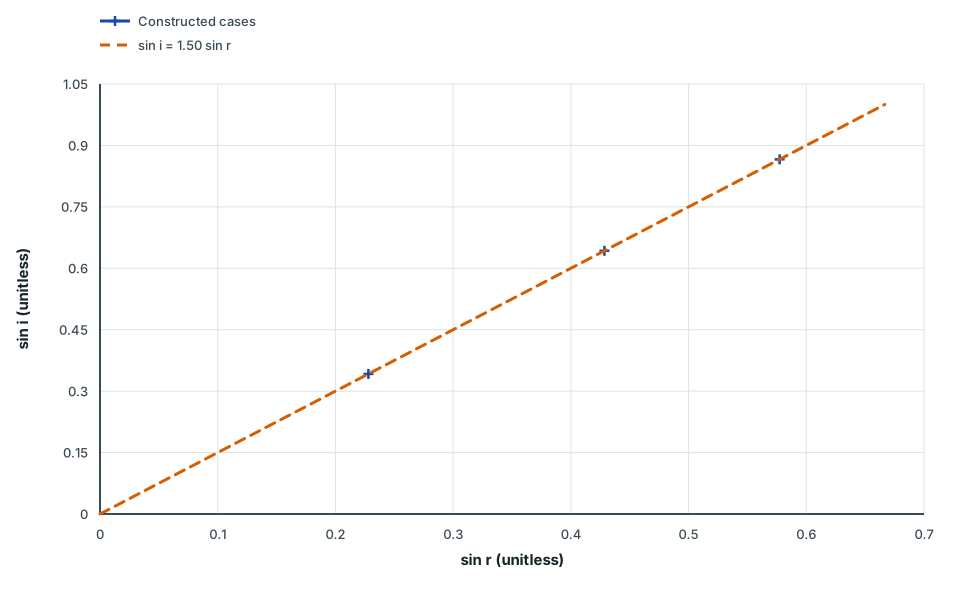
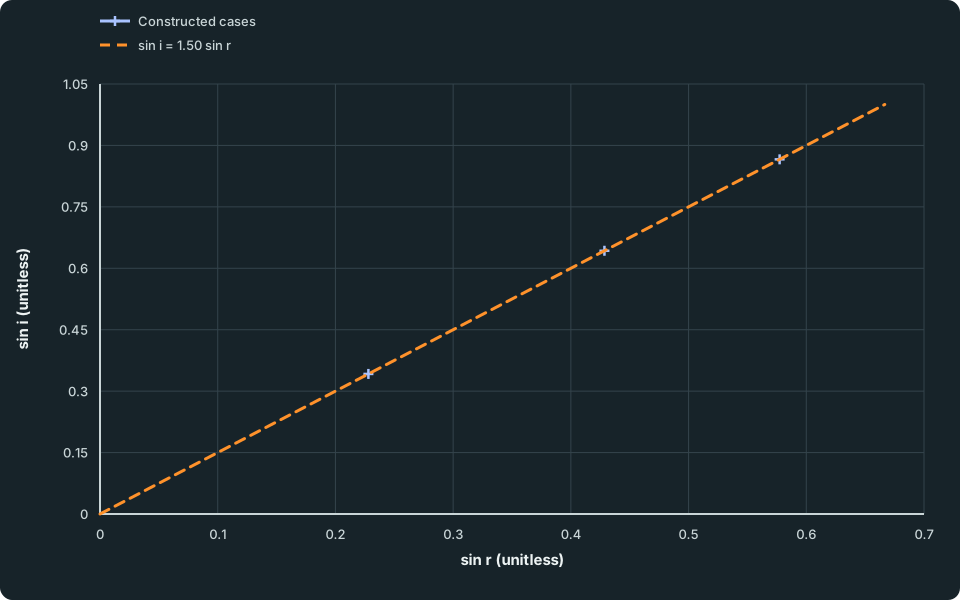
A graph of sin i against sin r. Three constructed points lie on a straight line of gradient 1.50 through the origin. Both axes are unitless. The adjacent angle table is calculated from the same points.
Scroll across the figure to read all labels.
View figure data
| Series | sin r (unitless) | sin i (unitless) |
|---|---|---|
| Constructed cases | 0.2280 | 0.3420 |
| Constructed cases | 0.4285 | 0.6428 |
| Constructed cases | 0.5774 | 0.8660 |
| sin i = 1.50 sin r | 0.0000 | 0.0000 |
| sin i = 1.50 sin r | 0.6667 | 1.0000 |
| i / ° | r / ° | sin i / sin r | i / r |
|---|---|---|---|
| 20.0 | 13.2 | 1.50 | 1.52 |
| 40.0 | 25.4 | 1.50 | 1.58 |
| 60.0 | 35.3 | 1.50 | 1.70 |
The graph is a straight line through the origin: its gradient is sin i / sin r = 1.50. The table beside it uses the same values, and its ratio i/r changes from row to row, so dividing the angles does not give the constant. At normal incidence, i = r = 0°, and the ratio cannot be calculated, so use non-zero angles.
Check your understanding 1 Angles or sines?
A student writes: “i = 60° and r = 30°, so the constant is 60 ÷ 30 = 2.” Correct the working.
Show the steps Optional working
Show answer
The rule uses the sines of the angles: sin 60° / sin 30° = 0.866 / 0.500 = 1.73. The ratio of the angles themselves is not the constant.
To find an unknown angle, rearrange the rule. If you know i and the constant, sin r = sin i ÷ constant. The sin⁻¹ key then turns sin r back into an angle.
Worked example 1
Finding the angle of refraction
Problem
Light passes from air into glass with an angle of incidence of 35°. For this air–glass pair, sin i / sin r = 1.50. Find the angle of refraction.
Show full solution
Rearrange for sin r
Method
Make sin r the subject.Reason
The unknown is inside the sine, so find sin r first.Working
Answer
sin r = (sin i)/1.50 = (sin 35°)/1.50 = 0.574/1.50 = 0.382Undo the sine
Method
Use sin⁻¹ in degree mode.Reason
0.382 is the sine of the angle, not the angle.Working
Answer
r = sin⁻¹ (0.382) = 22.5°
Check the answer makes sense
Working
Answer
The ray enters glass and slows down, so it should bend towards the normal: r = 22.5° is smaller than i = 35°, as expected.
Quick check
If your calculator gives sin 35° = −0.428, or sin⁻¹(0.382) = 0.392, it is in radians. Switch it to degrees.
Guided practice 2
Your turn: a ray entering water
Problem
Light passes from air into water with an angle of incidence of 50°. For air into water, sin i / sin r = 1.33. Find the angle of refraction.
Try this before viewing the solution
Show the steps Optional working
Show the steps Optional working
Hints
Hint 1
first step
Divide sin 50° by the constant to get sin r.
Hint 2
second step
Use sin⁻¹ on your value of sin r, with the calculator in degrees.
Show solution step by step
Find sin r
Method
Rearrange the rule.Reason
sin r = sin i ÷ constant.Working
Answer
sin r = 0.766 ÷ 1.33 = 0.576
Find r
Working
Answer
r = sin⁻¹ (0.576) = 35.2°, smaller than i as expected.
Quick check
For the same 50° incidence, glass with a constant of 1.50 gives r = 30.7°, while water gives 35.2°. The smaller water constant gives less bending.
Reversing the direction reverses the ratio. For light leaving glass into air, the angle in air is the larger one: sin(angle in air) = 1.50 × sin(angle in glass).
Check your understanding 2 Leaving the glass
A ray inside a glass block, with sin i / sin r = 1.50 for air into glass, meets the surface at 20° to the normal and passes into air. Find the angle it makes with the normal in air, and say whether it bends towards or away from the normal.
Show the steps Optional working
Show answer
sin(angle in air) = 1.50 × sin 20° = 1.50 × 0.342 = 0.513, so the angle is sin⁻¹(0.513) = 30.9°. It bends away from the normal, because light speeds up as it enters air.
Refractive index compares speeds of light
The refractive index, n, of a material is the ratio of the speed of light in a vacuum to the speed of light in the material:
The speed of light in a vacuum is c = 3.00 × 10⁸ m/s. Light travels almost as fast in air as in a vacuum, so take the refractive index of air as approximately 1.00.
- n has no unit: it is one speed divided by another.
- For the ordinary transparent materials and visible light used here, n is greater than 1: light travels more slowly than in a vacuum.
- A larger n means a smaller speed v, and a stronger bend when light enters from air.
For light going from air into a material, the constant in sin i / sin r is approximately the refractive index of that material. That is why the glass above has n = 1.50 and water has n = 1.33.
Worked example 3
From angles to the speed of light in glass
Problem
Light enters a glass block from air with i = 45° and r = 28°. Find the refractive index of the glass and the speed of light in it.
Show full solution
Find n from the angles
Method
The light comes from air, so the sine ratio is n.Reason
The air index is approximately 1, so this sine ratio is approximately n.Working
Answer
n = (sin 45°)/(sin 28°) = 0.707/0.469 = 1.51Rearrange n = c/v
Method
Make v the subject.Reason
v is the unknown speed in the glass.Working
Answer
v = c/n
Substitute and check
Working
Answer
v = (3.00 × 10⁸ m/s)/(sin 45°/sin 28°) = 1.99 × 10⁸ m/s (3 s.f.). Keep the unrounded n for this step. The result is less than c, as expected.
Quick check
If you get a speed greater than 3.00 × 10⁸ m/s, you have multiplied by n instead of dividing.
Check your understanding 3 Refractive index of water
Light travels at 2.25 × 10⁸ m/s in water. Calculate its refractive index, using c = 3.00 × 10⁸ m/s.
Show answer
Divide the vacuum speed by the speed in water:
The speed units cancel, so n has no unit. A value above 1 agrees with light travelling more slowly in water.
Check your understanding 4 Diamond and glass
Diamond has n = 2.42 and glass has n = 1.50. In which is light slower? Which bends light more when it enters from air at the same non-zero angle to the normal?
Show answer
Diamond. Its larger n means a smaller speed: v = 3.00 × 10⁸ / 2.42 = 1.24 × 10⁸ m/s. For the same i, sin r = sin i / n is smaller, so r is smaller and the ray bends more towards the normal.
Check your understanding 5 Choose the axes before interpreting a gradient
For light entering a material from air, a graph plots sin i vertically against sin r horizontally. Its straight line passes through (0, 0) and (0.60, 0.75). Find the refractive index and light speed, using c = 3.00 × 10⁸ m/s. What gradient would reversed axes give?
Show the steps Optional working
Show answer
The horizontal axis is sin r and the vertical axis is sin i, both dimensionless. Its gradient is 0.75/0.60 = 1.25, equal to sin i / sin r, so the air-to-material refractive index is 1.25. Light speed = c/n = 3.00 × 10⁸/1.25 = 2.40 × 10⁸ m/s. Swapping the axes gives the reciprocal gradient 0.80 = sin r / sin i; that is not the required air-to-material index. Check the plotted quantities before naming a gradient.
Common mistakes
- Dividing the angles, i / r, instead of their sines, sin i / sin r.
- Stopping at sin r = 0.382 and writing r = 0.382. Finish with sin⁻¹ to get the angle in degrees.
- Leaving the calculator in radians. Check that sin 30° gives 0.5 before you start.
- Saying a larger n means light travels faster. Since n = c/v, a larger n means a smaller speed.
- Giving n a unit, or a value below 1. The speed units cancel, and light is slower in these materials than in a vacuum.
Spotted an error? Report a correction
Syllabus and review details
- SEC G3 Combined Science Physics component 2027 · 2027
Physics section, PDF pages 8–24
Last reviewed: