Refraction investigation
Key idea: Trace rays through the same glass block at several incident angles and measure refraction angles from the normal. Plot sine of incidence against sine of refraction to find their constant ratio.
Offline pages
Saved on this device only. Connect at least once every 30 days to confirm Premium. Sign-out or a change of account removes saved copies.
Loading guide controls…
Guided lessons · coming soon
Guided lesson
Guided steps
- Trace the entry, exit and normals before following the pin method.
- Explain how leaning pins affect alignment and correct them.
- Check the axes and use a large gradient triangle.
- Calculate the sine ratio using the unrounded angle.
- Explain why fixed reading errors matter more at small angles.
- Use the reversed axes to find the gradient and index.
- Draw the graph and compare axes, points and gradient triangle.
On this page
You stopped at:
ContinueThe rule for refraction says that sin i/sin r is the same for every angle, as long as the light passes between the same two materials. You can test that claim with a glass block and four optical pins, traced as for reflection. Plot several readings to test whether the ratio stays constant and estimate its value.
Investigate refraction through a glass block
Keep the same block, the same entry face and the same light source, and change only the angle of incidence.
- Trace round a rectangular glass block on paper on a pin board.
- Draw a normal where the ray will enter, and an incident ray at a chosen angle i. Put two pins on it.
- Look through the block from the opposite side and put two pins in line with the images of the first two. They mark the emergent ray.
- Remove the block. Join the emergent ray to the outline, and draw the ray inside the block from the entry point to the exit point.
- Measure the angle of refraction r from the normal inside the block. Repeat for six angles, using the same block.
Check your understanding 1 Heads but not bases
A student can line up the pin heads with the images of the first two pins through the block, but the bases do not line up. Suggest a cause and a fix.
Show answer
One possible cause is leaning pins, whose heads lie on a different line from their bases. Push the pins in upright and line up their bases, looking through the block at table level with one eye closed.
The readings below are an illustrative set, rounded to whole degrees, so the points scatter slightly about a straight line. Leave out normal incidence, where i = r = 0 and the ratio cannot be calculated.
| i / ° | r / ° | sin i | sin r | sin i / sin r |
|---|---|---|---|---|
| 20 | 13 | 0.342 | 0.225 | 1.52 |
| 30 | 20 | 0.500 | 0.342 | 1.46 |
| 40 | 25 | 0.643 | 0.423 | 1.52 |
| 50 | 31 | 0.766 | 0.515 | 1.49 |
| 60 | 35 | 0.866 | 0.574 | 1.51 |
| 70 | 39 | 0.940 | 0.629 | 1.49 |
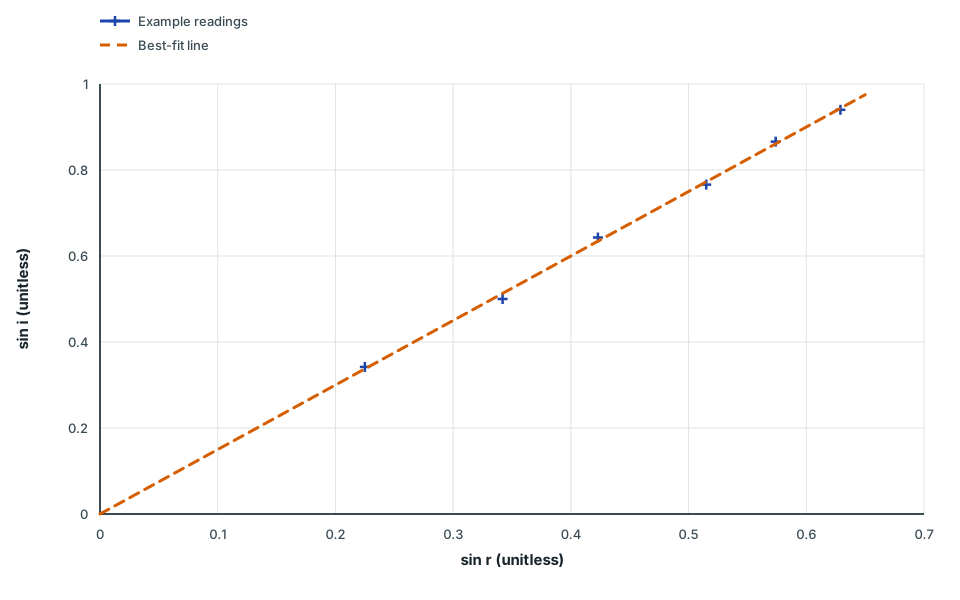
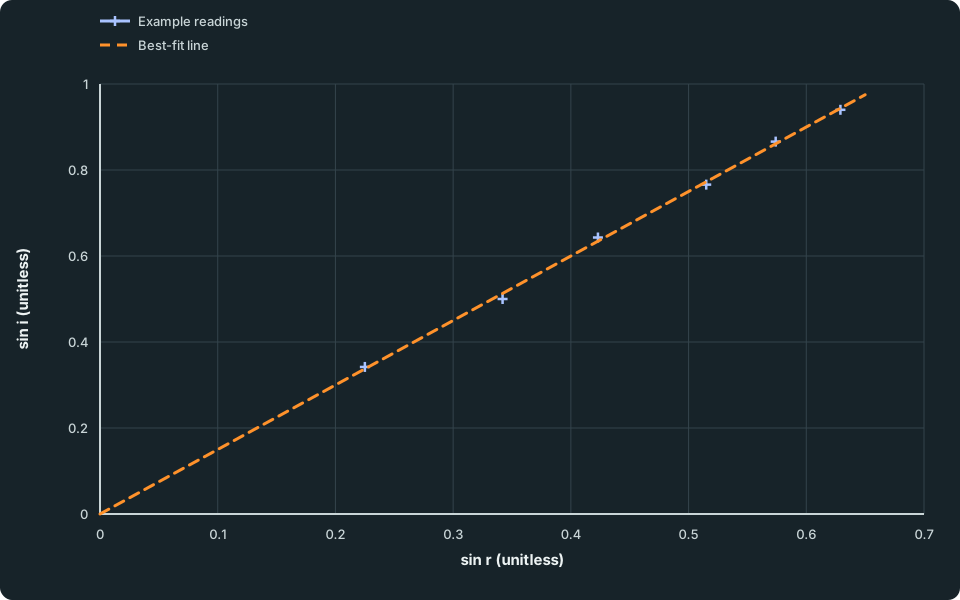
sin i against sin r for a glass block
Plotted points of sin i against sin r, both unitless, for angles of incidence from 20° to 70°, with a dashed best-fit straight line through the origin. The data table lists every plotted value.
Scroll across the figure to read all labels.
View figure data
| Series | sin r (unitless) | sin i (unitless) |
|---|---|---|
| Example readings | 0.225 | 0.342 |
| Example readings | 0.342 | 0.500 |
| Example readings | 0.423 | 0.643 |
| Example readings | 0.515 | 0.766 |
| Example readings | 0.574 | 0.866 |
| Example readings | 0.629 | 0.940 |
| Best-fit line | 0.000 | 0.000 |
| Best-fit line | 0.650 | 0.975 |
Worked example 1
Is sin i / sin r constant?
Problem
Use the graph of sin i against sin r to test whether sin i/sin r is constant for this block, and find the constant.
Show full solution
Describe the graph
Method
The points lie close to a straight line through the origin.
Reason
A straight line through the origin means sin i is proportional to sin r, so their ratio is constant.
Working
Answer
The graph uses all six rows at once, so one poor reading has less effect than it would on its own.
Find the gradient
Method
Read (0.100, 0.150) and (0.600, 0.900) from the line.Reason
The gradient of sin i against sin r is the constant ratio.Working
Answer
gradient = (0.900 - 0.150)/(0.600 - 0.100) = 0.750/0.500 = 1.50State the ratio
Working
Answer
The graph supports an approximately constant sin i/sin r of 1.50, with no unit, over the tested angles.
Quick check
Guided practice 2
Why is one ratio further from 1.50?
Problem
The i = 30° row gives 1.46, the value furthest from 1.50. Suppose the true angle of refraction was 19.5°. Calculate the ratio it would give, and explain why the same small reading error matters more in some rows than in others.
Try this before viewing the solution
Show the steps Optional working
Hints
Hint 1
size of the error
Rounding 19.5° to 20° is an error of 0.5°. What fraction of 20° is that, and what fraction of 39°?Show solution step by step
Recalculate
Method
Use the unrounded angle.Reason
In this hypothetical case, rounding a 19.5° angle to the nearest whole degree gives 20°.
Working
Answer
sin 30° ÷ sin 19.5° = 0.500 ÷ 0.334 = 1.50
Compare fractional angle errors
Method
A fixed error of about 0.5° is a larger fraction of a small angle.
Reason
0.5° is 2.5% of 20° but only about 1.3% of 39°.Working
Answer
“Rows with small angles are affected most. Use larger angles of incidence, draw thin lines, and use the gradient of the graph rather than one row.”
State the calculation and explanation
Working
Answer
The hypothetical 19.5° angle gives a ratio of 1.50. A fixed small angle-reading error has a larger fractional effect at small angles, so use a range of angles and the graph’s overall trend.
Quick check
Check your understanding 2 Explain the effect of a reading error
Why does a fixed angle-reading error matter more for a small angle than a large one? Suggest two ways to improve the estimate of the refractive index.
Show answer
A 0.5° error is 2.5% of 20° but only about 1.3% of 39°. Small angles have a larger fractional error, which affects the sine ratio more. Use a range of larger angles, thin pencil lines and accurate pin alignment. Estimate the index from the gradient of the graph of all readings rather than one ratio.
To extend the investigation, repeat it with a block of another transparent material, such as Perspex, and compare the two values of sin i/sin r.
Check your understanding 3 Compare a different block on reversed graph axes
For another block in air, n = sin i/sin r. A best-fit line plots sin r vertically against sin i horizontally, through (0.20, 0.16) and (0.70, 0.56). Calculate the gradient and n. Assume the line passes through the origin.
Show the steps Optional working
Show the steps Optional working
Show answer
Gradient = (0.56-0.16)/(0.70-0.20) = 0.80. Since sin r = (1/n) sin i, n = 1/0.80 = 1.25. Both quantities have no unit. Use the same surrounding medium and light source when comparing blocks; this index is smaller than the original glass block’s 1.50.
Check your understanding 4 Draw the reversed-axis graph
Plot the two supplied points on paper. Label the axes, draw the line through the origin and show a large gradient triangle. Compare your construction with the model criteria.
Show answer
Horizontal axis: sin i. Vertical axis: sin r. Both have no unit. The line through the origin passes through (0.20, 0.16) and (0.70, 0.56). Using these points, a gradient triangle has rise 0.40 and run 0.50. Its gradient is 0.80, which is 1/n on these axes.
Common mistakes
- Measuring the angle of refraction from the glass surface instead of from the normal inside the block.
- Judging the rule from one ratio instead of from the graph of all the readings.
- Letting the block move while placing the pins, so the outline no longer matches the surface the light crossed.
- Drawing the ray inside the block without joining the entry and exit points.
- Including normal incidence, where the ratio 0/0 cannot be calculated.
Spotted an error? Report a correction
Syllabus and review details
- SEC G3 Combined Science Physics component 2027 · 2027
Physics section, PDF pages 8–24
Last reviewed: