Sinusoidal Alternating Current & Voltage
Key idea: Use x = x0 sin(ωt) and ω = 2πf to find phase, period, frequency, peak values and instantaneous values in A Level sinusoidal a.c. questions.
Continue where you stopped
The core idea
On this page
Learning objectives
- Represent sinusoidal a.c. and use peak and r.m.s. values.
- Analyse mean power in resistive a.c. loads and half-wave rectification.
1. Definitions (Must Know)
A. Alternating current (a.c.)
Alternating current (a.c.) is a current that reverses direction periodically.
B. Period and frequency
- Period, T: time for one complete cycle (s).
- Frequency, f: number of cycles per second (Hz).
f = 1/T
C. Angular frequency, ω
Angular frequency, ω (rad s⁻¹):
ω = 2π f
D. Peak value (amplitude), x₀
Peak value (amplitude), x₀, is the maximum magnitude of a sinusoid (e.g. I₀ for current, V₀ for voltage).
E. Root-mean-square (r.m.s.) value
The r.m.s. value is the equivalent d.c. value that gives the same mean power in a resistor.
2. Key Ideas (What Earns Marks)
- A sinusoidal a.c. quantity can be represented by:
- x = x₀ sin(ω t)
- where x can be I or V.
- Converting between T, f and ω:
- T = 1/f, ω = 2π f, f = ω/2π
- For a sinusoidal wave:
- Iᵣₘₛ = I₀/(square root of 2), Vᵣₘₛ = V₀/(square root of 2)
- Quick checks:
- at t = 0: x = 0 (for the pure sin form)
- one full cycle: t = T = 2π/ω
Mains voltages quoted on appliances (e.g. 230 V) are almost always r.m.s. values, unless the question explicitly says “peak”.
3. Detailed Explanations
A. The sinusoidal model
Many a.c. supplies can be modelled as a sinusoid: x = x₀ sin(ω t)
Meaning:
- x₀ sets the maximum value
- ω sets how fast the oscillation happens
One cycle of sinusoidal a.c. (50 Hz example)
A single 50 Hz cycle of a sine wave showing peak values and the period.
Scroll across the graph to read all labels.
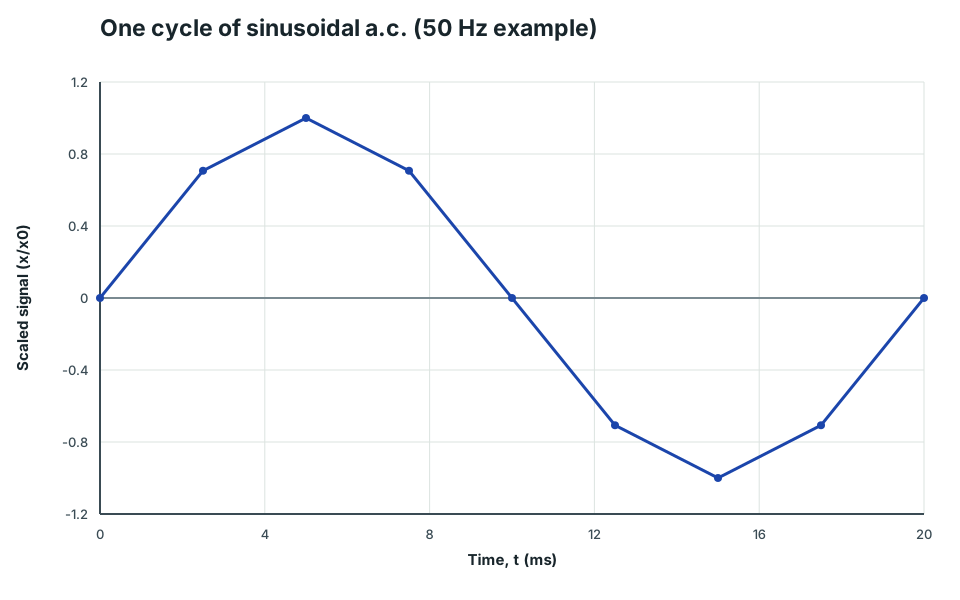
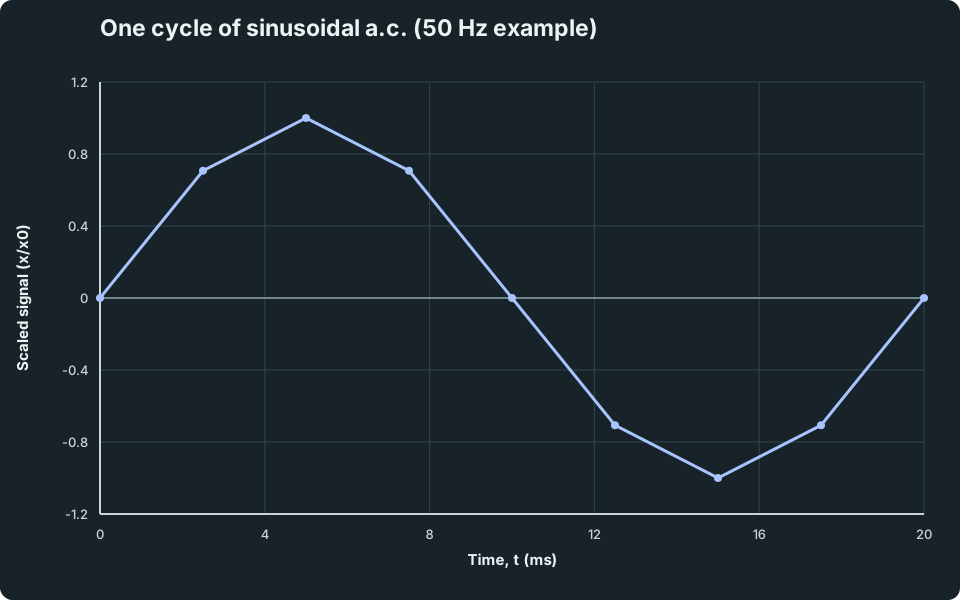
View figure data
| Time, t (ms) | x = x0 sin(ωt) |
|---|---|
| 0 | 0 |
| 2.5 | 0.707 |
| 5 | 1 |
| 7.5 | 0.707 |
| 10 | 0 |
| 12.5 | -0.707 |
| 15 | -1 |
| 17.5 | -0.707 |
| 20 | 0 |
B. Connecting angular frequency and frequency
One full cycle corresponds to a phase change of 2π radians.
If the angular frequency is ω rad s⁻¹, then the period is: T = 2π/ω
So: f = 1/T = ω/2π ⇒ ω = 2π f
C. Peak vs r.m.s.
For a sinusoidal a.c.: Iᵣₘₛ = I₀/(square root of 2), Vᵣₘₛ = V₀/(square root of 2)
These are the values used when calculating mean power in a purely resistive load: ⟨P⟩ = Iᵣₘₛ²R = Vᵣₘₛ²/R = IᵣₘₛVᵣₘₛ
The factors I₀/square root of 2 and V₀/square root of 2 apply to a sinusoidal waveform. For the general r.m.s. definition and non-sinusoidal boundary, continue to Root-Mean-Square Values.
AC Waveform & Power Explorer
Connect sinusoidal timing, r.m.s. values, resistive power and ideal half-wave output on synchronized graphs.
- Waveform Reading
- r.m.s. Values
- Resistive Power
- Rectification
4. Common Mistakes
- Using ω = 2f instead of ω = 2π f.
- Treating ω as “frequency” (it is rad s⁻¹, not Hz).
- Mixing degrees and radians when using calculator trig functions.
- Using peak values inside mean-power formulas instead of r.m.s. values.
5. Exam Tips
- State whether you are using peak or r.m.s. before substituting numbers.
- If you are asked for an equation, include the unit of ω (rad s⁻¹) in your working.
6. Worked Examples
Modelled example 1
Write the a.c. equation from peak value and frequency
Problem
Study the worked solution
Convert frequency to angular frequency
Method
Use ω = 2π f.Reason
Each cycle advances phase by 2π radians.Working
ω = 2π(50) = 100π rad s⁻¹Build the equation
Method
Insert peak and angular frequency into I = I₀ sin ω t.Reason
Zero phase starts at zero and increases positively.Working
I(t) = 5.0 sin(100π t) A
Guided practice 2
Find frequency from an a.c. equation
Problem
Try this before viewing the solution
Hints
Hint 1: read the coefficient of time
View solution step by step
Extract frequency
Method
Read ω = 400π and divide by 2π.Reason
Angular frequency counts phase radians per second.Working
f = 400π/2π = 200 HzFind period
Method
Take the reciprocal of frequency.Reason
Period is seconds per cycle.Working
T = 1/200 = 5.0 × 10⁻³ s
Common misconception 3
Convert between r.m.s. and peak voltage
Learner working
Try this before viewing the solution
View solution step by step
Reverse the r.m.s. relation
Method
Use V₀ = square root of 2 Vᵣₘₛ.Reason
Vᵣₘₛ = V₀/square root of 2 for a sinusoid.Working
V₀ = square root of 2 (230).Evaluate
Method
Obtain approximately 325 V.Reason
Peak magnitude must exceed the r.m.s. value.Working
V₀ = 3.25 × 10² V.
Examiner practice 4
Instantaneous current at a given time
Examination question
Try this before viewing the solution
View solution step by step
Convert time
1 markMethod
Use t = 2.5 × 10⁻³ s.Reason
The equation uses SI seconds.Working
t = 0.0025 s.Find phase
1 markMethod
Calculate 200π t = π/2.Reason
The sine argument is the phase in radians.Working
200π(0.0025) = π/2.Evaluate current
1 markMethod
Use sin(π/2) = 1.Reason
This instant is the positive peak.Working
I = 4.0 A.
Self-mark with the mark scheme
Compare your response with each mark point. Select a point only when your response contains that evidence.
Self-mark time, phase and value.
Challenge 5
Time to reach half the peak value
Inverse-time transfer
Try this before viewing the solution
Hints
Hint 1: solve for phase first
View solution step by step
Find the first phase
Method
Set sin(ω t) = 1/2 and use ω t = π/6.Reason
π/6 is the first positive sine solution.Working
ω t = π/6.Solve for time
Method
Divide by angular frequency.Reason
Phase grows at ω radians per second.Working
t = π/6ω
7. Mind Stretchers
Mind stretcher 1: Time for the first peakExtension
For x = x₀ sin(ω t), find the first time t > 0 when x = x₀.
Show Answer
Need sin(ω t) = 1, which first occurs at ω t = π/2. t = (π/2)/ω = π/2ω
Mind stretcher 2: Sine vs cosine formExtension
Show that x = x₀ cos(ω t) can be written as a sine function with a phase shift.
Show Answer
Use the identity cos(θ) = sin(θ + π/2): x = x₀ cos(ω t) = x₀ sin(ω t + π/2)
Mind stretcher 3: Optional (Enrichment)Extension
A. Phase constant (beyond the syllabus form)
Sometimes the sinusoid is written as:
x = x₀ sin(ω t + φ)
where φ is a phase constant that shifts the graph left/right. In this syllabus, you are usually given or asked to use the simpler form x = x₀ sin(ω t).
Continue with the next resource in this course.
Course and syllabus information
- Course
- GCE A-Level H2 Physics
- Edition
- GCE A-Level H2 Physics 2027