A Level Currents Hub
A Level Currents hub covering charge flow, drift velocity, energy per charge, electrical power, sinusoidal a.c., r.m.s. values and half-wave rectification.
Learning goals
- Relate current to charge flow, number density and drift velocity.
- Apply potential difference, e.m.f. and electrical power relationships.
- Represent sinusoidal a.c. and use peak and r.m.s. values.
- Analyse mean power in resistive a.c. loads and half-wave rectification.
Currents connects microscopic charge motion to electrical energy transfer, then extends the model to sinusoidal alternating current. Keep the energy story explicit: charge flows around a circuit, while sources and components transfer energy.
Prerequisites: O Level Current Electricity and basic sine-wave language from Oscillations.
Route: current and drift → energy per charge and power → sinusoidal a.c. → r.m.s. and mean power → half-wave rectification.
After this hub: take the A Level Currents Quiz, then attempt the Currents Structured Set.
Lessons
Work through these lessons in order.
- Charge flow, current and drift velocity
- Potential difference, power and e.m.f.
- Sinusoidal a.c., peak and r.m.s. values
- Mean a.c. power and half-wave rectification
- Drift Velocity & Current
Derive and use I = nAvq to link current, drift velocity, number density and cross-sectional area in exam-style A Level Physics questions and calculations.
- Potential Difference, E.M.F. & Electrical Power
Distinguish potential difference from e.m.f. using energy transferred per unit charge, then apply P = VI, P = I²R and P = V²/R.
- Sinusoidal Alternating Current & Voltage
Use x = x0 sin(ωt) and ω = 2πf to find phase, period, frequency, peak values and instantaneous values in A Level sinusoidal a.c. questions.
- Root-Mean-Square Values
Use r.m.s. current and voltage to calculate mean power in resistors, including I_rms = I0/√2 and V_rms = V0/√2 for sinusoidal a.c. (A Level Physics).
- Power Dissipation in a Resistive Load
Use Irms and Vrms to calculate mean power in resistors for sinusoidal AC, and relate this to instantaneous power p = vi in questions (A Level Physics).
- Half-Wave Rectification
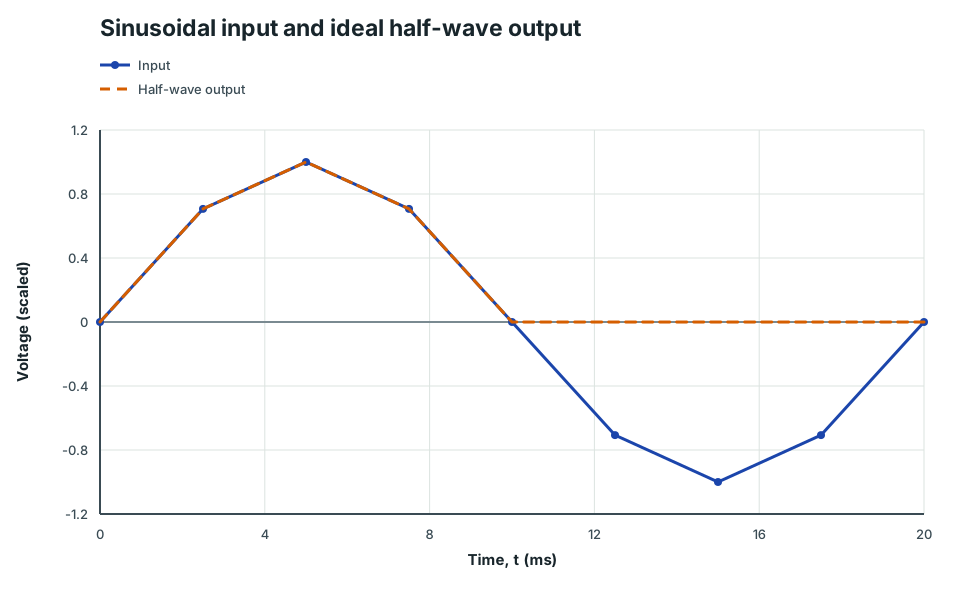
Explain half-wave rectification using a single diode and sketch the ideal sinusoidal input and pulsating output waveforms.
Revision
Quick reference
| Idea | Relationship | Meaning |
|---|---|---|
| Current | I = Q/t | charge passing per unit time |
| Drift current | I = nAvq | microscopic carrier model; use magnitudes in numerical work |
| E.m.f. | E = W_source/Q | energy supplied per unit charge |
| Potential difference | V = W_component/Q | energy transferred per unit charge |
| Electrical power | P = VI = I²R = V²/R | energy transferred per unit time |
| Sinusoidal a.c. | x = x₀ sin(ω t), ω = 2π f | alternating quantity and timing |
| Sinusoidal r.m.s. | Iᵣₘₛ = I₀/square root of 2, Vᵣₘₛ = V₀/square root of 2 | equal-heating d.c. value |
| Resistive a.c. power | ⟨P⟩ = (1/2)Pₘₐₓ | mean of sin² is 1/2 |
AC waveform and half-wave output
Sinusoidal input and ideal half-wave output
One input cycle showing that a single diode passes one half-cycle and blocks the other.
Scroll across the graph to read all labels.
View figure data
| Time, t (ms) | Input | Half-wave output |
|---|---|---|
| 0 | 0 | 0 |
| 2.5 | 0.707 | 0.707 |
| 5 | 1 | 1 |
| 7.5 | 0.707 | 0.707 |
| 10 | 0 | 0 |
| 12.5 | -0.707 | 0 |
| 15 | -1 | 0 |
| 17.5 | -0.707 | 0 |
| 20 | 0 | 0 |
Use the AC Waveform & Power Explorer to connect period, peak and r.m.s. values with the instantaneous power waveform.
Exam traps
- Current is not energy. Current measures charge flow; potential difference and e.m.f. measure energy per charge.
- Electron drift is opposite to conventional current in a metal.
- Peak is not r.m.s. The 1/square root of 2 shortcut applies to a complete sinusoid.
- Mean sinusoidal current is zero, but mean resistive power is not. Power depends on I².
- One diode does not produce steady d.c. It produces a pulsating half-wave output with one pulse per input cycle.
Practice
Use the quiz to diagnose gaps, then complete one structured question on drift current and one on a.c. or rectification.
Next hub: D.C. Circuits, where resistance, resistivity, internal resistance, Kirchhoff’s laws and potential dividers belong.
Continue with the next resource in this course.
Course and syllabus information
- Course
- GCE A-Level H2 Physics
- Edition
- GCE A-Level H2 Physics 2027