I–V characteristics and temperature
Key idea: Use V/I at an operating point to find resistance on an I–V curve. Heating raises a metal's resistance through scattering, but lowers an NTC thermistor's by increasing charge carriers.
Offline pages
Saved on this device only. Connect at least once every 30 days to confirm Premium. Sign-out or a change of account removes saved copies.
Loading guide controls…
Guided lessons · coming soon
Guided lesson
Guided steps
- Check the axes and compare the origin-to-point line with the tangent.
- Follow the coordinate ratio and compare it with the tangent result.
- Calculate the origin-to-point gradient and operating resistance.
- Connect each curve to its component and temperature conditions.
- Predict the fixed-temperature thermistor graphs before and after warming.
- Compare carrier number and drift speed at the same applied voltage.
- Find resistance when voltage is on the vertical axis.
- Explain how swapping axes changes the gradient’s meaning.
- Explain both temperature effects and the warmer thermistor graph.
On this page
You stopped at:
ContinueA graph of current against p.d., the I–V characteristic, is a fingerprint of a component. A resistor gives a straight line, a lamp a curve that flattens, a diode a sharp one-way bend. Each shape comes from what happens to the charge carriers inside, and especially from how the component responds to being heated.
Reading an I–V characteristic
On an I–V graph, the current I is plotted against the p.d. V. For an ohmic component, such as a metal wire at constant temperature, the graph is a straight line through the origin with gradient 1/R.
For a curved graph, the resistance at any point is still R = V/I, using the coordinates of that point. That is the reciprocal of the gradient of the line from the origin to the point, not of the tangent there. The tangent describes how the current responds to a small change in p.d., which is a different quantity.
Operating resistance and local tangent
A curved lamp I–V trace passes through P at 4 V and 0.5 A. A dashed line joins the origin to P and a dotted local tangent through P has a smaller gradient.
Scroll across the figure to read all labels.
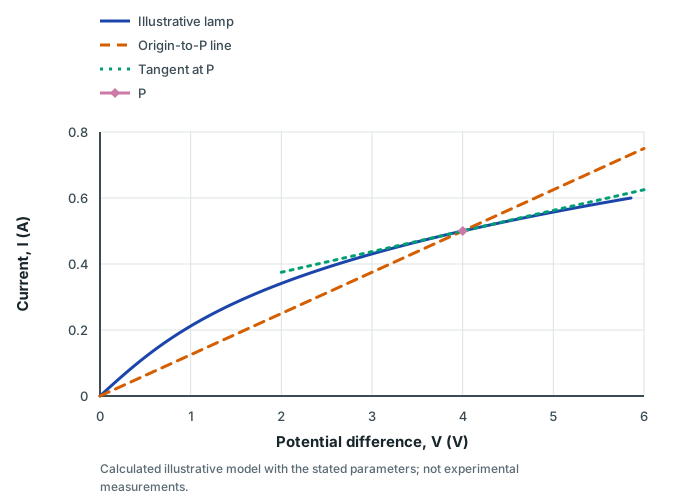
View figure data
| Series | Potential difference, V (V) | Current, I (A) |
|---|---|---|
| Illustrative lamp | 0.00000 | 0.0000 |
| Illustrative lamp | 0.01000 | 0.0025 |
| Illustrative lamp | 0.02000 | 0.0050 |
| Illustrative lamp | 0.03001 | 0.0075 |
| Illustrative lamp | 0.04002 | 0.0100 |
| Illustrative lamp | 0.05003 | 0.0125 |
| Illustrative lamp | 0.06005 | 0.0150 |
| Illustrative lamp | 0.07009 | 0.0175 |
| Illustrative lamp | 0.08013 | 0.0200 |
| Illustrative lamp | 0.09018 | 0.0225 |
| Illustrative lamp | 0.10025 | 0.0250 |
| Illustrative lamp | 0.11033 | 0.0275 |
| Illustrative lamp | 0.12043 | 0.0300 |
| Illustrative lamp | 0.13055 | 0.0325 |
| Illustrative lamp | 0.14069 | 0.0350 |
| Illustrative lamp | 0.15084 | 0.0375 |
| Illustrative lamp | 0.16102 | 0.0400 |
| Illustrative lamp | 0.17123 | 0.0425 |
| Illustrative lamp | 0.18146 | 0.0450 |
| Illustrative lamp | 0.19171 | 0.0475 |
| Illustrative lamp | 0.20200 | 0.0500 |
| Illustrative lamp | 0.21232 | 0.0525 |
| Illustrative lamp | 0.22266 | 0.0550 |
| Illustrative lamp | 0.23304 | 0.0575 |
| Illustrative lamp | 0.24346 | 0.0600 |
| Illustrative lamp | 0.25391 | 0.0625 |
| Illustrative lamp | 0.26439 | 0.0650 |
| Illustrative lamp | 0.27492 | 0.0675 |
| Illustrative lamp | 0.28549 | 0.0700 |
| Illustrative lamp | 0.29610 | 0.0725 |
| Illustrative lamp | 0.30675 | 0.0750 |
| Illustrative lamp | 0.31745 | 0.0775 |
| Illustrative lamp | 0.32819 | 0.0800 |
| Illustrative lamp | 0.33898 | 0.0825 |
| Illustrative lamp | 0.34983 | 0.0850 |
| Illustrative lamp | 0.36072 | 0.0875 |
| Illustrative lamp | 0.37166 | 0.0900 |
| Illustrative lamp | 0.38266 | 0.0925 |
| Illustrative lamp | 0.39372 | 0.0950 |
| Illustrative lamp | 0.40483 | 0.0975 |
| Illustrative lamp | 0.41600 | 0.1000 |
| Illustrative lamp | 0.42723 | 0.1025 |
| Illustrative lamp | 0.43852 | 0.1050 |
| Illustrative lamp | 0.44988 | 0.1075 |
| Illustrative lamp | 0.46130 | 0.1100 |
| Illustrative lamp | 0.47278 | 0.1125 |
| Illustrative lamp | 0.48433 | 0.1150 |
| Illustrative lamp | 0.49596 | 0.1175 |
| Illustrative lamp | 0.50765 | 0.1200 |
| Illustrative lamp | 0.51941 | 0.1225 |
| Illustrative lamp | 0.53125 | 0.1250 |
| Illustrative lamp | 0.54316 | 0.1275 |
| Illustrative lamp | 0.55515 | 0.1300 |
| Illustrative lamp | 0.56722 | 0.1325 |
| Illustrative lamp | 0.57937 | 0.1350 |
| Illustrative lamp | 0.59159 | 0.1375 |
| Illustrative lamp | 0.60390 | 0.1400 |
| Illustrative lamp | 0.61630 | 0.1425 |
| Illustrative lamp | 0.62878 | 0.1450 |
| Illustrative lamp | 0.64134 | 0.1475 |
| Illustrative lamp | 0.65400 | 0.1500 |
| Illustrative lamp | 0.66675 | 0.1525 |
| Illustrative lamp | 0.67958 | 0.1550 |
| Illustrative lamp | 0.69251 | 0.1575 |
| Illustrative lamp | 0.70554 | 0.1600 |
| Illustrative lamp | 0.71866 | 0.1625 |
| Illustrative lamp | 0.73187 | 0.1650 |
| Illustrative lamp | 0.74519 | 0.1675 |
| Illustrative lamp | 0.75861 | 0.1700 |
| Illustrative lamp | 0.77213 | 0.1725 |
| Illustrative lamp | 0.78575 | 0.1750 |
| Illustrative lamp | 0.79948 | 0.1775 |
| Illustrative lamp | 0.81331 | 0.1800 |
| Illustrative lamp | 0.82725 | 0.1825 |
| Illustrative lamp | 0.84131 | 0.1850 |
| Illustrative lamp | 0.85547 | 0.1875 |
| Illustrative lamp | 0.86974 | 0.1900 |
| Illustrative lamp | 0.88413 | 0.1925 |
| Illustrative lamp | 0.89864 | 0.1950 |
| Illustrative lamp | 0.91326 | 0.1975 |
| Illustrative lamp | 0.92800 | 0.2000 |
| Illustrative lamp | 0.94286 | 0.2025 |
| Illustrative lamp | 0.95784 | 0.2050 |
| Illustrative lamp | 0.97295 | 0.2075 |
| Illustrative lamp | 0.98818 | 0.2100 |
| Illustrative lamp | 1.00353 | 0.2125 |
| Illustrative lamp | 1.01901 | 0.2150 |
| Illustrative lamp | 1.03463 | 0.2175 |
| Illustrative lamp | 1.05037 | 0.2200 |
| Illustrative lamp | 1.06624 | 0.2225 |
| Illustrative lamp | 1.08225 | 0.2250 |
| Illustrative lamp | 1.09839 | 0.2275 |
| Illustrative lamp | 1.11467 | 0.2300 |
| Illustrative lamp | 1.13109 | 0.2325 |
| Illustrative lamp | 1.14765 | 0.2350 |
| Illustrative lamp | 1.16434 | 0.2375 |
| Illustrative lamp | 1.18118 | 0.2400 |
| Illustrative lamp | 1.19817 | 0.2425 |
| Illustrative lamp | 1.21530 | 0.2450 |
| Illustrative lamp | 1.23257 | 0.2475 |
| Illustrative lamp | 1.25000 | 0.2500 |
| Illustrative lamp | 1.26758 | 0.2525 |
| Illustrative lamp | 1.28530 | 0.2550 |
| Illustrative lamp | 1.30318 | 0.2575 |
| Illustrative lamp | 1.32122 | 0.2600 |
| Illustrative lamp | 1.33941 | 0.2625 |
| Illustrative lamp | 1.35775 | 0.2650 |
| Illustrative lamp | 1.37626 | 0.2675 |
| Illustrative lamp | 1.39493 | 0.2700 |
| Illustrative lamp | 1.41376 | 0.2725 |
| Illustrative lamp | 1.43275 | 0.2750 |
| Illustrative lamp | 1.45191 | 0.2775 |
| Illustrative lamp | 1.47123 | 0.2800 |
| Illustrative lamp | 1.49072 | 0.2825 |
| Illustrative lamp | 1.51039 | 0.2850 |
| Illustrative lamp | 1.53022 | 0.2875 |
| Illustrative lamp | 1.55022 | 0.2900 |
| Illustrative lamp | 1.57040 | 0.2925 |
| Illustrative lamp | 1.59076 | 0.2950 |
| Illustrative lamp | 1.61129 | 0.2975 |
| Illustrative lamp | 1.63200 | 0.3000 |
| Illustrative lamp | 1.65289 | 0.3025 |
| Illustrative lamp | 1.67396 | 0.3050 |
| Illustrative lamp | 1.69522 | 0.3075 |
| Illustrative lamp | 1.71666 | 0.3100 |
| Illustrative lamp | 1.73828 | 0.3125 |
| Illustrative lamp | 1.76009 | 0.3150 |
| Illustrative lamp | 1.78210 | 0.3175 |
| Illustrative lamp | 1.80429 | 0.3200 |
| Illustrative lamp | 1.82667 | 0.3225 |
| Illustrative lamp | 1.84925 | 0.3250 |
| Illustrative lamp | 1.87202 | 0.3275 |
| Illustrative lamp | 1.89499 | 0.3300 |
| Illustrative lamp | 1.91816 | 0.3325 |
| Illustrative lamp | 1.94153 | 0.3350 |
| Illustrative lamp | 1.96509 | 0.3375 |
| Illustrative lamp | 1.98886 | 0.3400 |
| Illustrative lamp | 2.01284 | 0.3425 |
| Illustrative lamp | 2.03702 | 0.3450 |
| Illustrative lamp | 2.06140 | 0.3475 |
| Illustrative lamp | 2.08600 | 0.3500 |
| Illustrative lamp | 2.11081 | 0.3525 |
| Illustrative lamp | 2.13582 | 0.3550 |
| Illustrative lamp | 2.16105 | 0.3575 |
| Illustrative lamp | 2.18650 | 0.3600 |
| Illustrative lamp | 2.21216 | 0.3625 |
| Illustrative lamp | 2.23803 | 0.3650 |
| Illustrative lamp | 2.26413 | 0.3675 |
| Illustrative lamp | 2.29045 | 0.3700 |
| Illustrative lamp | 2.31699 | 0.3725 |
| Illustrative lamp | 2.34375 | 0.3750 |
| Illustrative lamp | 2.37074 | 0.3775 |
| Illustrative lamp | 2.39795 | 0.3800 |
| Illustrative lamp | 2.42539 | 0.3825 |
| Illustrative lamp | 2.45307 | 0.3850 |
| Illustrative lamp | 2.48097 | 0.3875 |
| Illustrative lamp | 2.50910 | 0.3900 |
| Illustrative lamp | 2.53747 | 0.3925 |
| Illustrative lamp | 2.56608 | 0.3950 |
| Illustrative lamp | 2.59492 | 0.3975 |
| Illustrative lamp | 2.62400 | 0.4000 |
| Illustrative lamp | 2.65332 | 0.4025 |
| Illustrative lamp | 2.68288 | 0.4050 |
| Illustrative lamp | 2.71269 | 0.4075 |
| Illustrative lamp | 2.74274 | 0.4100 |
| Illustrative lamp | 2.77303 | 0.4125 |
| Illustrative lamp | 2.80357 | 0.4150 |
| Illustrative lamp | 2.83437 | 0.4175 |
| Illustrative lamp | 2.86541 | 0.4200 |
| Illustrative lamp | 2.89670 | 0.4225 |
| Illustrative lamp | 2.92825 | 0.4250 |
| Illustrative lamp | 2.96005 | 0.4275 |
| Illustrative lamp | 2.99211 | 0.4300 |
| Illustrative lamp | 3.02443 | 0.4325 |
| Illustrative lamp | 3.05701 | 0.4350 |
| Illustrative lamp | 3.08984 | 0.4375 |
| Illustrative lamp | 3.12294 | 0.4400 |
| Illustrative lamp | 3.15631 | 0.4425 |
| Illustrative lamp | 3.18994 | 0.4450 |
| Illustrative lamp | 3.22383 | 0.4475 |
| Illustrative lamp | 3.25800 | 0.4500 |
| Illustrative lamp | 3.29244 | 0.4525 |
| Illustrative lamp | 3.32714 | 0.4550 |
| Illustrative lamp | 3.36212 | 0.4575 |
| Illustrative lamp | 3.39738 | 0.4600 |
| Illustrative lamp | 3.43291 | 0.4625 |
| Illustrative lamp | 3.46871 | 0.4650 |
| Illustrative lamp | 3.50480 | 0.4675 |
| Illustrative lamp | 3.54117 | 0.4700 |
| Illustrative lamp | 3.57782 | 0.4725 |
| Illustrative lamp | 3.61475 | 0.4750 |
| Illustrative lamp | 3.65197 | 0.4775 |
| Illustrative lamp | 3.68947 | 0.4800 |
| Illustrative lamp | 3.72726 | 0.4825 |
| Illustrative lamp | 3.76535 | 0.4850 |
| Illustrative lamp | 3.80372 | 0.4875 |
| Illustrative lamp | 3.84238 | 0.4900 |
| Illustrative lamp | 3.88134 | 0.4925 |
| Illustrative lamp | 3.92060 | 0.4950 |
| Illustrative lamp | 3.96015 | 0.4975 |
| Illustrative lamp | 4.00000 | 0.5000 |
| Illustrative lamp | 4.04015 | 0.5025 |
| Illustrative lamp | 4.08060 | 0.5050 |
| Illustrative lamp | 4.12136 | 0.5075 |
| Illustrative lamp | 4.16242 | 0.5100 |
| Illustrative lamp | 4.20378 | 0.5125 |
| Illustrative lamp | 4.24545 | 0.5150 |
| Illustrative lamp | 4.28744 | 0.5175 |
| Illustrative lamp | 4.32973 | 0.5200 |
| Illustrative lamp | 4.37233 | 0.5225 |
| Illustrative lamp | 4.41525 | 0.5250 |
| Illustrative lamp | 4.45848 | 0.5275 |
| Illustrative lamp | 4.50203 | 0.5300 |
| Illustrative lamp | 4.54590 | 0.5325 |
| Illustrative lamp | 4.59009 | 0.5350 |
| Illustrative lamp | 4.63459 | 0.5375 |
| Illustrative lamp | 4.67942 | 0.5400 |
| Illustrative lamp | 4.72458 | 0.5425 |
| Illustrative lamp | 4.77006 | 0.5450 |
| Illustrative lamp | 4.81586 | 0.5475 |
| Illustrative lamp | 4.86200 | 0.5500 |
| Illustrative lamp | 4.90847 | 0.5525 |
| Illustrative lamp | 4.95526 | 0.5550 |
| Illustrative lamp | 5.00239 | 0.5575 |
| Illustrative lamp | 5.04986 | 0.5600 |
| Illustrative lamp | 5.09766 | 0.5625 |
| Illustrative lamp | 5.14579 | 0.5650 |
| Illustrative lamp | 5.19427 | 0.5675 |
| Illustrative lamp | 5.24309 | 0.5700 |
| Illustrative lamp | 5.29225 | 0.5725 |
| Illustrative lamp | 5.34175 | 0.5750 |
| Illustrative lamp | 5.39160 | 0.5775 |
| Illustrative lamp | 5.44179 | 0.5800 |
| Illustrative lamp | 5.49233 | 0.5825 |
| Illustrative lamp | 5.54323 | 0.5850 |
| Illustrative lamp | 5.59447 | 0.5875 |
| Illustrative lamp | 5.64606 | 0.5900 |
| Illustrative lamp | 5.69801 | 0.5925 |
| Illustrative lamp | 5.75032 | 0.5950 |
| Illustrative lamp | 5.80298 | 0.5975 |
| Illustrative lamp | 5.85600 | 0.6000 |
| Origin-to-P line | 0.00000 | 0.0000 |
| Origin-to-P line | 6.00000 | 0.7500 |
| Tangent at P | 2.00000 | 0.3750 |
| Tangent at P | 6.00000 | 0.6250 |
| P | 4.00000 | 0.5000 |
Worked example 1
Point or tangent?
Problem
On the lamp graph above, point P is at V = 4.00 V, I = 0.500 A. The tangent at P has a gradient of 0.0625 A V⁻¹. Find the resistance of the lamp at P.
Show full solution
Use the coordinates
Method
Divide the p.d. at P by the current at P.Reason
Resistance is defined as V/I at the operating point.Working
Answer
R = 4.00/0.500 = 8.00 Ω
The tangent
Working
Answer
1/0.0625 = 16.0 Ω is not the resistance at P; it describes the response to a small change near P.
Quick check
The line from the origin to P has gradient 0.500/4.00 = 0.125 A V⁻¹, whose reciprocal is the 8.00 Ω found above.
Guided practice 2
Another curved graph
Problem
At one point on a component’s I–V graph, V = 6.0 V and I = 0.20 A. The tangent there has a gradient of 0.020 A V⁻¹. Find the resistance of the component at that point.
Find R
Show the steps Optional working
Hints
Hint 1
definition
R = V/I at the point. The tangent gradient is not needed.
Show full solution
Resistance
Working
Answer
R = 6.0/0.20 = 30 Ω. The tangent would give 50 Ω, which is not the resistance.
Four components
Ohmic resistor. At constant temperature, I is proportional to V: a straight line through the origin.
Filament lamp. As the current increases, the filament gets hotter and its resistance rises. Each extra volt adds less current than the one before, so the graph curves and flattens. It is the same for either direction of current.
Semiconductor diode. In one direction (forward bias) the current is tiny until the p.d. reaches a few tenths of a volt, then rises very steeply. In the other direction (reverse bias) the current is almost zero. In its normal operating range it conducts readily in forward bias and has only a tiny reverse current; large reverse p.d.s can cause breakdown.
Semiconductor diode I–V characteristic
An illustrative diode characteristic with negligible reverse current and a rapidly increasing forward current after the knee region.
Scroll across the figure to read all labels.
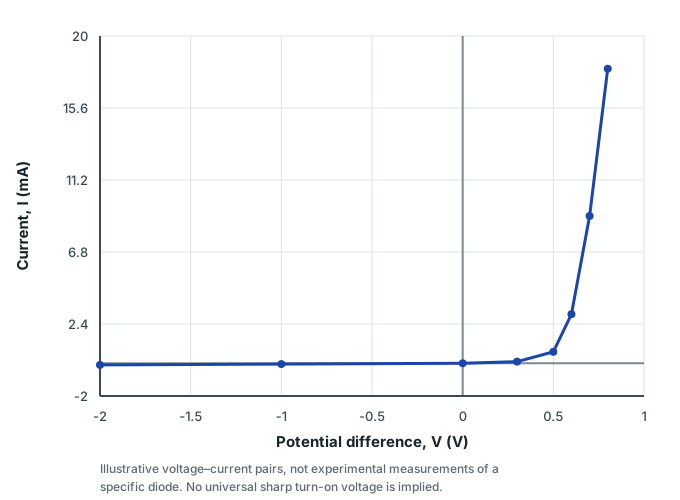
View figure data
| Potential difference, V (V) | Diode |
|---|---|
| -2.0 | -0.10 |
| -1.0 | -0.05 |
| 0.0 | 0.00 |
| 0.3 | 0.10 |
| 0.5 | 0.70 |
| 0.6 | 3.00 |
| 0.7 | 9.00 |
| 0.8 | 18.00 |
NTC thermistor. Its resistance falls as its temperature rises (negative temperature coefficient). If the current heats it noticeably, its resistance falls as the p.d. increases, so the graph curves upwards, getting steeper. At a fixed temperature, with currents too small to heat it, its I–V graph is close to a straight line, and the line is steeper at a higher temperature.
Check your understanding 1 Separate heating from the temperature setting
An NTC thermistor is held at a constant temperature while small currents are used. Predict the shape of its I–V graph. Then predict how that graph changes when the thermistor is held at a higher temperature.
Show answer
At each fixed temperature the low-current graph is approximately straight through the origin. The warmer graph is steeper because R is smaller. An upward-curving sweep can occur when the measuring current itself changes the temperature.
Why temperature changes resistance
The current in a conductor is I = nAvq, where n is the number of charge carriers per unit volume and v is their drift velocity. Compare the current produced by the same p.d. at two temperatures.
Metals (filament lamp). A metal already has a huge number of free electrons, and heating hardly changes it. But the atoms of a hotter metal vibrate more, so the electrons collide with them more often and their drift velocity is lower. The current is smaller for the same p.d., so the resistivity rises.
Semiconductors (NTC thermistor). A semiconductor has far fewer free charge carriers. Heating gives more electrons enough energy to break free, so the number density of carriers increases sharply. This outweighs the extra collisions, so the current is larger for the same p.d. and the resistivity falls.
Check your understanding 2 Reverse the graph axes
A graph plots V vertically and I horizontally. At point P the coordinates are I = 0.40 A and V = 8.0 V, while the tangent gradient is 35 V A⁻¹. Find the operating resistance. On paper, draw the line from the origin to P and explain how its gradient gives the resistance for these axes.
Show answer
R = 8.0/0.40 = 20 Ω. The origin-to-P line has gradient 20 V A⁻¹; for these reversed axes it equals R, rather than 1/R. The tangent gradient is not the operating resistance.
Check your understanding 3 Explain what the axes change
Compare how you find operating resistance from an I-against-V graph and a V-against-I graph. Compare the line from the origin with the tangent. Keep your sketch on paper.
Show answer
Check the axes first. With I vertical the origin-to-point gradient is I/V = 1/R. With V vertical it is V/I = R. On a curved graph the tangent describes small changes and cannot replace the coordinate ratio.
Exam-style question 1
Warming a metal and a thermistor
Examination question
A metal wire and an NTC thermistor are both warmed.
(a) Explain, in terms of charge carriers, why the resistivity of the metal increases. [2 marks]
(b) Explain, in terms of charge carriers, why the resistivity of the thermistor decreases. [2 marks]
(c) At a fixed temperature the thermistor is ohmic. State how its I–V graph changes when it is warmed. [1 mark]
Write your answer before viewing the mark scheme
Show solution step by step
(a) Metal
2 marksMethod
Use I = nAvq and decide which factor changes.Reason
In a metal the number of free electrons hardly changes, so the effect must come from the drift velocity.Working
Answer
The atoms vibrate more, so electrons collide with them more often and their drift velocity is lower for the same p.d. The current is smaller, so the resistivity is larger.
(b) Thermistor
2 marksReason
In a semiconductor the number of carriers is very sensitive to temperature.Working
Answer
More charge carriers are freed, so the number density n increases sharply, outweighing the extra collisions. The current is larger for the same p.d., so the resistivity is smaller.
(c) Graph
1 markWorking
Answer
It is still a straight line through the origin, but steeper, because its gradient is 1/R and R is smaller.
Self-mark with the mark scheme
Tick each mark point that your answer includes.
Tick each point only if your answer states it clearly.
Common mistakes
- Finding the resistance at a point on a curve from the gradient of the tangent instead of V/I.
- Explaining a lamp’s rising resistance by “fewer electrons”; the number stays about the same, but their drift velocity falls.
- Explaining a thermistor’s falling resistance by “electrons move faster”; it is the number of charge carriers that rises.
- Drawing a diode that conducts equally well in both directions.
Spotted an error? Report a correction
Syllabus and review details
- GCE A-Level H2 Physics 2027 · 2027
Content Overview, PDF pages 9–10; Subject Content, PDF pages 11–30
Last reviewed: