Electric Potential
Key idea: Define electric potential as work done per unit charge from infinity, use V = (1/4πϵ0)Q/r, and apply E = −dV/dr (A Level Physics).
Continue where you stopped
The core idea
On this page
Learning objectives
- Define electric potential and calculate potential due to point charges.
- Use the negative potential gradient and relate equipotentials to field lines.
1. Definitions (Must Know)
A. Electric potential, V
Electric potential, V, at a point is the work done per unit charge by an external force in bringing a small positive test charge from infinity to that point (slowly, so its kinetic energy does not change).
V = W/q
Unit: volt (V), where 1 V = 1 J C⁻¹.
B. Electric potential due to a point charge
For a point charge Q in free space / air:
V = (1/4πε₀)Q/r
where r is distance from Q.
Sign: V has the same sign as Q.
C. Potential difference
The potential difference between points A and B is:
Δ V = V_B - V_A
Work done by an external force to move a charge q slowly from A to B is:
Wₑₓₜ = qΔ V
2. Key Ideas (What Earns Marks)
- V is a scalar. It can be positive or negative.
- For a point charge: V ∝ 1/r (not 1/r²).
- Electric field strength is the negative potential gradient: E = -dV/dr
- In a uniform field (parallel plates), magnitude relationship: E = (Δ V)/d
Electric field lines point in the direction a positive test charge would accelerate. That is the direction of decreasing potential: vector E points “downhill” on the V landscape.
For a point charge, potential varies as 1/r while field varies as 1/r². Use V first for energy-per-charge steps, then use gradient ideas for E when needed.
3. Detailed Explanations
A. Potential vs field strength (quick contrast)
| Quantity | Meaning | Typical formula (point charge) |
|---|---|---|
| Electric potential, V | energy per unit charge | V = kQ/r |
| Electric field strength, E | force per unit charge | E = kQ/r² |
where k = 1/4πε₀.
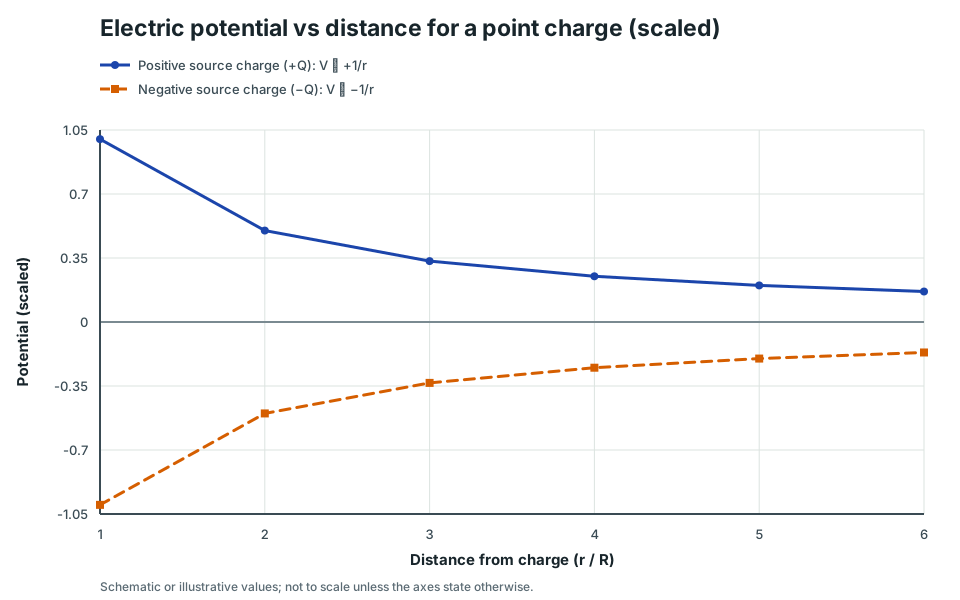
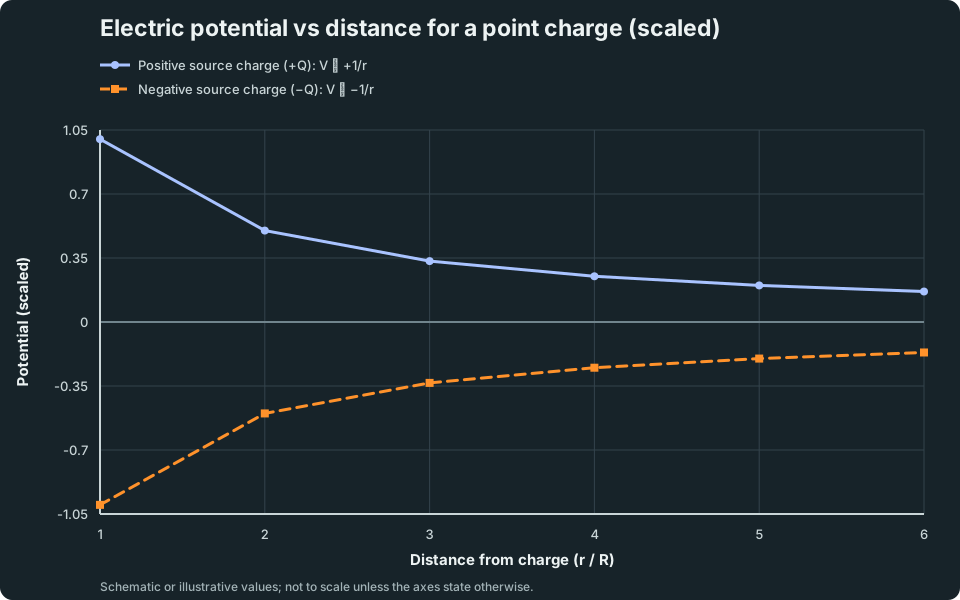
Graph intuition: V vs r (including sign)
Potential falls as 1/r, and it keeps the sign of the source charge Q. That means:
- near a positive charge, V is positive and decreases towards 0 as r increases,
- near a negative charge, V is negative and increases towards 0 as r increases.
Electric potential vs distance for a point charge (scaled)
Two curves showing V proportional to +1/r for a positive source charge and proportional to −1/r for a negative source charge.
Scroll across the graph to read all labels.
View figure data
| Distance from charge (r / R) | Positive source charge (+Q): V ∝ +1/r | Negative source charge (−Q): V ∝ −1/r |
|---|---|---|
| 1 | 1 | -1 |
| 2 | 0.5 | -0.5 |
| 3 | 0.333 | -0.333 |
| 4 | 0.25 | -0.25 |
| 5 | 0.2 | -0.2 |
| 6 | 0.1667 | -0.1667 |
B. Using E = -dV/dr (syllabus link)
Start from:
V = (1/4πε₀)Q/r
Differentiate with respect to r:
dV/dr = -(1/4πε₀)Q/r²
So:
E = -dV/dr = (1/4πε₀)Q/r²
This shows:
- the inverse-square dependence for E,
- the “downhill” direction: vector E points towards lower V.
C. What potential tells you about energy
Once you know V, you can find the potential energy change of a charge q between two points:
Δ U = qΔ V
If the field does the work (no external force), then:
W_field = -Δ U = -qΔ V
4. Common Mistakes
- Using V = kQ/r² (wrong power).
- Writing V = Er for a point charge (only use E = Δ V/d for uniform fields).
- Forgetting V can be negative.
- Mixing up V (potential) and U (potential energy).
5. Exam Tips
- State the reference: “V = 0 at infinity”.
- For energy changes, write Δ U = qΔ V first. Then W_field = -Δ U and, for slow motion, Wₑₓₜ = Δ U.
- For graphs: if you are given a V–r graph, the gradient gives -E.
6. Worked Examples
Modelled example 1
Potential due to a point charge
Problem
Study the worked solution
Select the point-charge relation
Method
Use V = kQ/r with the signed source charge.Reason
Potential is scalar and varies as 1/r.Working
V = ((8.99 × 10⁹)(6.0 × 10⁻⁹))/0.30Evaluate and retain sign
Method
Obtain + 180 V.Reason
A positive source has positive potential relative to infinity.Working
V = +180 V
Guided practice 2
Work done moving a charge through a p.d.
Problem
Try this before viewing the solution
Hints
Hint 1: signed potential change
Hint 2: slow-motion energy relation
View solution step by step
Find the potential change
Method
Subtract initial potential from final potential.Reason
Energy changes use final minus initial.Working
Δ V = 20-120 = -100 VCalculate external work
Method
Multiply by the signed charge.Reason
For slow motion, external work equals Δ U.Working
Wₑₓₜ = (-2.0 × 10⁻⁶)(-100) = 2.0 × 10⁻⁴ J
Common misconception 3
Using the gradient idea
Learner claim
Try this before viewing the solution
View solution step by step
Infer the radius change
Method
Double the radius.Reason
V ∝ 1/r for a point charge.Working
V₂/V₁ = 1/2 ⇒ r₂/r₁ = 2.Apply field scaling
Method
Quarter the field magnitude.Reason
E ∝ 1/r², consistent with the potential gradient.Working
E₂/E₁ = (r₁/r₂)² = (1/2)² = 1/4
Examiner practice 4
Superposition of potentials (two charges)
Examination question
Try this before viewing the solution
View solution step by step
Write scalar superposition
1 markMethod
Add signed contributions.Reason
Potential is scalar, so no direction resolution is needed.Working
V = k(Q₁/r₁ + Q₂/r₂)Use equal distances and opposite charges
1 markMethod
Substitute the two contributions.Reason
Their magnitudes match and signs differ.Working
V = k((4.0 × 10⁻⁹)/0.20-(4.0 × 10⁻⁹)/0.20)State the result
1 markMethod
Obtain 0 V.Reason
The scalar potential contributions cancel.Working
V = 0 V.
Self-mark with the mark scheme
Compare your response with each mark point. Select a point only when your response contains that evidence.
Self-mark signed scalar relation, substitution and result.
Challenge 5
Find charge from a known potential
Independent transfer
Try this before viewing the solution
Hints
Hint 1: retain the potential sign
View solution step by step
Rearrange
Method
Make source charge the subject.Reason
Potential is directly proportional to signed Q.Working
Q = Vr/kEvaluate and interpret
Method
Obtain + 2.00 × 10⁻⁸ C = +20 nC.Reason
Positive potential relative to infinity implies a positive isolated source charge.Working
Q = (360)(0.50)/(8.99 × 10⁹) = +20 nC
7. Mind Stretchers
Mind stretcher 1: Equipotentials are perpendicular to field linesExtension
Explain why equipotential surfaces are perpendicular to electric field lines.
Show Answer
Along an equipotential surface, Δ V = 0, so Δ U = qΔ V = 0 and W_field = -Δ U = 0.
If the electric field had a component along the surface, it would do work on a charge moving along the surface. Therefore, the field must have no tangential component: it must be perpendicular to the equipotential surface.
Mind stretcher 2: Same radius means same potentialExtension
Two points are the same distance from a point charge Q. Compare their potentials and explain.
Show Answer
For a point charge, V = kQ/r depends only on r. If the two points have the same r, they have the same potential (they lie on the same equipotential surface).
Mind stretcher 3: Optional (Enrichment)Extension
A. Potential as a line integral (calculus form)
Sometimes you will see:
Δ V = -∫ vector E · d vector r
This is a compact way to connect potential difference to the electric field along a path. For A Level questions here, you typically use V = kQ/r, E = kQ/r², and E = -dV/dr.
Mind stretcher 4: Simulation Bridge: Electric Field ExplorerExtension
Concept Explorer: Electric Field Explorer
Switch between parallel-plate and point-charge models, move the probe, and test E-V-r relationships with guided prompts.
- E = V/d
- V = kQ/r
- E = kQ/r²
- Field Direction
Explore field and potential in the Electric Field Explorer.
8. Practice (Quiz)
Practice point-charge potential and E = -dV/dr questions:
A Level Electric Fields QuizContinue with the next resource in this course.
Course and syllabus information
- Course
- GCE A-Level H2 Physics
- Edition
- GCE A-Level H2 Physics 2027