A Level Electric Fields Hub
A Level Physics electric fields hub: Coulomb's Law, electric potential, uniform fields, and capacitance.
Learning goals
- Apply Coulomb's law to the force between point charges.
- Define electric field strength and calculate resultant fields due to point charges.
- Define electric potential and calculate potential due to point charges.
- Relate electric potential, potential energy and work for systems of point charges.
- Use the negative potential gradient and relate equipotentials to field lines.
- Calculate field strength and force in uniform electric fields.
- Analyse charged-particle motion in uniform electric fields.
- Apply capacitance and capacitor-energy relationships.
Electric Fields connects force, energy and motion through two linked descriptions: the vector field vector E and the scalar potential V. Follow the route below in order so that point-charge, uniform-field and capacitor equations are used with the correct model and sign convention.
Understand first: revise field lines in O-Level Static Electricity, vector addition in Vector Addition and Components, and the field–potential analogy in Gravitation.
Common mark-loss errors: confusing E ∝ 1/r² with V ∝ 1/r, treating potential as a vector, reversing electron force direction, and writing W_field = qΔ V instead of W_field = -qΔ V.
Lessons
Work through these lessons in order.
- Coulomb force between point charges
- Electric field strength due to a point charge
- Potential, potential energy and negative gradient
- Uniform fields, force and charged-particle motion
- Capacitance and stored electric potential energy
- Coulomb's Law
Use Coulomb’s law to calculate the electric force between point charges, including direction (attraction/repulsion) and inverse-square scaling (A Level Physics).
- Electric Field Strength of a Point Charge
Define electric field strength, calculate the field due to point charges, determine direction, and apply vector superposition.
- Electric Potential
Define electric potential as work done per unit charge from infinity, use V = (1/4πϵ0)Q/r, and apply E = −dV/dr (A Level Physics).
- Electric Potential Energy
Relate electric potential energy to potential using U = qV, use U = kQq/r for point charges, and apply work–energy links for moving charges (A Level Physics).
- Equipotential Lines
Explain equipotential lines/surfaces, relate them to electric field lines, and use E as the negative potential gradient (A Level Physics).
- Uniform Electric Fields (Parallel Plates)
Use E = V/d and F = qE to analyse uniform electric fields and the motion of charged particles between parallel plates (A Level Physics).
- Acceleration Due to an Electric Field
Use F = qE and a = qE/m for charged particles in uniform fields, including kinematics and energy methods (A Level Physics).
- Capacitance
Use C = Q/V and the V–Q graph area to solve capacitance and energy stored in a capacitor questions (A Level Physics).
- Questions for Electric Field (JC) Set 1
A Level Physics electric fields practice questions (JC Set 1), with worked answers.
Revision
Quick Reference
| Quantity | Point-charge formula | Uniform-field formula |
|---|---|---|
| Force (F) | F = (| Qq|)/(4πε₀ r²) | vector F = q vector E |
| Field strength (E) | E = (| Q|)/(4πε₀ r²) | | E| = (|Δ V|)/d |
| Potential (V) | V = Q/(4πε₀ r) | Δ V = -EₓΔ x |
| Potential energy (U) | U = Qq/(4πε₀ r) | U = qV |
Capacitor: C = Q/V, Energy U = (1/2)CV²
Exam Templates (fast marks)
Point charge questions
- Sketch the situation and define r (centre-to-centre distance).
- Use either F = Qq/(4πε₀ r²) or E = Q/(4πε₀ r²), then link with F = qE.
- Add direction: field points away from + charge and toward − charge; force direction depends on sign of test charge.
Uniform field between plates
- Use E = V/d (magnitude) and decide sign with a chosen axis.
- Force: F = qE; acceleration: a = qE/m.
- Treat motion like a projectile: constant horizontal velocity, constant vertical acceleration.
Energy and potential
- Potential-energy change: Δ U = qΔ V.
- Work done by the field: W_field = -Δ U = -qΔ V; slow external work is the opposite.
- For capacitors: U = (1/2)CV² = (1/2)QV = Q²/2C (choose the form with known quantities).
Graph Skills (Exam + Practical)
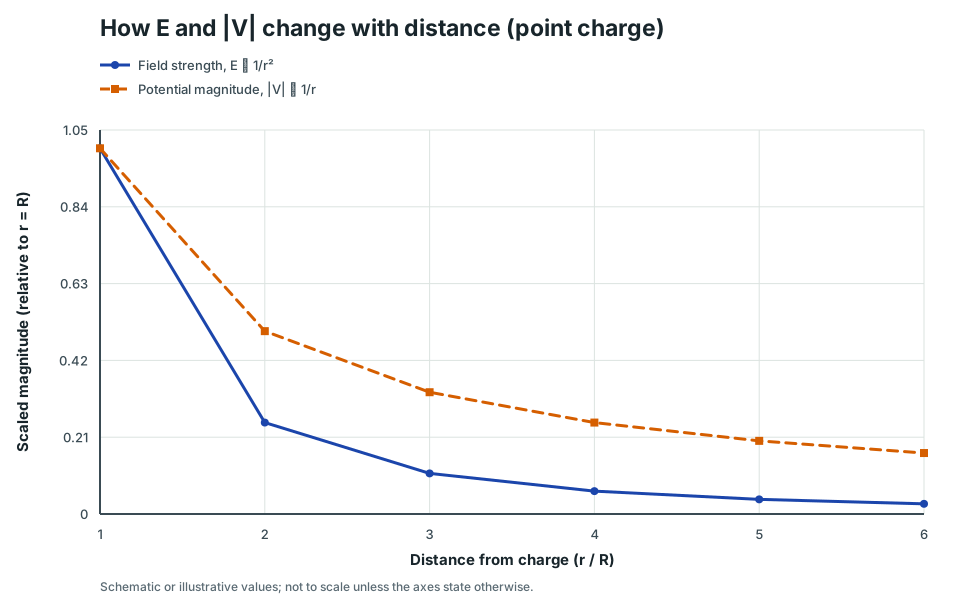
Inverse-square vs inverse (field vs potential)
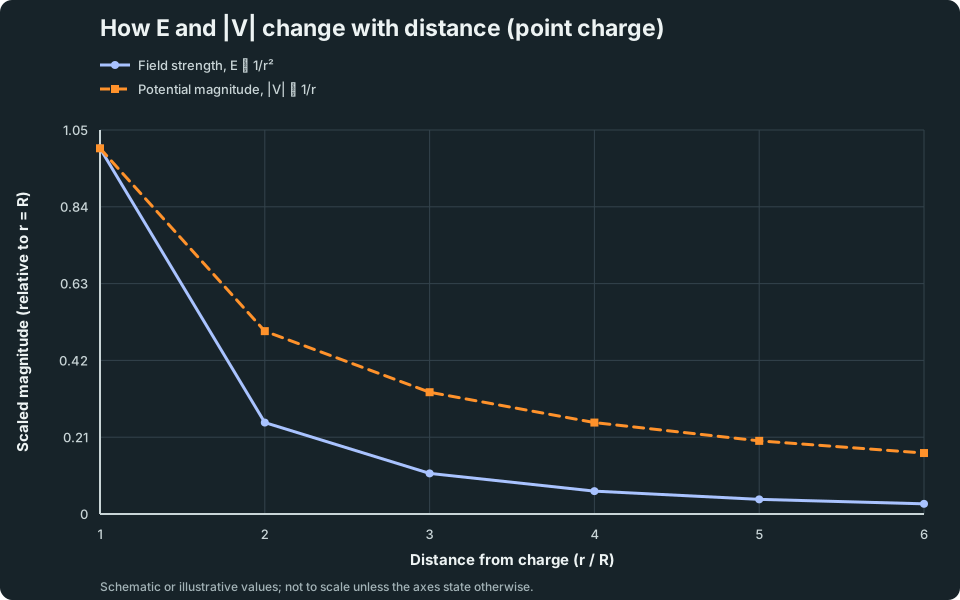
For a point charge, field strength falls with 1/r², while potential falls with 1/r (more slowly). This is why potential “extends” further than field.
How E and |V| change with distance (point charge)
Scaled plot showing electric field strength falling with 1/r^2 and potential magnitude falling with 1/r.
Scroll across the graph to read all labels.
View figure data
| Distance from charge (r / R) | Field strength, E ∝ 1/r² | Potential magnitude, |V| ∝ 1/r |
|---|---|---|
| 1 | 1 | 1 |
| 2 | 0.25 | 0.5 |
| 3 | 0.111 | 0.333 |
| 4 | 0.0625 | 0.25 |
| 5 | 0.04 | 0.2 |
| 6 | 0.0278 | 0.1667 |
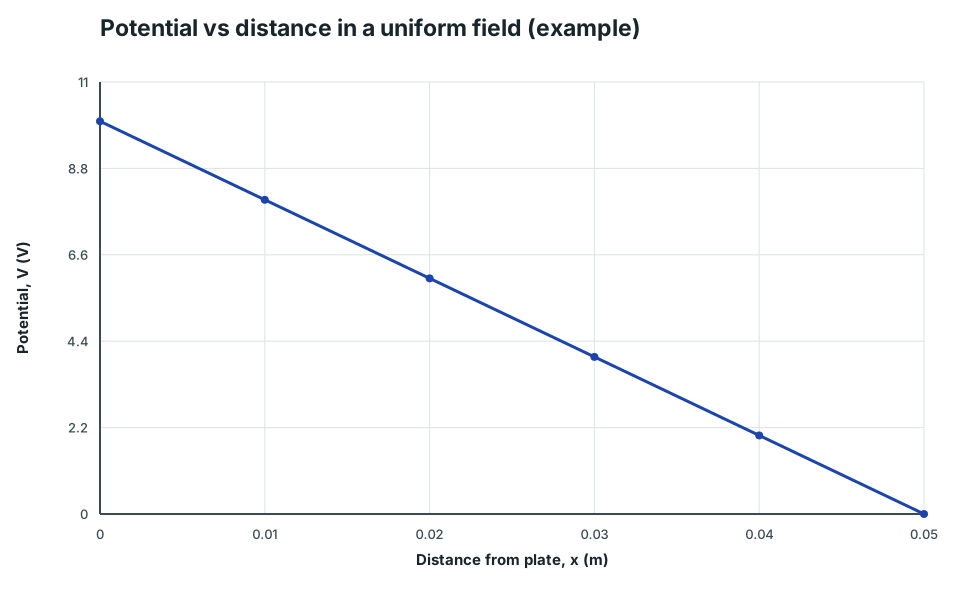
Uniform field: potential changes linearly with distance
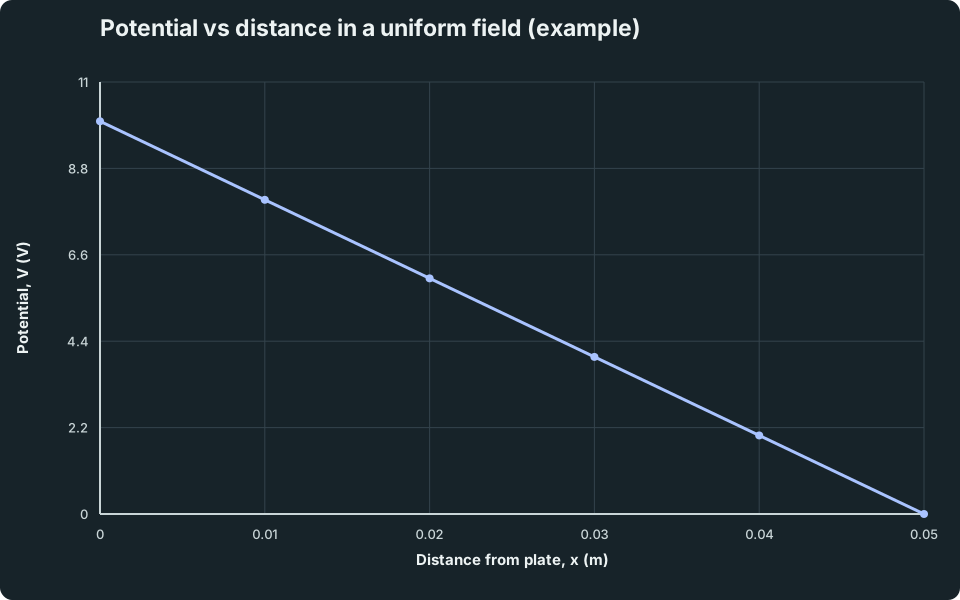
Between parallel plates (uniform field), potential varies linearly with distance, and the field strength is the negative gradient: E = -dV/dx (magnitude: E = ((Δ V)/d))
Potential vs distance in a uniform field (example)
A straight-line potential-distance graph between parallel plates; the gradient gives the electric field strength.
Scroll across the graph to read all labels.
View figure data
| Distance from plate, x (m) | V(x) (linear) |
|---|---|
| 0 | 10 |
| 0.01 | 8 |
| 0.02 | 6 |
| 0.03 | 4 |
| 0.04 | 2 |
| 0.05 | 0 |
Capacitor energy: quadratic in V
For a fixed capacitance, energy stored is U = (1/2)CV², so a plot of U against V is a curve (not a straight line).
Energy stored vs potential difference (fixed C)
A curve showing that capacitor energy increases with the square of potential difference.
Scroll across the graph to read all labels.


View figure data
| Potential difference, V (V) | U = ½CV² (C = 100 μF) |
|---|---|
| 0 | 0 |
| 5 | 0.00125 |
| 10 | 0.005 |
| 15 | 0.01125 |
| 20 | 0.02 |
What You Must Memorise
- Coulomb’s Law: The force between two point charges is proportional to the product of their charges and inversely proportional to the square of their separation.
- Electric Field Strength (E): Force per unit positive charge acting on a stationary point charge.
- Electric Potential (V): Work done per unit positive charge in bringing a small test charge from infinity to that point.
- Capacitance (C): The ratio of charge stored on one plate to the potential difference between the plates.
Top Exam Traps
- Analogy with Gravity: Electric force can be repulsive (unlike gravity). Potential can be positive (near +ve charge) or negative (near -ve charge).
- Field vs Potential: E = -dV/dr. Field strength is the (negative) gradient of the potential-distance graph.
- Work and energy: Δ U = qΔ V, but work done by the field is W_field = -qΔ V.
- Uniform vs Point Field: Don’t use kQ/r² for parallel plates. Use E = V/d.
- Motion: In a uniform field (like a CRT), an electron follows a parabolic path (like a projectile). In a magnetic field, it follows a circular path.
Practice
Test your understanding of Electric Fields:
A Level Electric Fields QuizElectric Fields Structured SetA Level Quiz HubThe archived JC Set 1 remains available as extra practice after the current quiz and structured set.
Next hub: Currents & Circuits
Continue with the next resource in this course.
Course and syllabus information
- Course
- GCE A-Level H2 Physics
- Edition
- GCE A-Level H2 Physics 2027