Uniform Electric Fields (Parallel Plates)
Key idea: Use E = V/d and F = qE to analyse uniform electric fields and the motion of charged particles between parallel plates (A Level Physics).
Continue where you stopped
The core idea
On this page
Learning objectives
- Calculate field strength and force in uniform electric fields.
- Analyse charged-particle motion in uniform electric fields.
1. Definitions (Must Know)
A. Uniform electric field
A uniform electric field is a field where electric field strength E has constant magnitude and direction (approximately true between large, parallel plates).
B. Electric field strength, E
Electric field strength, E, is force per unit positive charge:
E = F/q
Unit: N C⁻¹ (equivalently V m⁻¹).
C. Potential difference, Δ V
Potential difference, Δ V, is work done per unit charge by an external force:
Δ V = W/q
Unit: V, where 1 V = 1 J C⁻¹.
D. Potential gradient (1D)
Along a chosen axis x, the electric field is the negative potential gradient:
E = -dV/dx
2. Key Ideas (What Earns Marks)
- Between parallel plates separated by distance d with potential difference Δ V:
- E = (Δ V)/d (magnitude)
- direction: from the positive plate to the negative plate
- Field and potential are linked by:
- E = -dV/dx (1D)
- for a uniform field, E ≈ -(Δ V)/(Δ x)
- Force on a charge in a uniform field:
- F = qE
- Motion is kinematics with constant acceleration:
- a = qE/m
- negative charge accelerates opposite to the field direction.
vector E points from higher potential to lower potential (for a positive test charge). A negative charge accelerates opposite to vector E.
E = ΔV/d is valid where field lines are approximately parallel and evenly spaced (central plate region). Near edges, fringing means the field is no longer uniform.
3. Detailed Explanations
A. Why |E| = |Δ V|/d between parallel plates
Choose the x-axis along the field. Electric field is the negative potential gradient:
Eₓ = -dV/dx
The gradient is constant in a uniform field. Across plate separation d,
Δ V = -Eₓd
Therefore the magnitude relationship used for plate calculations is
|E| = (|Δ V|)/d
The minus sign carries the direction: the field points from higher potential to lower potential.
B. Motion of a charged particle in a uniform field
Because F = qE is constant, the acceleration is constant:
a = F/m = qE/m
So you can use kinematics:
- If the initial velocity is parallel to the field: 1D constant acceleration.
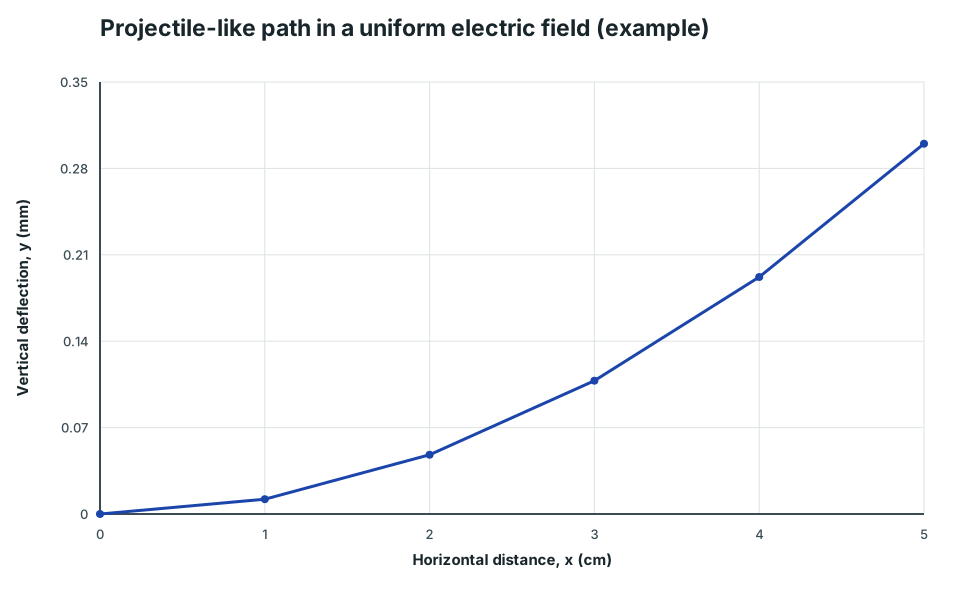
- If the initial velocity is perpendicular to the field: uniform velocity in one direction + uniform acceleration in the other (a “projectile-like” path).
Projectile-like path in a uniform electric field (example)
A parabolic y–x trajectory for a charged particle entering a uniform field with an initial horizontal velocity.
Scroll across the graph to read all labels.
View figure data
| Horizontal distance, x (cm) | Example trajectory (proton, values from worked example) |
|---|---|
| 0 | 0 |
| 1 | 0.012 |
| 2 | 0.048 |
| 3 | 0.108 |
| 4 | 0.192 |
| 5 | 0.3 |
4. Common Mistakes
- Using E = V/d without converting d to metres.
- Forgetting q can be negative (direction of acceleration flips).
- Mixing up units: 1 V/m = 1 N/C.
- Using potential difference when the question needs displacement along the field direction.
5. Exam Tips
- Always define axes and the sign convention (which direction is +).
- Use magnitudes first, then state the direction separately if signs are messy.
- Sanity check: a positive charge accelerates towards lower potential (towards the negative plate).
6. Worked Examples
Modelled example 1
Find E and the force on an electron
Problem
Study the worked solution
Find the field
Method
Use E = Δ V/d.Reason
Potential changes linearly in the central uniform region.Working
E = 500/0.020 = 2.5 × 10⁴ V m⁻¹Find force magnitude
Method
Use |F| = |q|E.Reason
The electron-charge magnitude sets force magnitude.Working
|F| = (1.60 × 10⁻¹⁹)(2.5 × 10⁴) = 4.0 × 10⁻¹⁵ NState direction
Method
Point towards the positive plate.Reason
Electron force is opposite the field.Working
vector Fₑ is opposite vector E.
Guided practice 2
Acceleration of a proton in a uniform field
Problem
Try this before viewing the solution
Hints
Hint 1: combine force and motion
View solution step by step
Substitute
Method
Use a = qE/m.Reason
The field gives a constant electric force.Working
a = ((1.60 × 10⁻¹⁹)(1.0 × 10⁴))/(1.67 × 10⁻²⁷)Evaluate
Method
Obtain 9.6 × 10¹¹ m s⁻² along the field.Reason
The proton is positively charged.Working
a ≈ 9.6 × 10¹¹ m s⁻².
Common misconception 3
Deflection while passing between plates
Learner claim
Try this before viewing the solution
View solution step by step
Find transit time
Method
Use horizontal length and speed.Reason
No horizontal electric force changes u.Working
t = 0.050/(2.0 × 10⁶) = 2.5 × 10⁻⁸ sFind vertical acceleration
Method
Use a = qE/m.Reason
The vertical field gives constant force.Working
a = 9.6 × 10¹¹ m s⁻².Find deflection
Method
Use y = (1/2)at².Reason
Initial vertical speed is zero.Working
y = (1/2)(9.6 × 10¹¹)(2.5 × 10⁻⁸)² = 3.0 × 10⁻⁴ m
Examiner practice 4
Find potential difference from E and d
Examination question
Try this before viewing the solution
View solution step by step
Convert separation
1 markMethod
Use 12 × 10⁻³ m.Reason
Field is given per metre.Working
d = 0.012 m.Use the relation
1 markMethod
Apply Δ V = Ed.Reason
The field is uniform.Working
Δ V = (3.0 × 10⁴)(12 × 10⁻³)Evaluate
1 markMethod
Obtain 360 V.Reason
Volt per metre times metre gives volt.Working
Δ V = 3.6 × 10² V.
Self-mark with the mark scheme
Compare your response with each mark point. Select a point only when your response contains that evidence.
Self-mark conversion, relation and result.
Challenge 5
Find separation from a required field
Independent transfer
Try this before viewing the solution
Hints
Hint 1: convert kilovolts
View solution step by step
Calculate separation
Method
Divide p.d. by field.Reason
E = Δ V/d in the uniform region.Working
d = (1.0 × 10³)/(2.0 × 10⁵) = 5.0 × 10⁻³ m = 5.0 mmState the boundary
Method
Use the central region of large parallel plates and neglect fringing.Reason
The relation assumes nearly constant field.Working
Plate size ≫ separation.
7. Mind Stretchers
Mind stretcher 1: Show that 1 V/m = 1 N/CExtension
Show Answer
1 V/m = (1 J/C)/(1 m) = (1 N m)/(C m) = 1 N/C
Mind stretcher 2: Why is the field approximately uniform between plates?Extension
Explain why the electric field is approximately uniform in the central region between two large, parallel plates.
Show Answer
In the central region, the field lines are roughly straight, parallel, and equally spaced, so the field has nearly constant direction and magnitude.
Non-uniformity occurs mainly near the edges due to fringing, but this is small if the plate size is much larger than the separation.
Mind stretcher 3: Simulation Bridge: Electric Field ExplorerExtension
Concept Explorer: Electric Field Explorer
Switch between parallel-plate and point-charge models, move the probe, and test E-V-r relationships with guided prompts.
- E = V/d
- V = kQ/r
- E = kQ/r²
- Field Direction
Explore uniform fields in the Electric Field Explorer.
Continue with the next resource in this course.
Course and syllabus information
- Course
- GCE A-Level H2 Physics
- Edition
- GCE A-Level H2 Physics 2027