Reading fields from potential graphs and maps
Key idea: Electric field points down the potential gradient: E = −dV/dx. Equipotentials cross field lines at right angles, and moving along one changes no electric potential energy.
Offline pages
Saved on this device only. Connect at least once every 30 days to confirm Premium. Sign-out or a change of account removes saved copies.
Loading guide controls…
Guided lessons · coming soon
Guided lesson
Guided steps
- Derive the negative gradient and read the tangent.
- Find the field and both charge-force directions.
- Find the signed field when potential rises.
- Explain how zero field can accompany non-zero potential.
- Explain zero work and perpendicular field lines on an equipotential.
- Predict potential, field direction and work along the symmetry axis.
- Move the probe vertically and compare the horizontal graph.
- Explain the readouts, arrow and horizontal graph gradient.
- Find the perpendicular equipotential separation.
- Calculate both average fields and test the spacing claim.
- Find the radius, both local fields and interval average.
- Explain how secant and tangent gradients differ.
On this page
You stopped at:
ContinueField strength and potential describe the same field in two ways, one as force per unit charge and one as energy per unit charge. They are linked: the field is strongest where the potential changes most steeply. That link lets you read a field from a graph of potential or from a map of equipotential lines.
Field strength is the negative potential gradient
Move a charge q a small distance Δ x along the direction of a field E. The field does work qEΔ x on it, and this equals the loss of electric potential energy, -qΔ V. So E = -(Δ V)/(Δ x), and in the limit
The electric field strength at a point is equal to the negative of the potential gradient there. The minus sign says that the field points from high potential to low potential. This also shows why V m⁻¹ is the same unit as N C⁻¹.
Potential across a uniform field
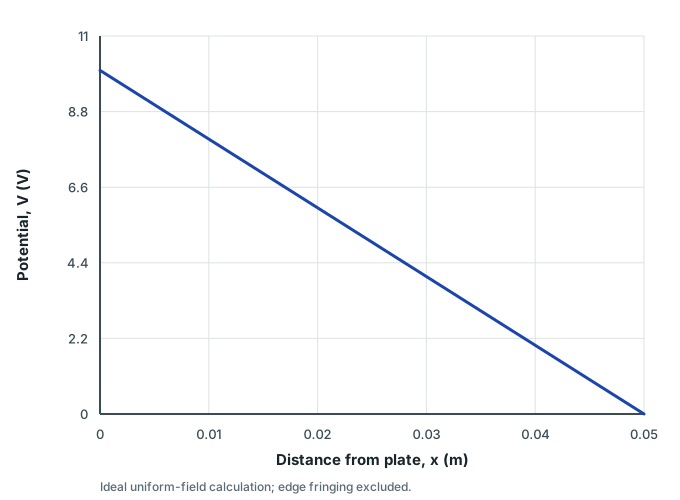
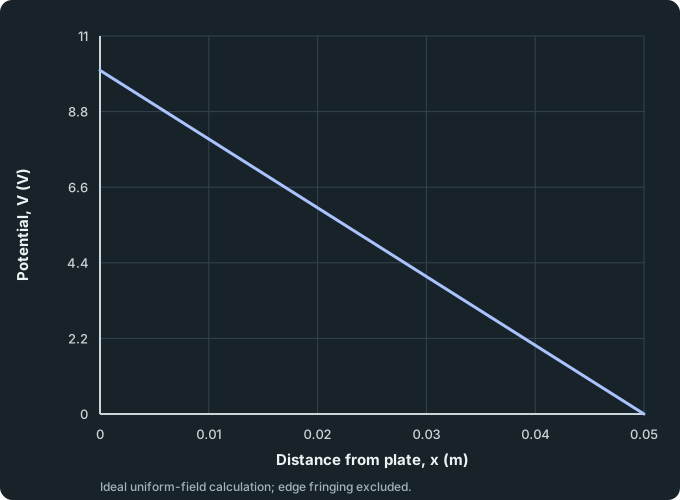
Calculated straight potential profile decreasing from ten volts to zero across five centimetres.
Scroll across the figure to read all labels.
View figure data
| Distance from plate, x (m) | V(x) = 10 − 200x |
|---|---|
| 0.000 | 10.0 |
| 0.001 | 9.8 |
| 0.002 | 9.6 |
| 0.003 | 9.4 |
| 0.004 | 9.2 |
| 0.005 | 9.0 |
| 0.006 | 8.8 |
| 0.007 | 8.6 |
| 0.008 | 8.4 |
| 0.009 | 8.2 |
| 0.010 | 8.0 |
| 0.011 | 7.8 |
| 0.012 | 7.6 |
| 0.013 | 7.4 |
| 0.014 | 7.2 |
| 0.015 | 7.0 |
| 0.016 | 6.8 |
| 0.017 | 6.6 |
| 0.018 | 6.4 |
| 0.019 | 6.2 |
| 0.020 | 6.0 |
| 0.021 | 5.8 |
| 0.022 | 5.6 |
| 0.023 | 5.4 |
| 0.024 | 5.2 |
| 0.025 | 5.0 |
| 0.026 | 4.8 |
| 0.027 | 4.6 |
| 0.028 | 4.4 |
| 0.029 | 4.2 |
| 0.030 | 4.0 |
| 0.031 | 3.8 |
| 0.032 | 3.6 |
| 0.033 | 3.4 |
| 0.034 | 3.2 |
| 0.035 | 3.0 |
| 0.036 | 2.8 |
| 0.037 | 2.6 |
| 0.038 | 2.4 |
| 0.039 | 2.2 |
| 0.040 | 2.0 |
| 0.041 | 1.8 |
| 0.042 | 1.6 |
| 0.043 | 1.4 |
| 0.044 | 1.2 |
| 0.045 | 1.0 |
| 0.046 | 0.8 |
| 0.047 | 0.6 |
| 0.048 | 0.4 |
| 0.049 | 0.2 |
| 0.050 | 0.0 |
Here the potential falls from 10 V to zero over 0.050 m. The gradient is -200 V m⁻¹, so the field is + 200 V m⁻¹: 200 V m⁻¹ in the + x direction. When the graph is curved, the field at a point comes from the gradient of the tangent there.
For a point charge, V = Q/4πε₀r, and -dV/dr = Q/4πε₀r²: the same field you found from Coulomb’s law.
Worked example 1
Field from a falling potential
Problem
The potential falls steadily from 120 V at x = 0 to 40 V at x = 0.20 m. Find the electric field, and the direction of the force on a positive and on a negative charge in it.
Show full solution
Potential gradient
Method
Divide the change in potential by the distance, final minus initial.Reason
The potential changes steadily, so the gradient is the same everywhere.Working
Answer
(Δ V)/(Δ x) = (40-120)/0.20 = -400 V m⁻¹
Field
Reason
E is the negative of the gradient.Working
Answer
E = +400 V m⁻¹, in the + x direction, towards lower potential
Forces
Working
Answer
The force on a positive charge is in the + x direction; the force on a negative charge is in the -x direction.
Try it yourself 2
A rising potential
Problem
The potential rises steadily from -60 V to + 20 V over a distance of 0.040 m in the + x direction. Find the field, taking + x as positive.
Find the field
Hints
Hint 1
sign
Which direction leads towards lower potential?
Show full solution
Field
Working
Answer
(Δ V)/(Δ x) = (20-(-60))/0.040 = +2000 V m⁻¹, so E = -2000 V m⁻¹: 2000 V m⁻¹ in the -x direction
Check your understanding 1 Zero field, non-zero potential
Explain why the field strength can be zero at a point where the potential is not zero.
Show answer
The field depends on the gradient of the potential, not on its value. Midway between two equal positive charges the fields cancel, so the potential graph is flat there, but the potential itself is positive.
Equipotentials
An equipotential is a line, or surface, joining points at the same potential. Moving a charge along an equipotential changes neither its potential nor its electric potential energy, so the field does no work on it. That is only possible if the force has no component along the equipotential: field lines always cross equipotentials at right angles.
When equipotentials are drawn at equal steps of potential, their spacing shows the field strength. Close together means a steep potential gradient and a strong field. Around a point charge, equipotentials are concentric circles that get further apart with distance. In the uniform field between parallel plates, they are equally spaced and parallel to the plates.
Check your understanding 2
Two equal and opposite charges are at equal distances on either side of the y-axis: positive on the left, negative on the right. Predict the potential on the y-axis, the field direction there, and the field’s work on a charge moved along that axis.
Show answer
The signed potentials cancel on the y-axis. The field is non-zero and points towards the negative charge, perpendicular to the axis. Along that axis Δ V = 0, so the field’s work -qΔ V is zero. Zero potential is a value; zero field would require every directional potential gradient to vanish.
Test the equipotential prediction
Use the stated equal and opposite charges, leave Show equipotentials on, and keep Probe x at 0. Change Probe y or drag the test-charge probe along the y-axis. Compare V at the probe, E at the probe and the field arrow. The plotted charge-mode graphs follow a horizontal slice at the probe’s current height, so they show how potential changes across the axis rather than along your vertical path.
Point charges: A +2.00 nanocoulombs, B −2.00 nanocoulombs. Field lines leave positive charges and end on negative ones; dashed equipotentials cross them at right angles. The probe reads E = 5754 newtons per coulomb and V = 0 volts.
- E at the probe
- 5754 N C⁻¹
- Direction of E (from +x)
- 0 °
- V at the probe
- 0 V
- Distance to nearest charge
- 7.21 cm
- V / d
- 12500 V m⁻¹
- Deflection leaving the plates
- 0.99 cm
Try this
0 of 4 donePut two like charges on the stage and find the point where E = 0. (not done yet)
Between like charges the two fields point opposite ways and cancel at a neutral point, nearer the smaller charge.
With a single charge, record E at three or more distances. (not done yet)
E against 1/r² is a straight line through the origin: E = kQ/r², so doubling r makes E a quarter.
Make the field between the plates 2.0 × 10⁴ V m⁻¹. (not done yet)
E = V/d: 400 V across 2.0 cm gives the same field as 800 V across 4.0 cm.
Make the beam leave the plates just clear of a plate. (not done yet)
Inside the plates the particle has a constant acceleration qE/m across the field, so its path is a parabola: y = qEL²/(2mv²).
You’ve tried every task.
Your readings
| # | r / cm | E / N C−1 | V / V | Remove |
|---|---|---|---|---|
| No readings yet. Set up a measurement, then record it. | ||||
Check your understanding 3
Use the model to explain why a zero-potential path can pass through a non-zero field. How does the horizontal potential graph account for the arrow at the axis?
Show answer
On the vertical symmetry axis, V = 0 but the field points horizontally from positive to negative. Along the axis potential is constant and no work is done; across the axis the potential falls, giving a non-zero horizontal field. The horizontal potential graph has a negative tangent gradient at the axis, consistent with positive Eₓ.
Guided practice 3
Spacing of equipotentials
Problem
In a uniform field of strength 2000 V m⁻¹, how far apart are two equipotentials that differ by 50 V?
Find the separation
Hints
Hint 1
rearrange
How does field magnitude relate potential difference to perpendicular distance?
Show full solution
Separation
Working
Answer
d = 50/2000 = 0.025 m, measured along the field, at right angles to the equipotentials
Check your understanding 4 Closest lines, strongest field?
A student says the two closest equipotential lines on a map always mark the strongest field. One pair differs by 10 V and is 5.0 mm apart; another differs by 100 V and is 10 mm apart. Is the student right?
Show answer
No. The first pair gives 10/0.0050 = 2.0 × 10³ V m⁻¹ and the second gives 100/0.010 = 1.0 × 10⁴ V m⁻¹, so the wider gap has the stronger field. Spacing compares fields only when the lines are drawn at equal steps of potential.
Check your understanding 5 Equipotentials round a point charge
The potential 0.10 m from a point charge is 200 V. How far from the charge is the 50 V equipotential? Find the field strength at both distances, and explain why (Δ V)/(Δ r) between them does not give the field at either.
Show the steps Optional working
Show the steps Optional working
Show answer
V ∝ 1/r, so Vr = 20 V m is constant and the 50 V equipotential is at r = 0.40 m. Since E = V/r for a point charge, E = 2000 V m⁻¹ at 0.10 m and 125 V m⁻¹ at 0.40 m. (150 V)/(0.30 m) = 500 V m⁻¹ is only an average, because the field is not uniform.
Check your understanding 6
Your secant estimate is 500 V m⁻¹, while the two local fields are 2000 and 125 V m⁻¹. Explain why these answers differ, using a sketch of V against r if helpful.
Show answer
The potential curve is not a straight line: its gradient changes with radius. The field at one point is minus the tangent gradient there. The secant across a finite interval gives the average field over that interval, so it need not equal either endpoint value. A much smaller interval around a chosen point approaches its local tangent gradient.
Common mistakes
- Dropping the minus sign: the field points towards lower potential.
- Thinking a large potential means a strong field; the field depends on how fast the potential changes.
- Comparing line spacing on a map whose equipotentials are not at equal steps of potential.
- Drawing field lines that cross equipotentials at an angle other than 90°.
- Using (Δ V)/(Δ r) across a wide gap in a non-uniform field as if it were the field at a point.
Spotted an error? Report a correction
Syllabus and review details
- GCE A-Level H2 Physics 2027 · 2027
Content Overview, PDF pages 9–10; Subject Content, PDF pages 11–30
Last reviewed: