Motion of a Moving Charge in a Uniform Magnetic Field
Key idea: Use F = Bqv sinθ and circular-motion ideas to analyse the motion of a charged particle in a uniform magnetic field, including helical paths (A Level Physics).
Continue where you stopped
The core idea
On this page
Learning objectives
- Analyse forces and paths of moving charges in uniform fields.
1. Definitions (Must Know)
A. Magnetic force on a moving charge
A charge q moving with speed v in a magnetic field of flux density B experiences a magnetic force of magnitude:
F = Bqv sin θ
where θ is the angle between vector v and vector B.
B. Special cases
- If vector v⊥ vector B, then sin θ = 1 and F = Bqv.
- If vector v∥ vector B, then sin θ = 0 and F = 0.
2. Key Ideas (What Earns Marks)
- Direction: the magnetic force is perpendicular to both vector v and vector B (use a right-hand rule / vector v × vector B).
- A magnetic force does no work on the charge because it is perpendicular to the motion, so the speed stays constant.
- If vector v⊥ vector B, the motion is uniform circular motion because the magnetic force provides the centripetal force: Bqv = mv²/r ⇒ r = mv/|q|B
- If vector v has a component parallel to vector B, the motion is helical (circular motion + constant forward motion).
In calculations, use magnitudes with |q| and state the direction separately (especially for electrons where q < 0).
3. Detailed Explanations
A. Why the force is perpendicular (what it implies)
The magnetic force always acts at right angles to the velocity, so:
- it changes the direction of the velocity,
- but not the speed.
So kinetic energy stays constant (no work done by the magnetic force).
B. Circular motion when vector v⊥ vector B
If vector v⊥ vector B, F = Bqv has constant magnitude and is always perpendicular to vector v.
That is exactly the condition for uniform circular motion. Using F_centripetal = mv²/r:
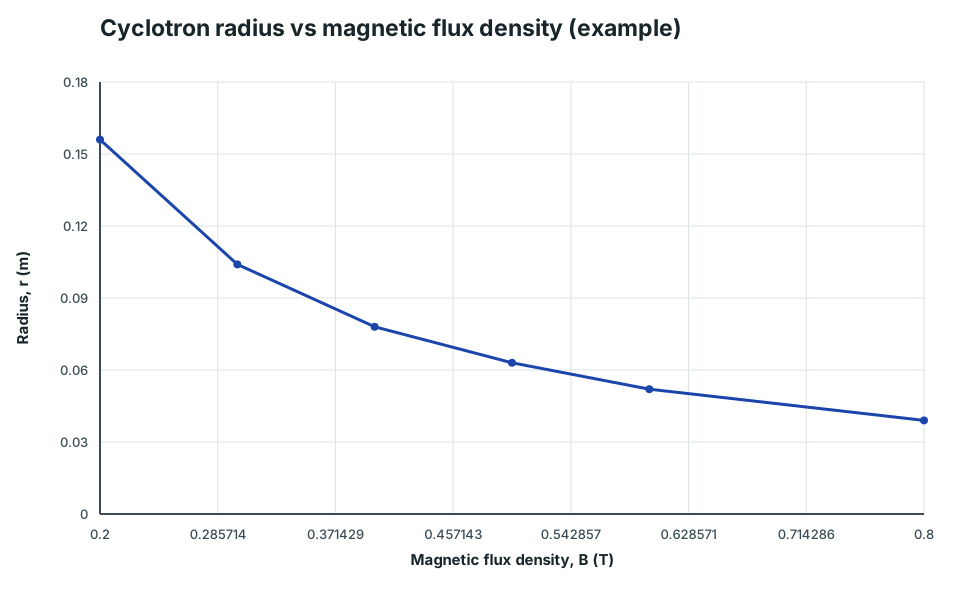
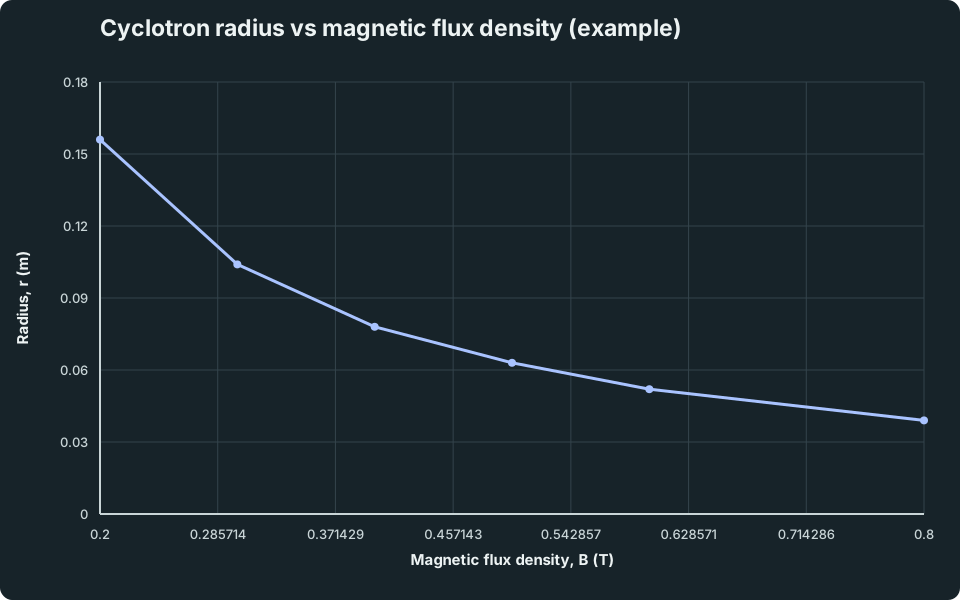
Cyclotron radius vs magnetic flux density (example)
An inverse curve showing that increasing B reduces the radius of curvature for a fixed particle speed and charge.
Scroll across the graph to read all labels.
View figure data
| Magnetic flux density, B (T) | Proton at v = 3.0×10⁶ m s⁻¹ (r = mv/|q|B) |
|---|---|
| 0.2 | 0.156 |
| 0.3 | 0.104 |
| 0.4 | 0.078 |
| 0.5 | 0.063 |
| 0.6 | 0.052 |
| 0.8 | 0.039 |
C. Helical motion when vector v is not perpendicular
Split the velocity into components:
- v_⊥ (perpendicular to vector B) → circular motion,
- v_∥ (parallel to vector B) → unchanged.
The combined path is a helix:
4. Common Mistakes
- Using F = Bqv without checking whether sin θ is needed.
- Forgetting that q can be negative (direction reverses).
- Claiming the particle “speeds up” in a magnetic field (it does not, in this model).
- Mixing up B (tesla) with magnetic flux Φ (weber).
5. Exam Tips
- Start by stating the angle: “vector v⊥ vector B, so sin θ = 1”.
- Use magnitudes for calculations, then add one clear direction sentence.
- If asked for radius in a magnetic field, write: Bqv = mv²/r then rearrange.
6. Worked Examples
Modelled example 1
Force on a charge
Problem
Study the worked solution
Apply the perpendicular case
Method
Use F = B|q|v.Reason
θ = 90°, so sin θ = 1; charge magnitude gives force magnitude.Working
F = B|q|vEvaluate
Method
F = 4.8 × 10⁻¹⁵ N.Reason
Substitute the field, charge magnitude and speed.Working
F = (1.5 × 10⁻³)(1.60 × 10⁻¹⁹)(2.0 × 10⁷) = 4.8 × 10⁻¹⁵ NDetermine direction
Method
Find vector v × vector B for positive charge, then reverse it for the electron.Reason
The electron has negative charge.Working
Direction requires the stated vector orientations.
Guided practice 2
Radius of circular motion
Problem
Try this before viewing the solution
Hints
Hint 1: make magnetic force centripetal
View solution step by step
Derive the radius relation
Method
Use r = mv/(|q|B).Reason
The perpendicular magnetic force supplies the centripetal force.Working
B|q|v = mv²/r ⇒ r = mv/|q|BEvaluate
Method
r = 7.8 × 10⁻² m.Reason
The speed remains constant while the force turns the velocity.Working
r = ((1.67 × 10⁻²⁷)(3.0 × 10⁶))/((1.60 × 10⁻¹⁹)(0.40)) = 7.8 × 10⁻² m
Common misconception 3
Angled entry
Learner claim
Try this before viewing the solution
View solution step by step
Resolve velocity
Method
Use v_⊥ = v sin θ for the circular component.Reason
The parallel component experiences no magnetic force.Working
v_⊥ = v sin θ, v_∥ = v cos θCorrect the radius
Method
r = mv sin θ/(|q|B).Reason
The perpendicular component alone supplies circular motion.Working
r = mv_⊥/|q|B = (mv sin θ)/|q|BCorrect the path
Method
The combined motion is helical, not a planar circle.Reason
v_∥ remains constant along the field while v_⊥ circulates.Working
Circular transverse motion + uniform parallel motion ⇒ helix.
Examiner practice 4
Period of circular motion
Examination question
Try this before viewing the solution
View solution step by step
Find the radius
1 markMethod
r = mv/(|q|B).Reason
Magnetic force supplies centripetal force.Working
B|q|v = mv²/r ⇒ r = mv/(|q|B)Derive the period
1 markMethod
T = 2π m/(|q|B).Reason
Use T = 2π r/v; the speed cancels.Working
T = (2π r)/v = (2π m)/|q|BEvaluate
1 markMethod
T = 3.28 × 10⁻⁷ s.Reason
The non-relativistic period depends on mass, charge magnitude and field, not speed.Working
T = (2π(1.67 × 10⁻²⁷))/((1.60 × 10⁻¹⁹)(0.20)) = 3.28 × 10⁻⁷ s
Self-mark with the mark scheme
Compare your response with each mark point. Select a point only when your response contains that evidence.
Self-mark the radius relation, period derivation and value.
Challenge 5
Helical pitch
Independent transfer
Try this before viewing the solution
Hints
Hint 1: advance during one transverse turn
View solution step by step
Find one-turn time
Method
T = 3.58 × 10⁻⁸ s.Reason
The transverse circular period is independent of v_⊥ in this model.Working
T = (2π(9.11 × 10⁻³¹))/((1.60 × 10⁻¹⁹)(1.0 × 10⁻³)) = 3.58 × 10⁻⁸ sFind axial advance
Method
p = 0.358 m ≈ 0.36 m.Reason
Pitch is the distance advanced parallel to the field during one turn.Working
p = v_∥ T = (1.0 × 10⁷)(3.58 × 10⁻⁸) = 0.358 mIdentify the controlling component
Method
v_∥ sets the pitch for a given period.Reason
v_⊥ sets the helix radius, not its axial advance per turn.Working
Pitch = v_∥ T.
7. Mind Stretchers
Mind stretcher 1: Why does B not change the speed?Extension
Explain, using work/energy, why a uniform magnetic field does not change a particle’s speed.
Show Answer
Work done is W = vector F · vector s. The magnetic force is always perpendicular to the displacement, so vector F · vector s = 0 and W = 0.
So kinetic energy does not change, and the speed stays constant.
Mind stretcher 2: Why is the period independent of speed?Extension
Show that, for non-relativistic motion with vector v⊥ vector B, the period T of circular motion is independent of the particle’s speed.
Show Answer
For circular motion: B|q|v = mv²/r ⇒ r = mv/|q|B
But v = (2π r)/T ⇒ T = (2π r)/v.
Substitute r = mv/|q|B: T = (2π/v)(mv/|q|B) = (2π m)/|q|B
v cancels, so T is independent of speed (in this model).
8. Optional (Enrichment)
A. Link to beam deflection and velocity selection
- Beam deflection in uniform fields: Deflection of Charged Particles.
- Crossed fields with no deflection: Velocity Selector.
Continue with the next resource in this course.
Course and syllabus information
- Course
- GCE A-Level H2 Physics
- Edition
- GCE A-Level H2 Physics 2027