Escape Speed
Key idea: Derive escape speed using energy: v_esc = √(2GM/r), apply it at different altitudes, and avoid common traps (A Level Physics).
Continue where you stopped
The core idea
On this page
Learning objectives
- Analyse escape speed using conservation of energy.
1. Definitions (Must Know)
A. Escape speed, v_esc
Escape speed (escape velocity), v_esc, at a distance r from the centre of a planet is the minimum speed needed to reach infinity with zero speed at infinity, assuming:
- no air resistance,
- no further propulsion,
- only the planet’s gravity acts.
For a planet of mass M:
v_esc = square root of (2GM/r)
At the surface (r = R):
v_esc = square root of (2GM/R) = square root of 2gR
2. Key Ideas (What Earns Marks)
- Escape speed is found using energy: (1/2)mv_esc² = Δ U
- With U = -GMm/r and U(∞) = 0: (1/2)mv_esc² = GMm/r
- v_esc depends on M and r, not on the rocket’s mass.
- Higher starting altitude (larger r) gives smaller escape speed.
Orbital speed for a circular orbit is v_orb = square root of (GM/r). Escape speed is larger by a factor of square root of 2: v_esc = square root of 2 v_orb.
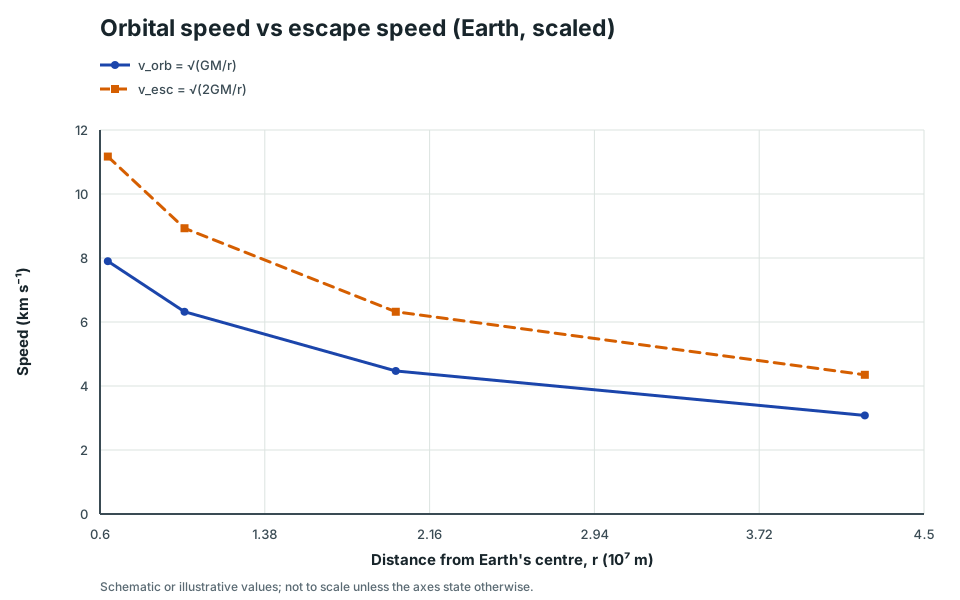
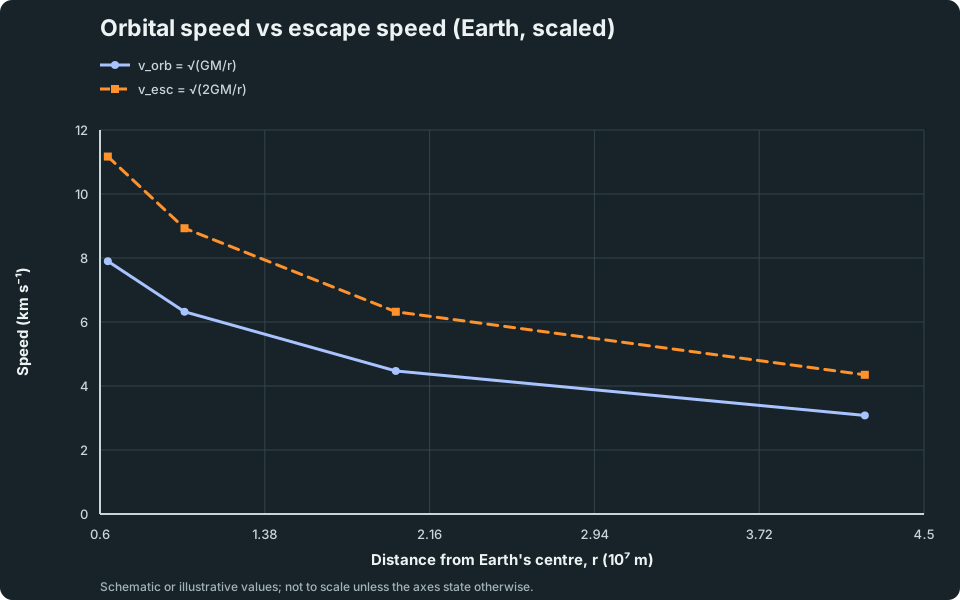
Orbital speed vs escape speed (Earth, scaled)
Both speeds decrease with distance, and escape speed is always √2 times orbital speed at the same radius.
Scroll across the graph to read all labels.
View figure data
| Distance from Earth's centre, r (10⁷ m) | v_orb = √(GM/r) | v_esc = √(2GM/r) |
|---|---|---|
| 0.637 | 7.9 | 11.17 |
| 1 | 6.32 | 8.93 |
| 2 | 4.47 | 6.32 |
| 4.22 | 3.08 | 4.35 |
Escape speed means reaching infinity with zero final speed under gravity alone. It does not mean zero speed at launch, and it assumes no air resistance after launch.
3. Detailed Explanations
A. Derivation using energy
Escape condition: the object reaches infinity with zero speed, so total energy at infinity is:
E_∞ = 0
At radius r, total energy is:
Eᵣ = (1/2)mv² - GMm/r
Set Eᵣ = E_∞ = 0 for the minimum speed:
B. Why square root of 2gR appears
At Earth’s surface, g = GM/R², so:
v_esc = square root of (2GM/R) = square root of 2gR
This is not the “uniform field to infinity” model. It is just an algebraic substitution using the exact surface value of g.
4. Common Mistakes
- Using r = h instead of r = R + h.
- Confusing escape speed with orbital speed.
- Forgetting that v_esc is a speed (direction not required).
- Adding mgΔ h all the way to infinity (uniform-field thinking) instead of using U = -GMm/r.
5. Exam Tips
- Start from U = -GMm/r with U(∞) = 0 and write “at escape, v(∞) = 0”.
- Keep r as centre-to-centre distance until the final substitution.
- Use 2–3 s.f. unless the question specifies otherwise.
6. Worked Examples
Modelled example 1
Escape speed from Earth’s surface
Problem
Study the worked solution
Set the energy boundary
Method
For minimum escape, set total energy at launch equal to zero.Reason
At infinity both U and the limiting final kinetic energy are zero.Working
(1/2)mv_esc²-GMm/R = 0Solve for speed
Method
Use v_esc = square root of (2GM/R).Reason
The launched object’s mass cancels from the energy equation.Working
v_esc = square root of (2GM/R)Evaluate
Method
Obtain 1.12 × 10⁴ m s⁻¹ = 11.2 km s⁻¹.Reason
The formula gives a speed magnitude.Working
v_esc = square root of ((2(6.67 × 10⁻¹¹)(5.97 × 10²⁴))/(6.37 × 10⁶)) ≈ 1.12 × 10⁴ m s⁻¹
Guided practice 2
Escape speed from an altitude
Problem
Try this before viewing the solution
Hints
Hint 1: replace altitude with radius
View solution step by step
Find the radial distance
Method
Obtain r = 6.67 × 10⁶ m.Reason
The gravitational potential energy uses distance from Earth’s centre.Working
r = R_E + h = 6.37 × 10⁶ + 3.00 × 10⁵ = 6.67 × 10⁶ mCalculate escape speed
Method
Obtain 1.09 × 10⁴ m s⁻¹, or 10.9 km s⁻¹.Reason
The larger starting radius makes the required speed slightly lower than at the surface.Working
v_esc = square root of ((2(3.99 × 10¹⁴))/(6.67 × 10⁶)) ≈ 1.09 × 10⁴ m s⁻¹
Common misconception 3
Comparing escape speeds (scaling)
Learner claim
Try this before viewing the solution
View solution step by step
Form the ratio inside the root
Method
The exoplanet has (M'/R')/(M/R) = 2/0.5 = 4.Reason
Both the source mass and surface radius change.Working
(M'/R')/(M/R) = 2/0.5 = 4Apply the square root
Method
The escape-speed ratio is 2.Reason
v_esc ∝ square root of (M/R), so the factor of four is under a square root.Working
v'/v = square root of 4 = 2
Examiner practice 4
Escape speed from g and R (using v_esc = square root of 2gR)
Examination question
Try this before viewing the solution
View solution step by step
Replace GM
1 markMethod
From g = GM/R², use GM = gR².Reason
This expresses the source parameter using the supplied surface data.Working
GM = gR²Simplify escape speed
1 markMethod
Obtain v_esc = square root of 2gR.Reason
Substitute GM = gR² into square root of (2GM/R).Working
v_esc = square root of (2gR²/R) = square root of 2gREvaluate
1 markMethod
Obtain 2.38 × 10³ m s⁻¹, or 2.4 km s⁻¹.Reason
The square-root expression has dimensions of speed.Working
v_esc = square root of (2(1.62)(1.74 × 10⁶)) ≈ 2.38 × 10³ m s⁻¹
Self-mark with the mark scheme
Compare your response with each mark point. Select a point only when your response contains that evidence.
Self-mark the substitution, simplified relation and value.
Challenge 5
How does v_esc change with altitude?
Independent transfer
Try this before viewing the solution
Hints
Hint 1: write one square root for each radius
View solution step by step
Form the speed ratio
Method
Divide the altitude expression by the surface expression.Reason
The same planet means the factor 2GM cancels.Working
(v_esc(R_E + h))/v_esc(R_E) = (square root of (2GM/(R_E + h)))/(square root of (2GM/R_E))Simplify and interpret
Method
Obtain square root of (R_E/(R_E + h)), which is less than one for h > 0.Reason
A higher starting point is less deeply bound gravitationally.Working
(v_esc(R_E + h))/v_esc(R_E) = square root of (R_E/(R_E + h)) < 1
7. Mind Stretchers
Mind stretcher 1: Show v_esc = square root of 2 v_orbExtension
Show that the escape speed from radius r is square root of 2 times the circular orbital speed at the same radius.
Show answer
Circular orbit: v_orb = square root of (GM/r).
Escape: v_esc = square root of (2GM/r) = square root of 2 square root of (GM/r) = square root of 2 v_orb.
Mind stretcher 2: Launch at 0.80v_escExtension
An object is launched upwards from Earth’s surface with speed 0.80v_esc. Explain why it will not escape, and describe what happens far from Earth.
Show answer
Escape requires total energy E = 0. With v = 0.80v_esc, the initial kinetic energy is only (0.80)² = 0.64 of what is needed to reach E = 0, so the total energy is negative (bound).
The object rises, slows down as kinetic energy is converted to gravitational potential energy, reaches a maximum distance where its speed becomes zero, then falls back.
Mind stretcher 3: Optional (Enrichment)Extension
A. Black holes (beyond syllabus)
If the escape speed from a radius exceeds the speed of light, even light cannot escape. This is one way to motivate the idea of a black hole, but it is not required for A Level calculations.
Continue with the next resource in this course.
Course and syllabus information
- Course
- GCE A-Level H2 Physics
- Edition
- GCE A-Level H2 Physics 2027