Circular Orbits & Geostationary Satellites
Key idea: Analyse circular orbits using gravity as centripetal force, use v = √(GM/r) and T² ∝ r³, and solve geostationary satellite problems (A Level Physics).
Continue where you stopped
The core idea
On this page
Learning objectives
- Analyse circular gravitational orbits and geostationary satellite conditions.
1. Definitions (Must Know)
A. Circular orbit
A circular orbit has constant orbital radius r (distance from the centre of the planet/star).
Gravity acts towards the centre and provides the centripetal force.
B. Orbital speed, v
For a mass m in a circular orbit around a mass M:
v = square root of (GM/r)
C. Orbital period, T
The orbital period, T, is the time for one complete orbit:
T = (2π r)/v
Combining with v = square root of (GM/r) gives:
T = 2π square root of (r³/GM)
D. Geostationary orbit
A geostationary satellite:
- orbits above the equator,
- moves west to east (same direction as Earth’s rotation),
- has the same period as Earth’s rotation (approximately 24 h),
- appears fixed above one point on Earth.
2. Key Ideas (What Earns Marks)
- Use “gravity provides centripetal”: GMm/r² = mv²/r
- Then: v = square root of (GM/r)
- Period–radius relationship (very exam-useful): T = 2π square root of (r³/GM) ⇒ T² ∝ r³
- For a circular orbit only: K = GMm/2r, U = -GMm/r and E = K + U = -GMm/2r.
- For geostationary orbit, use T = 24 × 3600 s and solve for r, then altitude h = r-R_E.
3. Detailed Explanations
A. Deriving orbital speed for a circular orbit
Gravitational force provides the centripetal force:
B. Deriving the period formula
Distance for one orbit is 2π r, so:
v = (2π r)/T
Substitute v² = GM/r:
Kepler’s 3rd law (linear form): T² vs r³
For circular orbits around the same central mass, T squared is proportional to r cubed.
Scroll across the graph to read all labels.
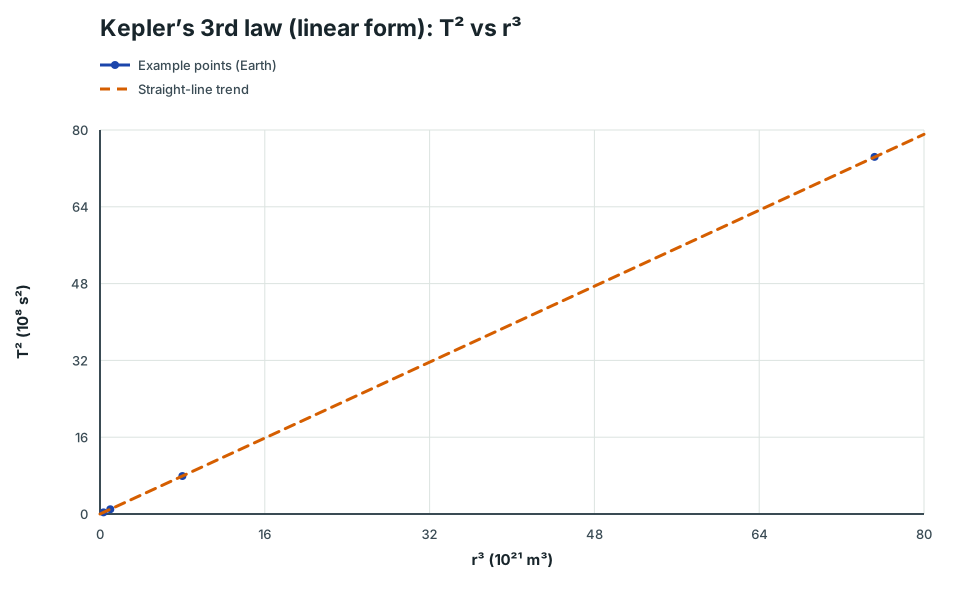
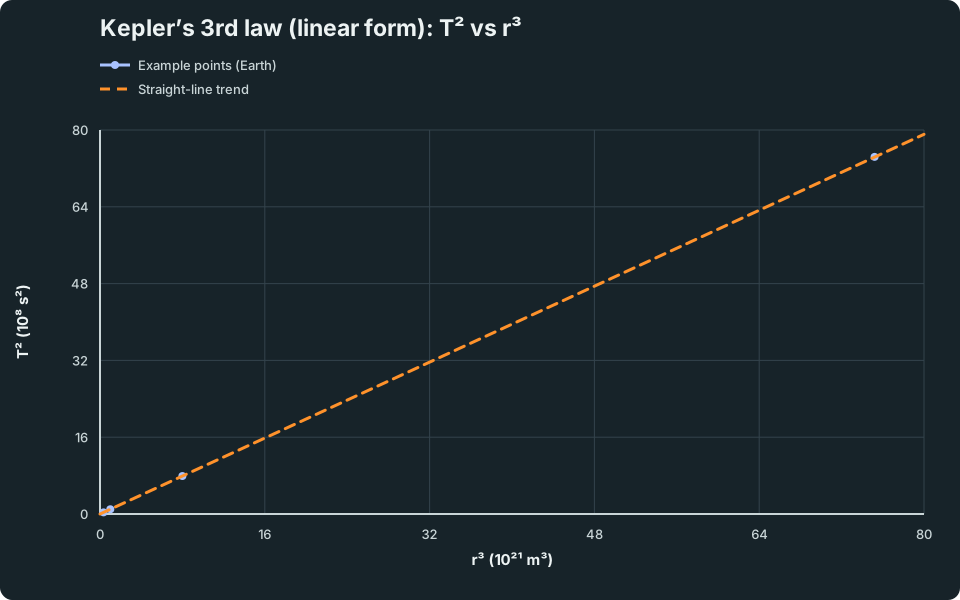
View figure data
| Series | r³ (10²¹ m³) | r³ uncertainty | T² (10⁸ s²) | T² uncertainty |
|---|---|---|---|---|
| Example points (Earth) | 0.343 | 0.339 | ||
| Example points (Earth) | 1 | 0.989 | ||
| Example points (Earth) | 8 | 7.91 | ||
| Example points (Earth) | 75.2 | 74.4 | ||
| Straight-line trend | 0 | 0 | ||
| Straight-line trend | 80 | 79.1 |
C. Energy in a circular orbit
From the radial force equation,
GMm/r² = mv²/r ⇒ mv² = GMm/r.
Therefore
K = (1/2)mv² = GMm/2r = -(1/2)U,
and the total mechanical energy is
E = K + U = -GMm/2r.
The negative total energy identifies a bound orbit. These energy expressions are for a circular orbit at radius r; do not apply them unchanged to an arbitrary point on an elliptical path.
D. Geostationary satellites (what makes them special)
Geostationary satellites must match Earth’s angular speed. This forces a unique orbital radius r for Earth.
Once you find r, you can find:
- orbital speed: v = square root of (GM/r),
- altitude above Earth: h = r-R_E,
- applications: communications links and continuous weather observation of the same region.
4. Common Mistakes
- Using altitude h as r (use r = R_E + h).
- Mixing up orbital speed v = square root of (GM/r) with escape speed v_esc = square root of (2GM/r).
- Forgetting to convert 24 h to seconds.
- Claiming a polar satellite can be geostationary (it cannot).
- Using the circular-orbit energy result E = -GMm/(2r) as though it were the gravitational potential energy; U = -GMm/r.
5. Exam Tips
- Start by writing GMm/r² = mv²/r before substituting numbers.
- Use T² ∝ r³ for ratio questions: T₁/T₂ = (r₁/r₂)^(3/2)
- Keep r as a distance from the centre until the very end.
6. Worked Examples
Modelled example 1
Orbital speed around Earth
Problem
Study the worked solution
Identify the inward force
Method
Set gravitational force equal to the required centripetal force.Reason
Gravity is the resultant radial force maintaining the circular orbit.Working
GMm/r² = mv²/rDerive orbital speed
Method
Cancel m and one factor of r to get v = square root of (GM/r).Reason
The orbiting mass does not determine the speed at a given radius around the same source.Working
v² = GM/r, v = square root of (GM/r)Evaluate
Method
Obtain 7.55 × 10³ m s⁻¹.Reason
The speed is tangential while acceleration and gravity point inward.Working
v = square root of ((3.99 × 10¹⁴)/(7.00 × 10⁶)) ≈ 7.55 × 10³ m s⁻¹
Guided practice 2
Radius and altitude of a geostationary orbit
Problem
Try this before viewing the solution
Hints
Hint 1: solve for centre distance first
View solution step by step
Find orbital radius
Method
Obtain r ≈ 4.22 × 10⁷ m.Reason
The period equation returns distance from Earth’s centre.Working
r = (GMT²/4π²)^(1/3) = (((3.99 × 10¹⁴)(86400)²)/4π²)^(1/3) ≈ 4.22 × 10⁷ mConvert radius to altitude
Method
Obtain h ≈ 3.58 × 10⁷ m = 3.58 × 10⁴ km.Reason
Altitude is measured from Earth’s surface.Working
h = r-R_E = (4.22-0.637) × 10⁷ ≈ 3.58 × 10⁷ m
Common misconception 3
Ratio of orbital periods (Mars satellites)
Learner claim
Try this before viewing the solution
View solution step by step
Take the square root of the law
Method
Use T ∝ r^(3/2).Reason
T² ∝ r³ does not mean T ∝ r³.Working
T ∝ square root of r³ = r^(3/2)Evaluate the ratio
Method
Obtain T_P/T_D ≈ 0.241.Reason
Both satellites orbit the same central mass, so the proportionality constant cancels.Working
T_P/T_D = (9.5/24.5)^(3/2) ≈ 0.241
Examiner practice 4
Find orbital period from orbital radius
Examination question
Try this before viewing the solution
View solution step by step
Select the period relation
1 markMethod
Use T = 2π square root of (r³/(GM)).Reason
This combines circular path length with gravity providing centripetal acceleration.Working
T = 2π square root of (r³/GM)Calculate in seconds
1 markMethod
Obtain 5.83 × 10³ s.Reason
The supplied quantities are in SI units.Working
T = 2π square root of (((7.00 × 10⁶)³)/(3.99 × 10¹⁴)) ≈ 5.83 × 10³ sConvert to minutes
1 markMethod
Obtain about 97 min.Reason
Divide seconds by 60 s min⁻¹.Working
T ≈ 5830/60 ≈ 97 min
Self-mark with the mark scheme
Compare your response with each mark point. Select a point only when your response contains that evidence.
Self-mark the equation, SI result and time conversion.
Challenge 5
Find the mass of the central body from an orbit
Independent transfer
Try this before viewing the solution
Hints
Hint 1: make M the subject
View solution step by step
Rearrange the period law
Method
Use M = 4π²r³/(GT²).Reason
The orbit supplies a gravitational measurement of the central mass.Working
M = 4π²r³/GT²Evaluate
Method
Obtain 1.35 × 10²⁵ kg.Reason
Cube the radius and square the period before applying G.Working
M = (4π²(4.50 × 10⁸)³)/((6.67 × 10⁻¹¹)(2.00 × 10⁶)²) ≈ 1.35 × 10²⁵ kg
7. Mind Stretchers
Mind stretcher 1: Why a polar satellite cannot be geostationaryExtension
Explain why a satellite cannot be geostationary above the North Pole.
Show answer
To appear fixed above a point on Earth, the satellite must rotate with Earth and remain above the same latitude. The only circular orbit that stays above a fixed point is an equatorial orbit (the orbit plane must match Earth’s equatorial plane). A satellite above the pole would require an orbit plane through the pole, which cannot keep the satellite above the same point while Earth rotates.
Mind stretcher 2: How v and T change with larger orbital radiusExtension
A satellite is moved to a circular orbit with larger radius. State what happens to its orbital speed and period.
Show answer
From v = square root of (GM/r), increasing r decreases v.
From T = 2π square root of (r³/(GM)), increasing r increases T.
Mind stretcher 3: Optional (Enrichment)Extension
A. Elliptical orbits (beyond syllabus)
Most real orbits are slightly elliptical. A common extension is that the period depends on the semi-major axis a via T² ∝ a³ (Kepler’s third law). Detailed ellipse geometry and energy methods are not required for the A Level gravitation learning outcomes.
Continue with the next resource in this course.
Course and syllabus information
- Course
- GCE A-Level H2 Physics
- Edition
- GCE A-Level H2 Physics 2027