Activity, Half-life and Decay constant
Key idea: Define activity, decay constant and half-life, and solve problems using A=λN, N=N0 e^{-λt}, and t1/2 = ln2/λ (A Level Physics).
Continue where you stopped
The core idea
On this page
Learning objectives
- Analyse random radioactive decay, activity, decay constant and half-life.
1. Definitions (Must Know)
A. Activity, A
The activity, A, of a radioactive sample is the number of decays per unit time.
Unit: becquerel (Bq), where 1 Bq = 1 decay s⁻¹.
B. Decay constant, λ
The decay constant, λ, is the probability of decay per unit time for a nucleus.
Unit: s⁻¹.
C. Relationship between A and N
If N is the number of undecayed nuclei: A = -dN/dt = λ N
D. Half-life, t_(1/2)
The half-life, t_(1/2), is the time taken for N (or A) to fall to half its initial value.
Useful relation: t_(1/2) = (ln 2)/λ
2. Key Ideas (What Earns Marks)
- A = λ N and A has unit Bq.
- Exponential decay laws:
- N = N₀e^(-λ t)
- A = A₀e^(-λ t)
- Half-life relation: t_(1/2) = (ln 2)/λ
- When using measured count rates, subtract background first (see Random Nature of Radioactive Decay).
Decide whether the data column is N, A, or count rate before using formulas. Activity and undecayed nuclei follow the same exponential form but represent different physical quantities.
3. Detailed Explanations
A. Why the decay is exponential
If each nucleus has the same probability of decaying per unit time, then the rate of decay is proportional to how many nuclei remain: -dN/dt ∝ N ⇒ -dN/dt = λ N
Solving gives: N = N₀e^(-λ t)
B. Half-life from the exponential law
At t = t_(1/2), N = N₀/2: 1/2 = e^(-λ t_(1/2)) ⇒ t_(1/2) = (ln 2)/λ
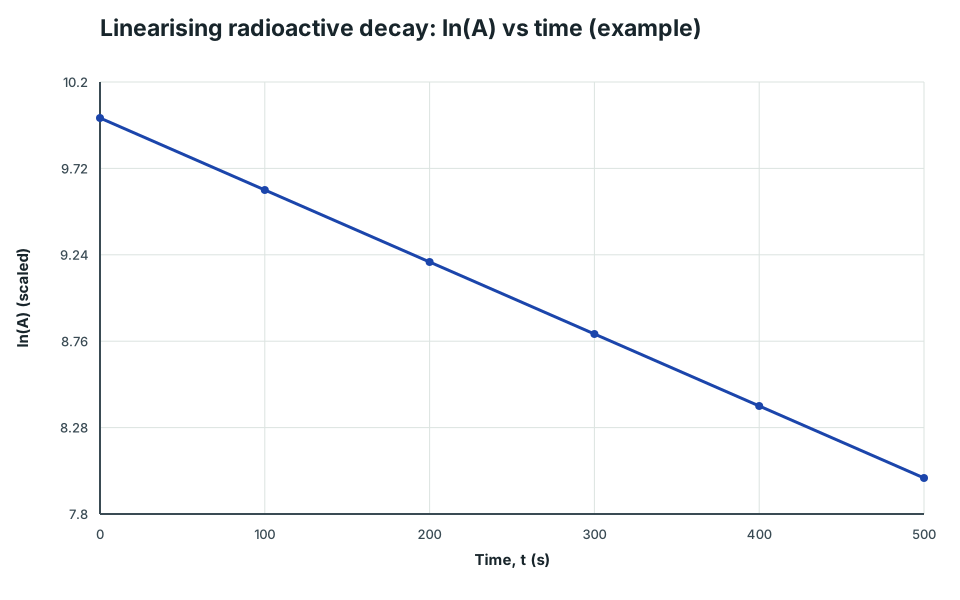
Graph skill: straight line using ln
From N = N₀e^(-λ t): ln N = ln N₀ - λ t
So plotting ln N (or ln A) against t gives a straight line whose gradient is -λ.
Linearising radioactive decay: ln(A) vs time (example)
A straight-line ln(A) against time plot; the negative gradient equals the decay constant λ.
Scroll across the graph to read all labels.
View figure data
| Time, t (s) | Example data (gradient = −λ) |
|---|---|
| 0 | 10 |
| 100 | 9.6 |
| 200 | 9.2 |
| 300 | 8.8 |
| 400 | 8.4 |
| 500 | 8 |
4. Common Mistakes
- Mixing up counts with count rate (divide by time first).
- Forgetting to subtract background before doing half-life/decay-constant calculations.
- Using A = λ N with inconsistent units for A (must be decays per second).
5. Exam Tips
- If the question gives half-life, find λ using t_(1/2) = ln 2/λ before anything else.
- When plotting data, use ln A vs t for a straight line (gradient = -λ) if asked.
- State whether you are using N or A (both follow the same exponential form).
6. Worked Examples
Modelled example 1
Find decay constant from half-life
Problem
Study the worked solution
Convert time to seconds
Method
t_(1/2) = 4.32 × 10⁵ s.Reason
The requested decay-constant unit is per second.Working
t_(1/2) = 5.0(24)(3600) = 4.32 × 10⁵ sUse the half-life relation
Method
λ = 1.60 × 10⁻⁶ s⁻¹.Reason
Half-life is inversely related to decay probability per unit time.Working
λ = (ln 2)/(t_(1/2)) = 0.693/(4.32 × 10⁵) = 1.60 × 10⁻⁶ s⁻¹
Guided practice 2
Activity after a time
Problem
Try this before viewing the solution
Hints
Hint 1: form the dimensionless exponent
View solution step by step
Calculate the exponent
Method
λ t = 0.60.Reason
The product of s⁻¹ and seconds is dimensionless.Working
(2.0 × 10⁻⁶)(3.0 × 10⁵) = 0.60Apply exponential decay
Method
A = 4.4 × 10² Bq.Reason
The negative exponent makes activity decrease from its initial value.Working
A = 800e^(-0.60) = 4.4 × 10² Bq
Common misconception 3
Half-life from decay constant
Learner claim
Try this before viewing the solution
View solution step by step
Repair the relationship
Method
t_(1/2) = ln 2/λ.Reason
A larger per-time decay probability makes the population halve sooner, not later.Working
t_(1/2) = 0.693/(5.0 × 10⁻⁵) = 1.39 × 10⁴ sConvert to hours
Method
t_(1/2) = 3.85 h ≈ 3.9 h.Reason
Divide seconds by 3600 s h⁻¹.Working
t_(1/2) = (1.39 × 10⁴)/3600 = 3.85 h
Examiner practice 4
Number of nuclei from activity
Examination question
Try this before viewing the solution
View solution step by step
Rearrange activity relation
1 markMethod
N = A/λ.Reason
Activity is the decay probability per unit time multiplied by the number remaining.Working
A = λ N ⇒ N = A/λEvaluate
1 markMethod
N = 1.2 × 10¹⁰ nuclei.Reason
The number of nuclei is a count and therefore dimensionless.Working
N = (3.0 × 10⁶)/(2.5 × 10⁻⁴) = 1.2 × 10¹⁰
Self-mark with the mark scheme
Compare your response with each mark point. Select a point only when your response contains that evidence.
Self-mark the rearranged activity relation and final number.
Challenge 5
Finding λ from a straight-line plot
Independent transfer
Try this before viewing the solution
Hints
Hint 1: connect equation and graph
View solution step by step
Calculate graph gradient
Method
m = -0.0040 s⁻¹.Reason
Use the change in ln A divided by the time change.Working
m = (9.2-10.0)/(200-0) = -0.0040 s⁻¹Interpret the sign
Method
λ = 4.0 × 10⁻³ s⁻¹.Reason
The linearised equation has gradient -λ, while the decay constant itself is positive.Working
λ = -m = 4.0 × 10⁻³ s⁻¹
7. Mind Stretchers
Mind stretcher 1: Half-life counting shortcutExtension
Without using exponentials, how would you estimate the activity after 4 half-lives?
Show Answer
Each half-life halves the activity, so after 4 half-lives: A = A₀/2⁴ = A₀/16
Mind stretcher 2: Why does half-life stay constant?Extension
If activity decreases with time, why doesn’t the half-life “get longer” as the sample gets weaker?
Show Answer
Half-life depends on the decay constant λ, which is a property of the nuclide (probability of decay per unit time) and does not change with how many nuclei you have.
As N decreases, activity decreases because A = λ N, but λ (and hence t_(1/2) = ln 2/λ) stays constant.
Continue with the next resource in this course.
Course and syllabus information
- Course
- GCE A-Level H2 Physics
- Edition
- GCE A-Level H2 Physics 2027