SHM Graphs (Displacement, Velocity, Acceleration)
Key idea: Use and interpret x–t, v–t and a–t relationships in simple harmonic motion, including phase and phase difference (A Level Physics).
Continue where you stopped
The core idea
On this page
Learning objectives
- Use oscillation quantities and describe free oscillations and their investigation.
- Relate displacement, velocity, acceleration and phase in simple harmonic motion.
- Identify and analyse simple harmonic motion using its defining equation and sinusoidal solutions.
1. Definitions (Must Know)
- Displacement, x (m): distance from the equilibrium position (positive or negative).
- Amplitude, x₀ (m): maximum magnitude of displacement.
- Period, T (s): time for one complete cycle.
- Frequency, f (Hz): cycles per second, f = 1/T.
- Angular frequency, ω (rad s⁻¹): ω = 2π f = 2π/T.
- Phase, θ (rad): the “position” within a cycle, e.g. θ = ω t + φ.
- Phase constant, φ (rad): the phase at t = 0 (sets where the motion starts).
- Phase difference, Δφ (rad): how far one oscillation leads or lags another.
2. Key Ideas (What Earns Marks)
- For SHM:
- x = x₀ sin(ω t + φ)
- v = dx/dt = ω x₀ cos(ω t + φ)
- a = -ω²x₀ sin(ω t + φ) so a = -ω²x
- Phase relationships (must know):
- velocity is π/2 ahead of displacement
- acceleration is π out of phase with displacement (opposite sign)
- Useful “no-time” relation:
- v = ±ω square root of (x₀²-x²)
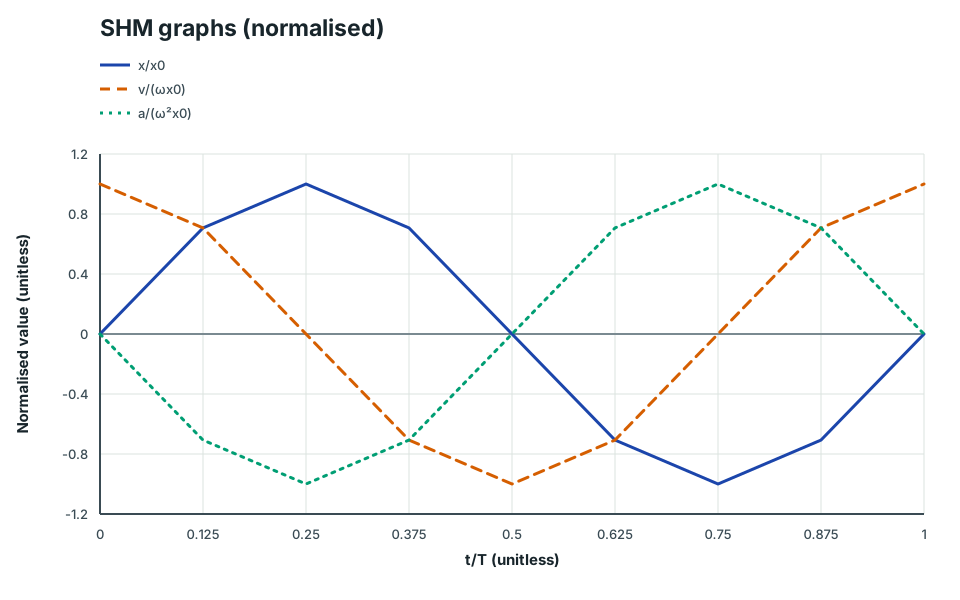
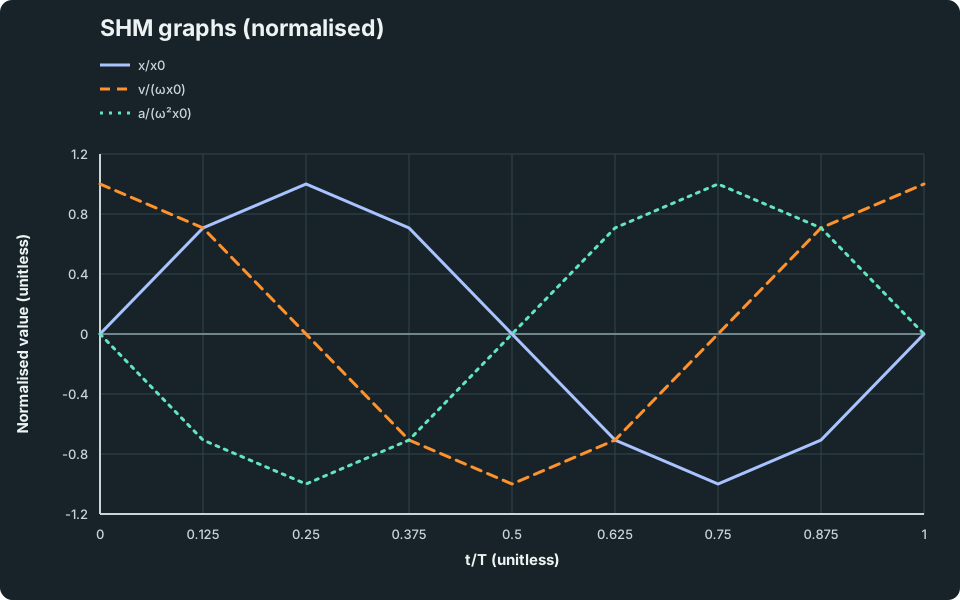
For SHM, velocity leads displacement by π/2, and acceleration is π out of phase with displacement. Marking these phase links on the graph avoids sign mistakes.
3. Detailed Explanations
A. One set of graphs that shows everything
To compare shapes without worrying about units, plot normalised quantities:
- x/x₀ = sin(2π t/T)
- v/(ω x₀) = cos(2π t/T)
- a/(ω² x₀) = - sin(2π t/T)
SHM graphs (normalised)
SHM graphs (normalised). x/x0, v/(ωx0), a/(ω²x0) plotted as Normalised value against t/T.
Scroll across the graph to read all labels.
View figure data
| t/T (unitless) | x/x0 | v/(ωx0) | a/(ω²x0) |
|---|---|---|---|
| 0 | 0 | 1 | 0 |
| 0.125 | 0.7071 | 0.7071 | -0.7071 |
| 0.25 | 1 | 0 | -1 |
| 0.375 | 0.7071 | -0.7071 | -0.7071 |
| 0.5 | 0 | -1 | 0 |
| 0.625 | -0.7071 | -0.7071 | 0.7071 |
| 0.75 | -1 | 0 | 1 |
| 0.875 | -0.7071 | 0.7071 | 0.7071 |
| 1 | 0 | 1 | 0 |
Read these directly:
- At maximum displacement (x = ± x₀): v = 0 and |a| is maximum.
- At equilibrium (x = 0): |v| is maximum and a = 0.
- v reaches its maximum a quarter cycle (T/4) before x reaches its maximum.
B. “Experimental + graphical” approach (what practical questions want)
If you measure a displacement–time graph x(t) (e.g. motion sensor / light gate + data logger):
- Period T: time between successive peaks (or troughs).
- Frequency f = 1/T and ω = 2π/T.
- Velocity is the gradient of the x–t graph: v = dx/dt.
- Acceleration comes from the gradient of the v–t graph (or curvature of x–t).
4. Common Mistakes
- Writing x = x₀ sin(ω t) + φ (phase must be inside the sine/cosine).
- Mixing degrees and radians.
- Forgetting the minus sign in a = -ω²x (acceleration points towards equilibrium).
5. Exam Tips
- If you’re asked for phase difference between x and v: answer π/2 (velocity leads).
- If you’re asked to “sketch v–t given x–t”: same frequency, shifted left by T/4.
- Use the “equilibrium/extreme” checkpoints to sanity-check sketches.
6. Worked Examples
Modelled example 1
Extract SHM parameters from an equation
Problem
Study the worked solution
Read amplitude and angular frequency
Method
x₀ = 0.040 m and ω = 10π rad s⁻¹.Reason
These are the displacement coefficient and the coefficient of t.Working
Compare with x = x₀ sin(ω t).Find cycle quantities
Method
f = 5.0 Hz and T = 0.20 s.Reason
Use f = ω/(2π) and T = 1/f.Working
f = 10π/2π = 5.0 Hz, T = 1/5.0 = 0.20 sFind maximum speed
Method
vₘₐₓ = 1.26 m s⁻¹.Reason
Velocity amplitude is ω x₀.Working
vₘₐₓ = (10π)(0.040) = 1.26 m s⁻¹Find maximum acceleration
Method
aₘₐₓ = 39.5 m s⁻².Reason
Acceleration amplitude is ω²x₀.Working
aₘₐₓ = (10π)²(0.040) = 39.5 m s⁻²
Guided practice 2
Find the phase constant from initial conditions
Problem
Try this before viewing the solution
Hints
Hint 1: use both initial conditions
View solution step by step
Use initial displacement
Method
φ = 0 or π.Reason
At equilibrium, x(0) = x₀ sin φ = 0.Working
sin φ = 0 ⇒ φ = 0 or πUse motion direction
Method
Select φ = 0.Reason
v(0) = ω x₀ cos φ must be positive; cos 0 > 0 but cos π < 0.Working
φ = 0
Common misconception 3
Phase difference between x and v
Learner claim
Try this before viewing the solution
View solution step by step
Differentiate displacement
Method
v = ω x₀ cos(ω t).Reason
Velocity is the gradient of the displacement–time graph.Working
v = dx/dt = ω x₀ cos(ω t)Express the phase shift
Method
Velocity leads displacement by π/2.Reason
cos θ = sin(θ + π/2); the positive shift reaches corresponding features earlier.Working
v = ω x₀ sin(ω t + π/2)
Examiner practice 4
Using checkpoints to fill missing values
Examination question
Try this before viewing the solution
View solution step by step
State velocity
1 markMethod
v = 0.Reason
The particle instantaneously stops before reversing at an extreme.Working
v = 0.State acceleration
1 markMethod
a = -ω²x₀.Reason
Apply the defining relation at x = +x₀.Working
a = -ω²x₀Describe direction
1 markMethod
Acceleration points towards equilibrium and has maximum magnitude.Reason
At the positive extreme, the restoring direction is negative.Working
|a| = ω²x₀ towards x = 0.
Self-mark with the mark scheme
Compare your response with each mark point. Select a point only when your response contains that evidence.
Self-mark velocity, signed acceleration and direction.
Challenge 5
Find v at a displacement using the no-time relation
Independent transfer
Try this before viewing the solution
Hints
Hint 1: separate magnitude from direction
View solution step by step
Calculate the magnitude
Method
Obtain |v| = 0.749 m s⁻¹ ≈ 0.75 m s⁻¹.Reason
The no-time relation combines the amplitude, displacement and angular frequency.Working
|v| = 12 square root of (0.080²-0.050²) = 12 square root of 0.0039 = 0.749 m s⁻¹Interpret the sign ambiguity
Method
The velocity may be + 0.749 or -0.749 m s⁻¹.Reason
The particle passes the same displacement once in each direction per cycle; a direction or phase condition is needed.Working
Speed = 0.75 m s⁻¹; velocity sign is not fixed.
7. Mind Stretchers
Mind stretcher 1: Why is acceleration “opposite” to displacement?Extension
Explain why a = -ω²x automatically means the motion is always pulled back toward equilibrium.
Show Answer
If x > 0 (to the right of equilibrium), then a = -ω²x < 0 (acceleration to the left), so the particle is accelerated back toward equilibrium.
If x < 0, then a > 0, again pointing back toward equilibrium.
Mind stretcher 2: Convert phase difference to a time differenceExtension
Two oscillations have the same period T = 0.50 s. One oscillation leads the other by a phase difference of Δφ = π/2.
Find the time lead.
Show Answer
Δ t = (Δφ/2π)T
Δ t = ((π/2)/2π)(0.50) = 0.125 s
Mind stretcher 3: Simulation Bridge: SHM ExplorerExtension
Concept Explorer: SHM Explorer
Adjust amplitude, period, and phase to connect x-v-a checkpoints and test SHM equations with guided prompts.
- x-v-a Checkpoints
- Phase Relation
- vₘₐₓ = ωA
- a = −ω²x
Compare the graphs in the SHM Explorer.
Continue with the next resource in this course.
Course and syllabus information
- Course
- GCE A-Level H2 Physics
- Edition
- GCE A-Level H2 Physics 2027