Coolidge X-ray Tube
Key idea: Understand how a Coolidge X-ray tube produces X-rays, and how accelerating voltage sets the maximum photon energy (optional enrichment for A Level Physics).
Continue where you stopped
The core idea
On this page
Learning objectives
- Explore potential-barrier transmission, tunnelling and X-ray production and spectra beyond the H2 syllabus.
X-ray tube construction and minimum-wavelength calculations are not named in the current 9478 Quantum Physics outcomes. Use this page only if your school or an older paper requires the topic.
X-ray production is not a core H2 Physics (9478) learning outcome. Use this page as enrichment to connect photon energy (E = hf) to accelerating potential (eV).
1. Definitions (Must Know)
A. X-rays
X-rays are electromagnetic waves with very short wavelength (roughly 0.01 nm to 10 nm), so individual photons have high energy.
B. Coolidge X-ray tube
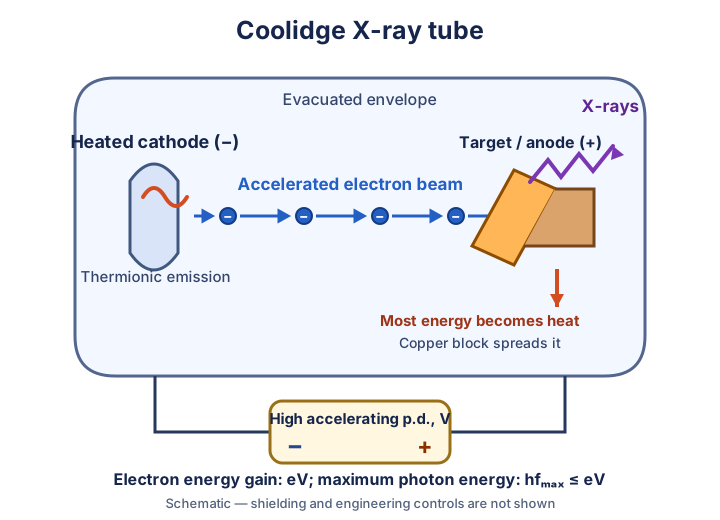
A Coolidge X-ray tube produces X-rays by:
- heating a cathode to emit electrons (thermionic emission),
- accelerating the electrons through a large potential difference V,
- decelerating them rapidly in a metal target (anode), converting energy into X-ray photons.
C. Accelerating potential, V
When an electron is accelerated through potential difference V, it gains kinetic energy: Δ E = eV where e = 1.60 × 10⁻¹⁹ C.
2. Key Ideas (What Earns Marks)
- The largest possible X-ray photon energy is about the electron’s kinetic energy gain: Eₘₐₓ ≈ eV
- So the shortest (cut-off) wavelength satisfies: λₘᵢₙ = hc/eV
- Only a small fraction of the electron energy becomes X-rays; most becomes heat in the target.
3. Detailed Explanations
A. Why a large potential difference matters
If the accelerating voltage is larger, each electron arrives with higher kinetic energy (eV). That increases:
- the maximum possible photon energy (so λₘᵢₙ becomes smaller),
- the overall X-ray intensity (more energy available per electron).
B. Why the target (anode) gets hot
Rapid deceleration in the target transfers energy to the lattice (atomic vibrations), so most input electrical energy becomes thermal energy in the target.
C. Material choices (engineering, not examinable)
Targets are chosen to manage heating and to improve X-ray output.
Common design goals:
- high melting point (to survive heating),
- good thermal conductivity (to spread heat),
- often high atomic number (increases X-ray production efficiency).
X-rays are ionising radiation. Production and shielding are tightly controlled in real equipment.
4. Common Mistakes
- Mixing up electron-volt (eV) (a unit of energy) with voltage V (potential difference).
- Thinking every electron produces a single photon of energy eV (in reality, there is a distribution of photon energies).
- Forgetting the cut-off wavelength depends on V, not on the filament temperature.
5. Exam Tips
- If a question gives an accelerating voltage and asks for the maximum photon energy or minimum wavelength, start with:
- Eₘₐₓ = eV
- λₘᵢₙ = hc/eV
- Keep units consistent: V in volts, h in J·s, c in m/s, so λ comes out in metres.
6. Worked Examples
Modelled example 1
Minimum wavelength from accelerating voltage
Problem
Study the worked solution
State the ideal maximum
Method
Set maximum photon energy equal to electron kinetic-energy gain.Reason
The cut-off case assumes one photon receives almost all eV.Working
hc/λₘᵢₙ = eVConvert voltage
Method
50 kV is 5.0 × 10⁴ V.Reason
SI substitution with charge in coulombs requires volts.Working
V = 5.0 × 10⁴ VCalculate
Method
Rearrange and substitute.Reason
The result is the shortest, highest-energy wavelength.Working
λₘᵢₙ = hc/eV = 2.5 × 10⁻¹¹ m = 0.025 nm
Guided practice 2
Maximum photon energy
Problem
Try this before viewing the solution
Hints
Hint 1: convert kilovolts
View solution step by step
Convert
Method
Write kilovolts as volts.Reason
The coulomb-volt product gives joules.Working
30 kV = 3.0 × 10⁴ VCalculate
Method
Multiply by the elementary charge.Reason
This is the maximum electron energy available to one photon.Working
Eₘₐₓ = (1.60 × 10⁻¹⁹)(3.0 × 10⁴) = 4.8 × 10⁻¹⁵ J
Common misconception 3
Voltage needed for a target cut-off wavelength (eV·nm shortcut)
Learner claim
Try this before viewing the solution
View solution step by step
Find photon energy
Method
Use the wavelength form in eV.Reason
The supplied constant pairs eV with nm.Working
Eₘₐₓ = 1240/0.020 = 6.2 × 10⁴ eV = 62 keVMap energy to voltage
Method
A single electron gains V eV through V volts.Reason
Electronvolt is an energy unit; volt is potential difference.Working
62 keV ↔ 62 kVState the answer
Method
The required accelerating potential is approximately 62 kV.Reason
That potential supplies up to 62 keV per electron.Working
V ≈ 62 kV
Examiner practice 4
Maximum frequency from accelerating voltage
Examination question
Try this before viewing the solution
View solution step by step
Convert voltage
1 markMethod
40 kV is 4.0 × 10⁴ V.Reason
Use SI units with coulombs.Working
V = 4.0 × 10⁴ VFind maximum energy
1 markMethod
Calculate eV.Reason
This is the ideal photon-energy maximum.Working
Eₘₐₓ = 6.4 × 10⁻¹⁵ JRelate energy and frequency
1 markMethod
Use Eₘₐₓ = hfₘₐₓ.Reason
Photon energy is proportional to frequency.Working
fₘₐₓ = Eₘₐₓ/hCalculate
1 markMethod
Evaluate and state hertz.Reason
Frequency has units s⁻¹.Working
fₘₐₓ = 9.7 × 10¹⁸ Hz
Self-mark with the mark scheme
Compare your response with each mark point. Select a point only when your response contains that evidence.
Self-mark voltage conversion, electron energy, photon relation and result.
Challenge 5
What changes when you increase V?
Independent transfer
Try this before viewing the solution
Hints
Hint 1: separate photon limit from output
View solution step by step
Cut-off
Method
λₘᵢₙ decreases.Reason
A larger V gives a larger maximum photon energy, and wavelength is inversely related.Working
λₘᵢₙ ∝ 1/VIntensity
Method
Overall X-ray intensity typically increases.Reason
Each electron arrives with more energy, increasing available X-ray output under the stated unchanged controls.Working
eV↑ ⇒ available energy per electron↑
7. Mind Stretchers
Mind stretcher 1: What changes if you increase filament current?Extension
Show Answer
Increasing filament current increases the number of electrons emitted per second, so X-ray intensity increases. The cut-off wavelength λₘᵢₙ is set mainly by accelerating voltage V, so it stays (approximately) unchanged.
Mind stretcher 2: Why does the target heat up so much?Extension
Explain why most of the electrical energy ends up as heat in the target rather than X-rays.
Show Answer
Most incoming electrons undergo many inelastic collisions with the target material, transferring energy to the lattice (atomic vibrations), which becomes thermal energy.
Only a small fraction of interactions produce X-ray photons, so X-ray production is inefficient and heating dominates.
8. Optional (Enrichment)
A. Why vacuum matters
The tube is evacuated so electrons can accelerate without frequent collisions with gas molecules (which would reduce electron energy and waste power as heat/light).
Continue with the next resource in this course.
Course and syllabus information
- Course
- A-level H2 Physics topic extensions
- Syllabus scope
- Beyond the syllabus
- Edition
- A-level H2 Physics topic extensions