Features of X-ray Spectrum
Key idea: Learn how an X-ray spectrum forms: continuous bremsstrahlung plus characteristic lines, and how accelerating voltage sets the cut-off wavelength (optional enrichment for A Level Physics).
Continue where you stopped
The core idea
On this page
Learning objectives
- Explore potential-barrier transmission, tunnelling and X-ray production and spectra beyond the H2 syllabus.
Continuous and characteristic X-ray spectra are not named in the current 9478 Quantum Physics outcomes. Keep this extension separate from the examinable treatment of atomic emission and absorption line spectra.
X-ray spectra are not a core H2 Physics (9478) learning outcome. Use this page as enrichment to practise photon energy ideas (E = hf = hc/λ) and energy transfer from accelerated electrons (eV).
1. Definitions (Must Know)
Continuous and characteristic X-ray spectrum
Relative intensity is zero below the minimum wavelength. From that cutoff a continuous background rises and falls, with narrow K beta and K alpha characteristic lines superimposed.
Scroll across the graph to read all labels.
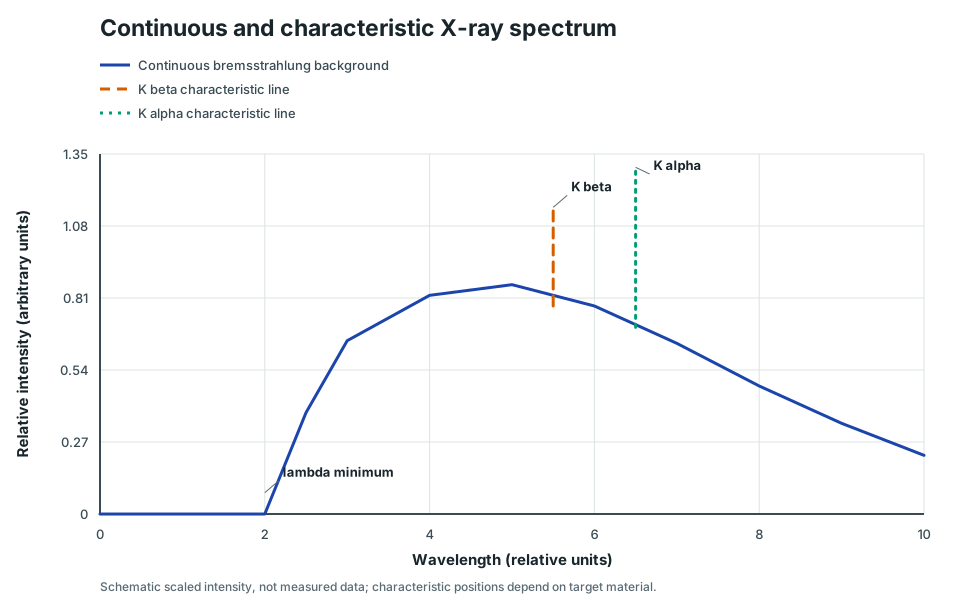
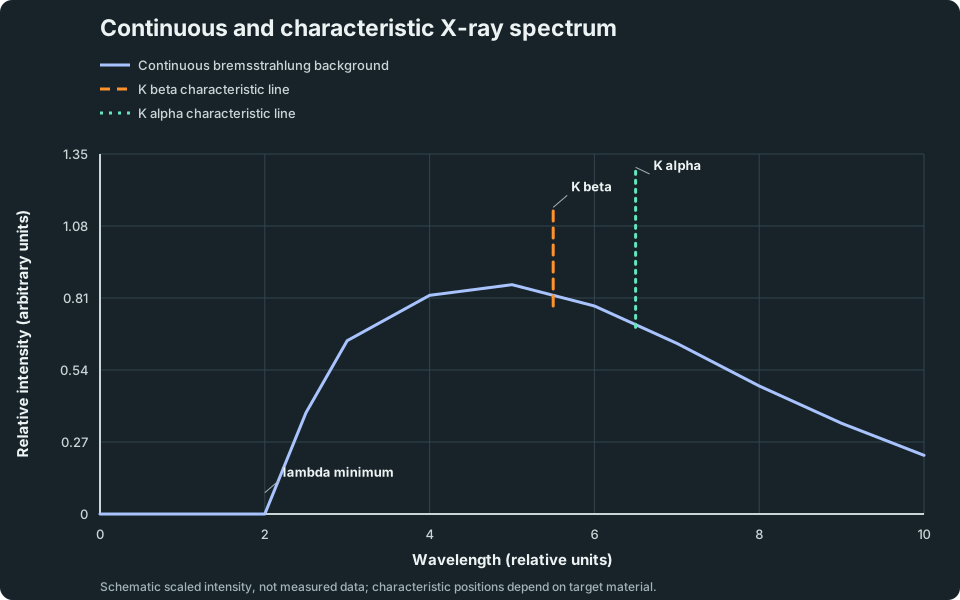
View figure data
| Series | Wavelength (relative units) | Wavelength uncertainty | Relative intensity (arbitrary units) | Relative intensity uncertainty |
|---|---|---|---|---|
| Continuous bremsstrahlung background | 0 | 0 | ||
| Continuous bremsstrahlung background | 1 | 0 | ||
| Continuous bremsstrahlung background | 2 | 0 | ||
| Continuous bremsstrahlung background | 2.5 | 0.38 | ||
| Continuous bremsstrahlung background | 3 | 0.65 | ||
| Continuous bremsstrahlung background | 4 | 0.82 | ||
| Continuous bremsstrahlung background | 5 | 0.86 | ||
| Continuous bremsstrahlung background | 6 | 0.78 | ||
| Continuous bremsstrahlung background | 7 | 0.64 | ||
| Continuous bremsstrahlung background | 8 | 0.48 | ||
| Continuous bremsstrahlung background | 9 | 0.34 | ||
| Continuous bremsstrahlung background | 10 | 0.22 | ||
| K beta characteristic line | 5.5 | 0.78 | ||
| K beta characteristic line | 5.5 | 1.15 | ||
| K alpha characteristic line | 6.5 | 0.7 | ||
| K alpha characteristic line | 6.5 | 1.3 |
A. Bremsstrahlung (continuous X-rays)
Bremsstrahlung (“braking radiation”) are X-ray photons emitted when fast electrons are decelerated in the target. Because electrons can lose any fraction of their energy in each interaction, the spectrum is continuous.
B. Characteristic X-rays (line peaks)
Characteristic X-rays are emitted when an incoming electron knocks out an inner-shell electron in the target atom, and another electron drops down to fill the vacancy. The photon energy equals the energy level difference, so the spectrum contains sharp peaks (discrete lines).
C. Cut-off (minimum) wavelength, λₘᵢₙ
The cut-off wavelength λₘᵢₙ is the shortest wavelength present in the continuous spectrum. It corresponds to the maximum possible photon energy.
If the electron is accelerated through potential difference V, the maximum photon energy is approximately: Eₘₐₓ ≈ eV so: λₘᵢₙ = hc/eV
2. Key Ideas (What Earns Marks)
- An X-ray spectrum has:
- a continuous background (bremsstrahlung),
- sharp peaks (characteristic X-rays).
- Increasing accelerating voltage V:
- decreases λₘᵢₙ (harder X-rays),
- increases overall intensity,
- does not shift the characteristic peak wavelengths (those depend mainly on target material).
- Maximum photon energy comes from conservation of energy: eV ≈ hc/λₘᵢₙ
3. Detailed Explanations
A. Why the spectrum has a continuous background
Incoming electrons are deflected by the electric field of nuclei in the target. Different encounters transfer different energy amounts to radiation, so photon energies range from near zero up to a maximum.
The maximum energy photon happens (approximately) when an electron loses almost all its kinetic energy in one interaction: eV ≈ Eₘₐₓ = hc/λₘᵢₙ
B. Why sharp peaks appear
If an incoming electron ejects an inner-shell electron of the target atom, an outer electron can drop into the vacancy and emit a photon with a fixed energy set by the target’s energy levels. That produces discrete (line) peaks.
C. What changes when you change V or the target material
- Increase V:
- λₘᵢₙ decreases,
- the continuous spectrum intensity increases.
- Change target material:
- characteristic peak positions change (different energy level spacings),
- the continuous background still exists.
4. Common Mistakes
- Using λₘᵢₙ to describe the characteristic peaks (cut-off applies to the continuous spectrum).
- Saying “doubling V doubles λₘᵢₙ” (it halves λₘᵢₙ, since λₘᵢₙ ∝ 1/V).
- Forgetting 1 eV = 1.60 × 10⁻¹⁹ J when mixing eV and SI units.
5. Exam Tips
- If a spectrum graph is given, identify:
- cut-off wavelength λₘᵢₙ (where the curve hits the axis),
- characteristic peaks (sharp spikes above the background).
- For calculations, start with: λₘᵢₙ = hc/eV
- State what stays the same when V changes: characteristic peak wavelengths.
6. Worked Examples
Modelled example 1
Cut-off wavelength
Problem
Study the worked solution
Identify the feature
Method
The cut-off is the shortest continuous-spectrum wavelength.Reason
It corresponds to the maximum possible bremsstrahlung photon energy.Working
eV = hc/λₘᵢₙConvert voltage
Method
100 kV is 1.00 × 10⁵ V.Reason
SI constants require volts.Working
V = 1.00 × 10⁵ VCalculate
Method
Rearrange and substitute.Reason
The result belongs to the continuous cutoff, not a characteristic line.Working
λₘᵢₙ = 1.24 × 10⁻¹¹ m = 0.0124 nm
Guided practice 2
Doubling the accelerating voltage
Problem
Try this before viewing the solution
Hints
Hint 1: separate the mechanisms
View solution step by step
Cut-off
Method
λₘᵢₙ halves.Reason
λₘᵢₙ = hc/(eV) is inversely proportional to voltage.Working
V × 2 ⇒ λₘᵢₙ/2Characteristic lines
Method
The characteristic peak wavelengths remain the same.Reason
The unchanged target retains the same inner-shell energy gaps.Working
Δ E_target unchanged
Common misconception 3
Voltage needed for a cut-off wavelength (eV·nm shortcut)
Learner claim
Try this before viewing the solution
View solution step by step
Classify the feature
Method
λₘᵢₙ is the continuous bremsstrahlung cutoff.Reason
It represents the maximum photon energy available from eV.Working
Eₘₐₓ = hc/λₘᵢₙCalculate energy
Method
Use the eV·nm shortcut.Reason
Units remain paired.Working
Eₘₐₓ = 1240/0.015 = 8.27 × 10⁴ eV = 82.7 keVMap to voltage
Method
The required accelerating voltage is about 82.7 kV, or 83 kV.Reason
One electron gains V eV through V volts.Working
V ≈ 83 kV
Examiner practice 4
Identify continuous vs characteristic features
Examination question
Try this before viewing the solution
View solution step by step
Identify background
1 markMethod
The smooth distribution ending at λₘᵢₙ is bremsstrahlung.Reason
It spans a continuous range of wavelengths.Working
continuous backgroundExplain background
1 markMethod
Fast electrons lose varying energy amounts when decelerated in the target.Reason
Different losses produce a continuum of photon energies.Working
Δ E variableIdentify peaks
1 markMethod
The narrow spikes are characteristic X-rays.Reason
They occur at discrete wavelengths.Working
sharp linesExplain peaks
1 markMethod
Outer electrons fill inner-shell vacancies and emit target-specific energy gaps.Reason
Atomic levels are discrete.Working
E_γ = Δ E_atomic
Self-mark with the mark scheme
Compare your response with each mark point. Select a point only when your response contains that evidence.
Self-mark identification and origin of the continuous and characteristic components.
Challenge 5
Changing the target material
Independent transfer
Try this before viewing the solution
Hints
Hint 1: assign each feature to its control
View solution step by step
Cut-off
Method
λₘᵢₙ remains approximately unchanged.Reason
The unchanged accelerating voltage fixes the maximum electron and photon energy.Working
λₘᵢₙ = hc/(eV)Characteristic peaks
Method
The peak wavelengths shift.Reason
Different target atoms have different inner-shell energy gaps.Working
Δ E_atomic changes ⇒ λₗᵢₙₑ changes
7. Mind Stretchers
Mind stretcher 1: Why is eV ≈ hc/λₘᵢₙ only an approximation?Extension
Show Answer
Some energy can go into other processes (heat, multiple photons, etc.), so “all electron kinetic energy goes into one photon” is an idealised maximum-energy case used to estimate the cut-off.
Mind stretcher 2: Why are characteristic lines superimposed on a continuous background?Extension
Explain why characteristic peaks appear on top of a continuous spectrum rather than replacing it.
Show Answer
Bremsstrahlung occurs for many deceleration interactions and produces a continuous range of photon energies.
Characteristic X-rays occur in addition when inner-shell vacancies are created and filled, producing discrete photon energies. Both processes happen in the target, so the characteristic lines appear on top of the continuous background.
8. Optional (Enrichment)
A. K-series lines (K_α, K_β)
Many textbooks label inner-shell characteristic lines as:
- K_α: transition into the n = 1 shell from n = 2
- K_β: transition into the n = 1 shell from n = 3
These details are useful for understanding spectra, but are not required for the 9478 quantum learning outcomes.
Continue with the next resource in this course.
Course and syllabus information
- Course
- A-level H2 Physics topic extensions
- Syllabus scope
- Beyond the syllabus
- Edition
- A-level H2 Physics topic extensions