Quantum Tunnelling
Key idea: Understand quantum tunnelling as a wavefunction effect: finite transmission through a potential barrier even when energy is below barrier height (optional enrichment for A Level Physics).
Continue where you stopped
The core idea
On this page
Learning objectives
- Explore potential-barrier transmission, tunnelling and X-ray production and spectra beyond the H2 syllabus.
Quantum tunnelling is not explicitly listed in the 9478 quantum learning outcomes. Treat this lesson as enrichment that builds on the syllabus idea that particles are described by wavefunctions and probability density.
1. Definitions (Must Know)
A. Potential barrier
A potential barrier is a region where the particle has higher potential energy U than in neighbouring regions.
In a simple 1D model, a barrier has:
- height U₀,
- width L.
B. Classically allowed vs forbidden
- If E > U₀, the particle is classically allowed to cross the barrier.
- If E < U₀, the barrier region is classically forbidden (the particle “shouldn’t” cross in classical physics).
C. Quantum tunnelling
Quantum tunnelling is when there is still a non-zero probability of finding the particle on the far side of the barrier even when E < U₀.
2. Key Ideas (What Earns Marks)
- In quantum physics, particles are described by a wavefunction ψ; probabilities come from |ψ|².
- In a classically forbidden region (E < U), the wavefunction does not become zero immediately; it decays (often exponentially).
- A thicker or “higher” barrier makes transmission less likely (probability decreases strongly, often exponentially).
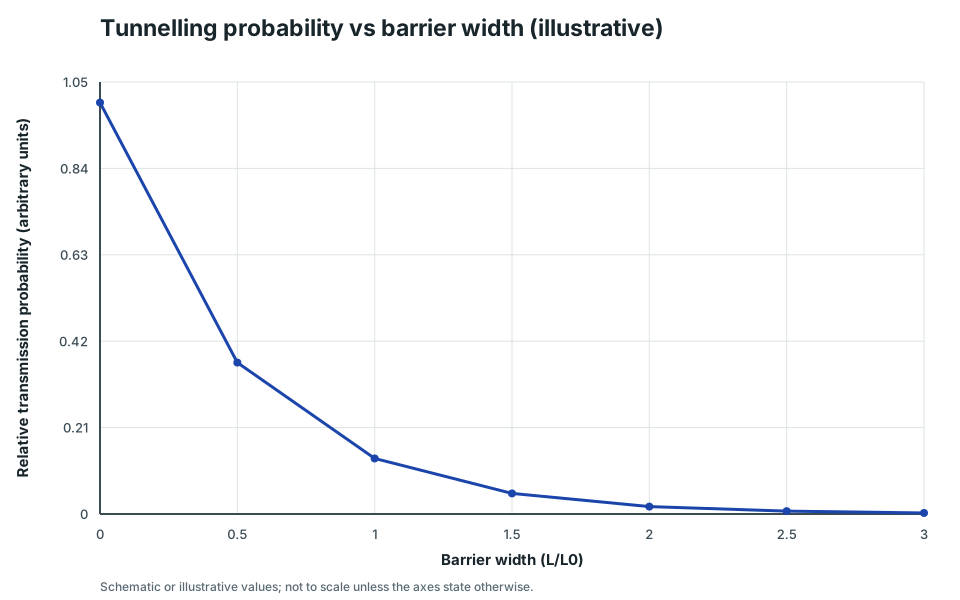
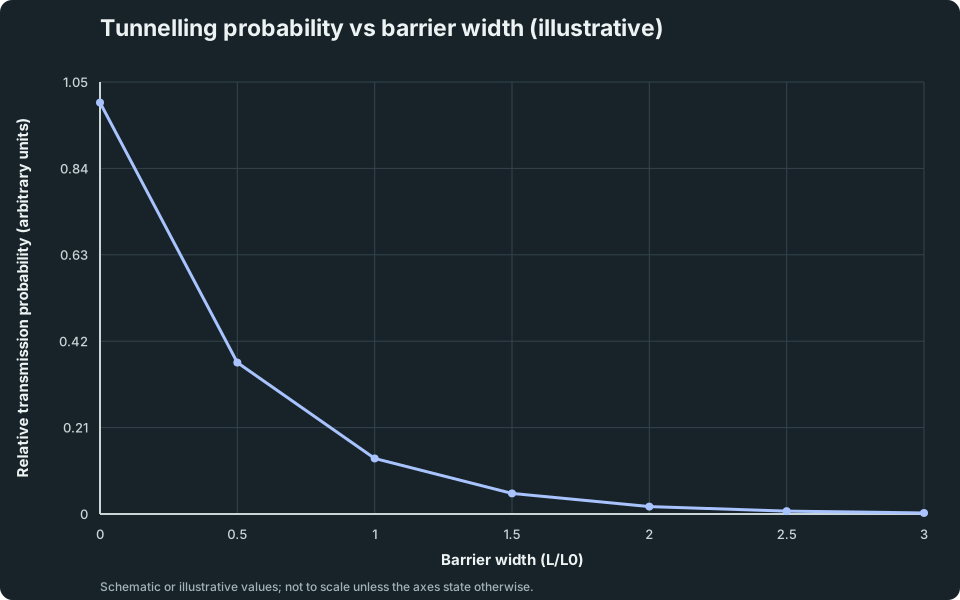
Tunnelling probability vs barrier width (illustrative)
An exponential-style decay showing that transmission probability drops rapidly as barrier width increases.
Scroll across the graph to read all labels.
View figure data
| Barrier width (L/L0) | T ∝ e^(−2κL) (scaled) |
|---|---|
| 0 | 1 |
| 0.5 | 0.368 |
| 1 | 0.135 |
| 1.5 | 0.05 |
| 2 | 0.018 |
| 2.5 | 0.007 |
| 3 | 0.0025 |
3. Detailed Explanations
The figure above combines the barrier profile with the incident, reflected, decaying and transmitted wavefunction regions.
A. Why tunnelling is possible (wavefunction view)
If a particle is described by a wavefunction, it is spread out in space: it does not have a single exact position.
At a barrier, the wavefunction must behave smoothly (it does not “snap” to zero at the boundary). Inside a region where E < U, the wavefunction typically decreases rapidly, but it can remain non-zero throughout the barrier.
If ψ is still non-zero at the far side, then |ψ|² is non-zero there too, so there is a finite probability the particle is detected beyond the barrier.
4. Common Mistakes
- Saying tunnelling “breaks conservation of energy” (it does not; the particle energy E stays the same in this simple model).
- Treating tunnelling as a particle “teleporting” (it is a probability effect from the wavefunction).
- Thinking E < U₀ means “impossible” (it is classically forbidden, not quantum-impossible).
5. Exam Tips
- If the question asks “what changes the tunnelling probability?”, state the trends clearly:
- barrier width L increases ⇒ transmission probability decreases,
- barrier height (or U₀-E) increases ⇒ transmission probability decreases,
- particle mass increases ⇒ transmission probability decreases.
- Use precise language: “probability decreases strongly (often exponentially)”.
6. Worked Examples
Modelled example 1
Trend question (no calculation)
Problem
Study the worked solution
Describe the forbidden region
Method
The wavefunction decays rather than becoming immediately zero inside the barrier.Reason
E < U₀ makes the region classically forbidden.Working
ψ∼ e^(-κ x)Increase the width
Method
A wider barrier gives the wavefunction a longer decay distance.Reason
Its amplitude at the far boundary becomes smaller.Working
L↑ ⇒ |ψ_far|↓State the probability trend
Method
Transmission probability decreases strongly, often exponentially.Reason
Detection probability depends on squared wavefunction magnitude.Working
T ∝ e^(-2κ L)
Common misconception 2
Comparing two particles
Learner claim
Try this before viewing the solution
View solution step by step
Identify the missing variable
Method
Barrier penetration depends on mass as well as energy and barrier properties.Reason
The decay constant increases with particle mass.Working
κ ∝ square root of (m(U₀-E))Compare masses
Method
The electron is much less massive than the proton.Reason
It therefore has a smaller decay constant for the same barrier.Working
mₑ≪ mₚ ⇒ κₑ < κₚConclude
Method
The electron is more likely to tunnel.Reason
Its wavefunction penetrates farther and produces a larger T.Working
Tₑ > Tₚ
7. Mind Stretchers
Mind stretcher 1: Why does tunnelling matter for microscopes?Extension
Show Answer
In a scanning tunnelling microscope, electrons tunnel across a tiny gap between a sharp tip and a conducting surface. The tunnelling current depends extremely strongly on the gap size, so measuring current can map surface height at near-atomic resolution.
8. Optional (Enrichment)
A. A common model for transmission probability
In many 1D models, the transmission probability has the form: T ∝ e^(-2κ L) where κ depends on the particle mass and on the energy gap (U₀-E).
B. Video intuition (optional)
Continue with the next resource in this course.
Course and syllabus information
- Course
- A-level H2 Physics topic extensions
- Syllabus scope
- Beyond the syllabus
- Edition
- A-level H2 Physics topic extensions