Scanning Tunneling Microscope
Key idea: See how a scanning tunnelling microscope (STM) uses electron tunnelling current to map conducting surfaces with near-atomic resolution (optional enrichment for A Level Physics).
Continue where you stopped
The core idea
On this page
Learning objectives
- Explore potential-barrier transmission, tunnelling and X-ray production and spectra beyond the H2 syllabus.
STM is an application of tunnelling and is not required by the 9478 quantum learning outcomes. Treat this page as enrichment that connects the tunnelling idea to a real device.
1. Definitions (Must Know)
A. Scanning tunnelling microscope (STM)
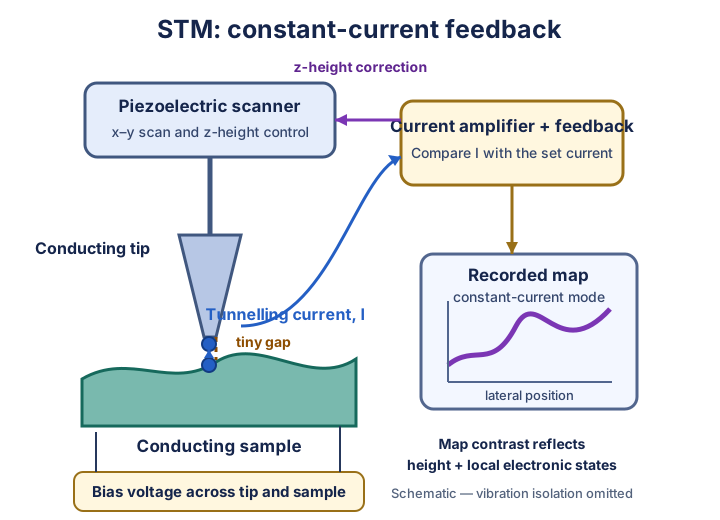
A scanning tunnelling microscope (STM) is a non-optical microscope that uses electron tunnelling between a sharp metallic tip and a conducting surface to map the surface at near-atomic scale.
B. Tunnelling current
The tunnelling current is the small current that flows because electrons can tunnel across the tiny gap between tip and surface.
C. Feedback control (constant-current mode)
In constant-current mode, a feedback circuit adjusts the tip height to keep the tunnelling current roughly constant while scanning. The recorded tip position produces a map influenced by both surface height and the availability of local electronic states; it is not a literal picture of hard atomic spheres.
2. Key Ideas (What Earns Marks)
- STM relies on tunnelling: electrons cross a classically forbidden gap.
- The tunnelling current depends extremely strongly on the tip–sample separation, so very small height changes produce measurable current changes (high resolution).
- STM requires a conducting path (tip and sample need to conduct).
3. Detailed Explanations
A. Why STM can “see” atoms
Quantum tunnelling probability falls very rapidly as the gap increases. That means the current changes a lot when the tip moves by a tiny amount, allowing very fine height sensitivity.
B. A typical constant-current workflow
- Set a bias voltage between tip and sample.
- Bring the tip close enough for a measurable tunnelling current.
- Scan sideways while a feedback loop adjusts the tip height to keep current constant.
- Plot the recorded tip height against lateral position. Interpret this constant-current contrast as a combination of surface topography and local electronic structure.
C. Limitations
STM needs a conducting surface. Insulating contamination layers (e.g. oxides) can suppress tunnelling current and reduce image quality.
4. Common Mistakes
- Thinking STM uses light (it is not an optical microscope).
- Saying electrons “jump because they have enough energy” (the point is tunnelling when energy is insufficient).
- Forgetting the need for conductivity (no reliable tunnelling current if the surface is insulating).
5. Exam Tips
- If asked “why is resolution high?”, answer with “tunnelling current depends extremely strongly on tip–sample separation.”
- If asked for limitations, lead with “requires conducting surface / clean surface”.
- Use the key link back to quantum content: the signal exists because tunnelling probability is non-zero.
6. Worked Examples
Modelled example 1
Trend question
Problem
Study the worked solution
Map the gap to a barrier
Method
The vacuum gap acts as the tunnelling-barrier width.Reason
Electrons cross a classically forbidden separation.Working
L≡ d_gapApply the decay trend
Method
A larger gap strongly reduces transmission probability.Reason
The wavefunction decays farther before reaching the sample.Working
T ∝ e^(-2κ d)Map probability to current
Method
Tunnelling current decreases strongly, often approximately exponentially.Reason
Fewer electrons tunnel per unit time at fixed bias.Working
d↑ ⇒ Iₜᵤₙₙₑₗ↓
Common misconception 2
Why feedback is needed
Learner claim
Try this before viewing the solution
View solution step by step
State the controlled quantity
Method
The feedback holds tunnelling current approximately constant.Reason
Current changes sharply with gap size.Working
Iₜᵤₙₙₑₗ ≈ IₛₑₜState the actuator
Method
The controller adjusts tip height while scanning sideways.Reason
Moving vertically restores the target separation-sensitive current.Working
zₜᵢₚ variesInterpret the map
Method
Recorded height reflects both topography and local electronic states.Reason
Tunnelling current depends on electronic-state availability as well as separation.Working
contrast = topographic + electronic influences
7. Mind Stretchers
Mind stretcher 1: Constant-current vs constant-height modeExtension
Which mode is safer for rough surfaces: constant-current or constant-height?
Show Answer
Constant-current is safer for rough surfaces because the tip height adjusts to avoid crashing into the sample. Constant-height can be faster but risks collision if the surface height varies too much.
8. Optional (Enrichment)
A. Historical note
Scanning tunnelling microscopy became a major surface-analysis technique in the 1980s and was recognised with the 1986 Nobel Prize in Physics.
B. Links
Continue with the next resource in this course.
Course and syllabus information
- Course
- A-level H2 Physics topic extensions
- Syllabus scope
- Beyond the syllabus
- Edition
- A-level H2 Physics topic extensions