Expansion work and pressure–volume areas
Key idea: A gas expanding against constant external pressure does work pΔV. Compression reverses the energy transfer; say whether work is done by the gas or on it.
Offline pages
Saved on this device only. Connect at least once every 30 days to confirm Premium. Sign-out or a change of account removes saved copies.
Loading guide controls…
Guided lessons · coming soon
Guided lesson
Guided steps
- Derive the constant-pressure work and identify whose pressure and sign enter it.
- Include both atmosphere and load before calculating the two work conventions.
- Calculate the signed volume change and both work values.
- Use the opposing pressure to find the work during expansion into empty space.
- Find the net work over the two different loads.
- Derive the piston work and explain the by-gas and on-gas conventions before comparing the criteria.
- Use the straight sloping path and the signed return area to find both work values.
On this page
You stopped at:
ContinueIn a car engine, burning fuel heats the gas in a cylinder, and the gas expands and pushes the piston down: the gas does work. A bicycle pump does the opposite, pushing a piston in and doing work on the air inside. Which way the energy goes depends on whether the gas expands or is compressed.
Work done by a gas
For a slowly moving piston with negligible friction and acceleration, the gas pressure balances the external pressure p. The resisting force is pA for piston area A. If the gas expands against this constant pressure p and the piston moves out a distance Δ x, the work done by the gas is
since AΔ x is the increase in volume, Δ V. The pressure here is the constant external pressure the gas expands against, which includes the atmosphere outside the piston as well as any load on it.
- When a gas expands, Δ V is positive: the gas does work on its surroundings, and energy leaves the gas.
- When a gas is compressed, the surroundings do work on the gas, and energy enters it.
So the work done on a gas is minus the work done by it. Always say which one you mean.
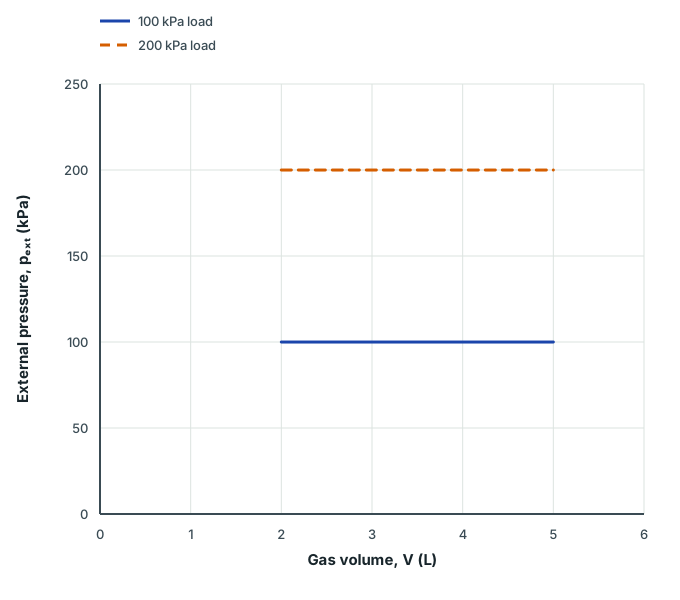
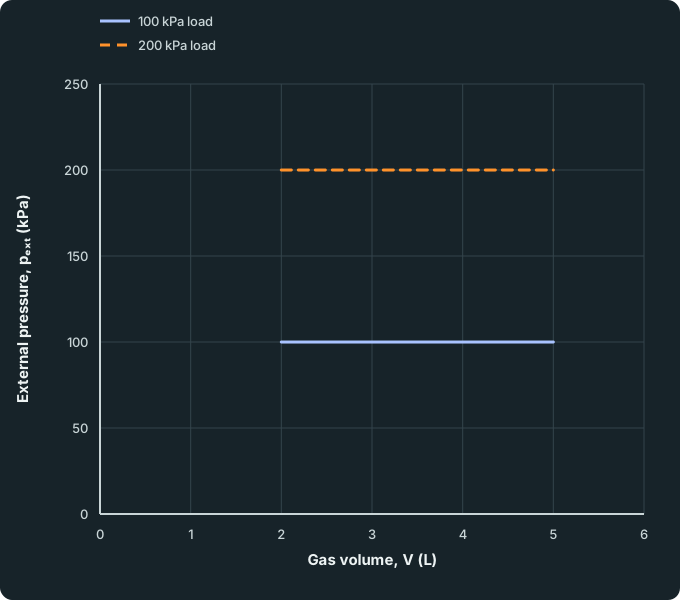
On a graph of external pressure against volume, the signed work done by the gas is the area under the path between the starting and finishing volumes. For a quasi-static process the gas pressure is effectively equal to the external pressure, so the gas’s pressure–volume graph gives the same area. For a constant pressure the area is a rectangle. One kilopascal times one litre is one joule.
Two opposing loads during expansion
Horizontal lines at 100 and 200 kilopascals span volumes two to five litres. Their work areas are 300 and 600 joules respectively.
Scroll across the figure to read all labels.
View figure data
| Gas volume, V (L) | 100 kPa load | 200 kPa load |
|---|---|---|
| 2 | 100 | 200 |
| 5 | 100 | 200 |
Worked example 1
Expanding against the atmosphere and a load
Problem
Gas in a cylinder expands slowly from 2.00 L to 5.00 L, pushing a piston against atmospheric pressure, 100 kPa, and a load that adds a further 50.0 kPa. Find the work done by the gas and the work done on it.
Show full solution
External pressure
Method
Add the atmospheric pressure and the load.Reason
The gas has to push back both the atmosphere and the load.Working
Answer
p = 100 + 50.0 = 150 kPa = 1.50 × 10⁵ Pa
Volume change
Reason
Final minus initial; convert litres to cubic metres.Working
Answer
Δ V = 5.00-2.00 = 3.00 L = 3.00 × 10⁻³ m³
Work
Working
Answer
Work done by the gas = pΔ V = (1.50 × 10⁵)(3.00 × 10⁻³) = +450 J, so the work done on the gas is -450 J.
Quick check
Using only the load’s 50.0 kPa would give 150 J and miss the work done pushing back the atmosphere.
Guided practice 2
A compression
Problem
A gas is compressed from 5.0 × 10⁻³ m³ to 3.0 × 10⁻³ m³ at a constant pressure of 2.0 × 10⁵ Pa. Find the work done by the gas and the work done on it.
Find both values
Show the steps Optional working
Show the steps Optional working
Hints
Hint 1
sign of ΔV
Δ V is final minus initial volume, which is negative when the gas is compressed.
Show solution step by step
Volume change
Reason
The gas ends up smaller.Working
Answer
Δ V = 3.0 × 10⁻³-5.0 × 10⁻³ = -2.0 × 10⁻³ m³
Work
Working
Answer
Work done by the gas = pΔ V = (2.0 × 10⁵)(-2.0 × 10⁻³) = -400 J; work done on the gas = +400 J. Energy enters the gas.
Spot the mistake 3
Expanding into a vacuum
Problem
Gas at 100 kPa fills 2.00 L of a rigid box; the other 3.00 L is empty. A partition is removed and the gas spreads through the whole box. A learner calculates the work done by the gas as 100 kPa × 3.00 L = 300 J. What is the work done by the gas?
Find the work
Show solution step by step
External pressure
Reason
The gas expands into empty space, so nothing pushes back.Working
Answer
pₑₓₜₑᵣₙₐₗ = 0
Work
Working
Answer
Work done = 0 × Δ V = 0. Against a constant external pressure of 100 kPa, the same expansion would do 300 J of work.
Common mistake
The pressure in W = pΔ V is the external pressure the gas pushes against, not the pressure of the gas itself.
Try it yourself 4
Out and back again
Problem
A gas expands from 2.00 L to 5.00 L at a constant pressure of 100 kPa, then is compressed back to 2.00 L at a constant pressure of 250 kPa. Find the total work done by the gas over both stages.
Find the total work
Show the steps Optional working
Hints
Hint 1
stage by stage
The volume ends where it started, but the pressures differ, so work out each stage separately. 1 kPa × 1 L = 1 J.
Show solution step by step
Each stage
Reason
Each stage has its own pressure and sign of Δ V.Working
Answer
Expansion: 100 × (+3.00) = +300 J. Compression: 250 × (-3.00) = -750 J.
Total
Working
Answer
+ 300-750 = -450 J: overall, 450 J of work is done on the gas. The volume returns to its starting value, but the net work is not zero, because work depends on the path, not just the start and end volumes.
Exam-style question 1
Work done by an expanding gas
Examination question
(a) A gas expands against a constant external pressure p, pushing a piston of area A out through a distance Δ x. Show that the work done by the gas is pΔ V. [2 marks]
(b) Explain the difference between the work done by a gas and the work done on a gas. [2 marks]
Write your answer before viewing the mark scheme
Show solution step by step
(a) Derivation
2 marksMethod
Use work = force × distance.Reason
The force on the piston is pressure × area.Working
Answer
F = pA, so W = FΔ x = pAΔ x. The change in volume is Δ V = AΔ x, so W = pΔ V.
(b) By and on
2 marksWorking
Answer
When a gas expands, it does work on its surroundings and energy leaves the gas. When it is compressed, the surroundings do work on it and energy enters the gas. The work done on the gas is minus the work done by it.
Self-mark with the mark scheme
Tick each mark point that your answer includes.
Tick each point only if your answer states it clearly.
Check your understanding 1 A sloping pressure–volume path
A gas expands quasi-statically from 2.00 L at 100 kPa to 5.00 L at 200 kPa. On its pressure–volume graph the path is a straight line. It then returns to 2.00 L at a constant external pressure of 100 kPa. Find the work done by the gas on the outward stage and the net work done by it over both stages. Ignore any work during a pressure adjustment at fixed volume.
Show the steps Optional working
Show the steps Optional working
Show answer
Outward work = (1/2)(100 + 200)(5.00-2.00) = +450 J. The return contributes 100(2.00-5.00) = -300 J, giving net work + 150 J. The outward path has changing pressure, so using only its starting pressure misses the triangular area. Returning to the same volume does not make the work zero.
Common mistakes
- Not saying whether W is work done by the gas or on the gas.
- Using the gas’s own pressure instead of the external pressure, especially for expansion into a vacuum.
- Leaving out atmospheric pressure from the external pressure.
- Forgetting that Δ V is negative in a compression.
- Multiplying kPa by litres and calling the answer kJ; it is J.
Spotted an error? Report a correction
Syllabus and review details
- GCE A-Level H2 Physics 2027 · 2027
Content Overview, PDF pages 9–10; Subject Content, PDF pages 11–30
Last reviewed: