A Level Thermal Physics Hub
A Level Physics thermal hub: thermodynamic temperature, ideal gases, kinetic theory, internal energy, thermodynamic laws, heat capacity and latent heat.
Learning goals
- Use thermodynamic temperature and convert between Celsius and kelvin.
- Use ideal-gas equations with particles, moles and SI units.
- Apply the kinetic model to gas pressure and mean translational kinetic energy.
- Derive pV = ⅓Nm⟨c²⟩ from the definition of pressure and a one-dimensional model of molecular collisions extended to three dimensions.
- Relate microscopic energy, internal energy and thermal equilibrium.
- Apply work conventions and the zeroth and first laws of thermodynamics.
- Define and use heat capacity and specific heat capacity in energy balances.
- Define and use specific latent heat in phase-change energy balances.
Thermal Physics links measurable states such as pressure, volume and temperature to microscopic energy and particle motion. The route below separates gas-model assumptions, energy stores, energy transfers and phase changes so that each equation is used with the correct system and conditions.
Understand first: revise energy transfers and changes of state in O Level Thermal Physics, then review momentum change in Kinematics before the kinetic-theory derivation.
Common mark-loss errors: using Celsius in gas equations, mixing n with N, treating heat as stored energy, changing the meaning of work in the first law, and combining temperature-change and phase-change stages into one equation.
Move to structured work when: you can define the system, name each transfer, state the work convention and write one energy term for every stage of a thermal process.
Lessons
Work through these lessons in order.
- Thermodynamic temperature and Celsius conversion
- Ideal-gas equations, particles and moles
- Kinetic model, pressure derivation and molecular energy
- Internal energy, temperature and thermal equilibrium
- Work, zeroth law and first law
- Specific heat capacity and specific latent heat
- Thermodynamic Temperature Scale (Kelvin)
Learn what makes the Kelvin scale an absolute thermodynamic temperature scale and how to convert between Celsius and kelvin for A Level Physics.
- Ideal Gas
Learn the ideal gas equation of state pV = NkT and how to use it in calculations with moles, particles and SI units (A Level Physics).
- Pressure in gases: Boyle’s law
Learn Boyle’s law for a fixed mass of gas: absolute pressure, isothermal compression, p–V graphs, particle reasoning, and worked A Level examples.
- Kinetic Theory of Gases
Derive pV = (1/3)Nm⟨c^2⟩ from the particle model, connect it to pV = NkT, and solve kinetic theory questions (A Level Physics).
- Thermodynamic Systems
Internal energy, thermal equilibrium (zeroth law), and work done by/on a gas (W = pΔV) for A Level Physics.
- First Law of Thermodynamics
Apply the first law of thermodynamics ΔU = Q + W (work done on the system), including constant-volume and constant-pressure (pΔV) cases (A Level Physics).
- Specific Heat Capacity
Define and use heat capacity and specific heat capacity, solve energy-balance problems, and evaluate an electrical heating experiment.
- Specific Latent Heat
Define and use specific latent heat, interpret constant-temperature phase changes, and solve multi-stage thermal energy balances.
- Questions for Thermal Physics (JC) Set 1
A Level Physics thermal physics practice questions (JC Set 1), with worked answers.
- Questions for Thermal Physics (JC) Set 2
More A Level Physics thermal physics practice questions (JC Set 2), with worked answers.
Revision
Quick Reference
| Law / Quantity | Formula | Unit |
|---|---|---|
| Ideal Gas Law | pV = nRT or pV = NkT | - |
| Mean KE | ⟨Eₖ⟩ = (3/2)kT | Joule (J) |
| First law (work sign defined) | Δ U = Q + Wₒₙ | J |
| Constant-pressure work | W_by = pΔ V; Wₒₙ = -pΔ V | J |
| Specific heat capacity | Q = mcΔ T | J kg⁻¹ K⁻¹ |
| Specific latent heat | Q = ml | J kg⁻¹ |
Constants: R = 8.31 J mol⁻¹K⁻¹, k = 1.38 × 10⁻²³ J K⁻¹
Exam templates (fast marks)
1) Gas law conversions
- Convert temperature to Kelvin: T = θ + 273.15.
- Convert units consistently (Pa, m³, mol).
- Use pV = nRT (moles) or pV = NkT (molecules), not both.
2) First law questions
- State the sign convention you are using (this hub uses Δ U = Q + W where W is work done on the gas).
- Identify the process (isothermal, isobaric, isochoric, adiabatic) if given.
- Use W_by = pΔ V only when the external pressure is constant, and reverse its sign for Wₒₙ.
- Use special cases: isochoric Δ V = 0 ⇒ W = 0; isothermal ideal gas Δ U = 0.
Graph Skills (Exam + Practical)
Absolute zero from a pressure–temperature graph
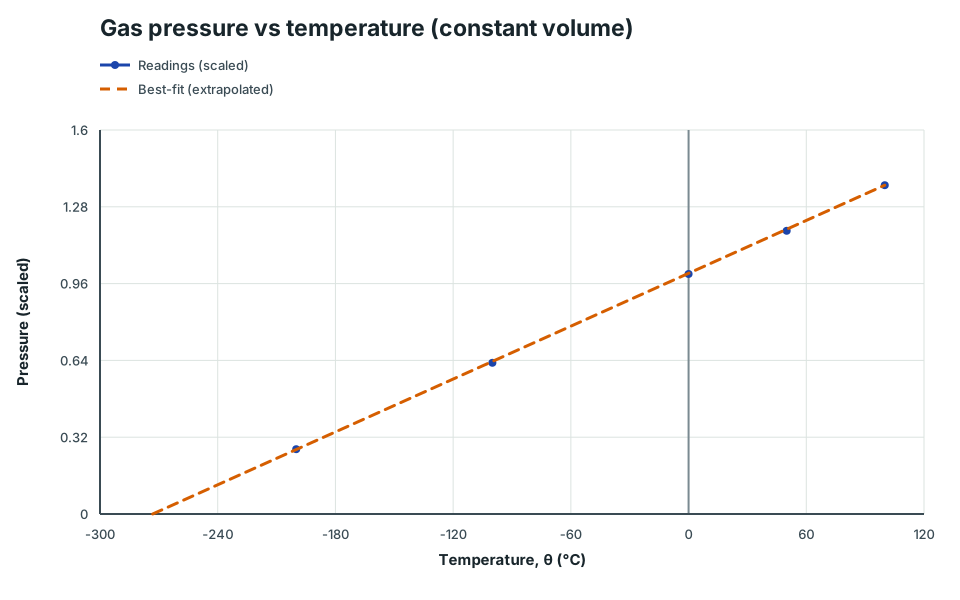
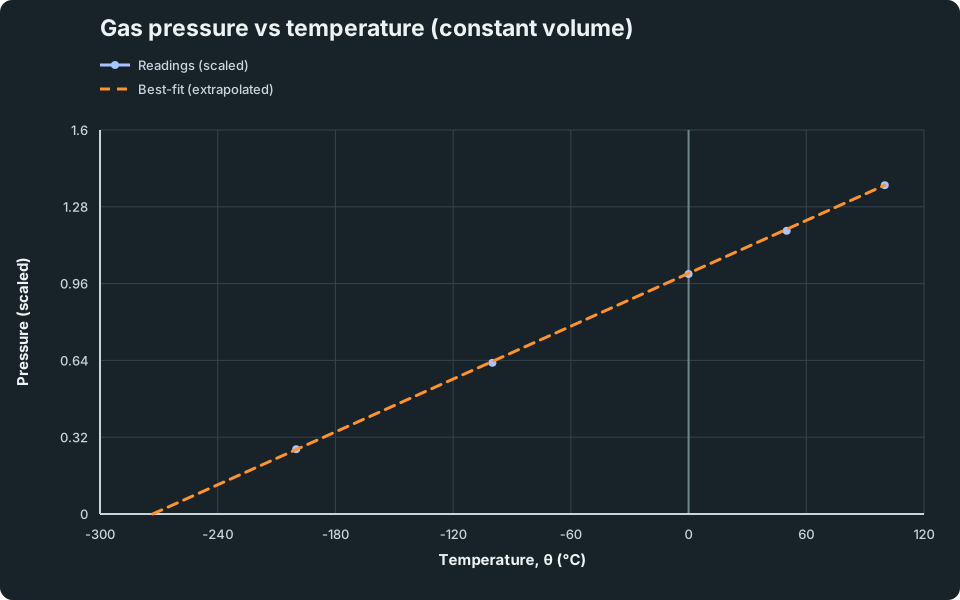
At constant volume, the ideal gas law implies p ∝ T (Kelvin). If you plot pressure against temperature in °C and extrapolate, the line hits p = 0 at about -273.15°C.
Gas pressure vs temperature (constant volume)
A straight-line p–θ plot that extrapolates to zero pressure at about −273 °C, illustrating absolute zero.
Scroll across the graph to read all labels.
View figure data
| Series | Temperature, θ (°C) | Temperature, θ uncertainty | Pressure (scaled) | Pressure uncertainty |
|---|---|---|---|---|
| Readings (scaled) | -200 | 0.27 | ||
| Readings (scaled) | -100 | 0.63 | ||
| Readings (scaled) | 0 | 1 | ||
| Readings (scaled) | 50 | 1.18 | ||
| Readings (scaled) | 100 | 1.37 | ||
| Best-fit (extrapolated) | -273.15 | 0 | ||
| Best-fit (extrapolated) | 100 | 1.37 |
What You Must Memorise
- Ideal Gas Assumptions: Random motion, negligible volume of particles, elastic collisions, negligible forces between collisions.
- Absolute Zero: The temperature at which gas pressure/volume extrapolates to zero (0K or -273.15°C).
- Internal energy: the sum of microscopic kinetic and potential energies associated with the particles of a system.
- First Law: The increase in internal energy equals the heat supplied plus work done on the system.
- Isothermal: Constant temperature (Δ U = 0 for ideal gas).
- Adiabatic: No heat transfer (Q = 0).
Top Exam Traps
- Work Sign Convention: Be VERY careful. Is it work done ON the gas (+W, compresses) or BY the gas (-W, expands)? The formula Δ U = Q + W assumes work ON.
- Temperature Unit: Always convert ° C to Kelvin for gas laws (T = θ + 273.15).
- rms Speed: square root of (⟨c²⟩) is the root-mean-square speed. ⟨c⟩² is the square of the mean speed. They are not the same.
- Internal Energy: For an ideal gas, U depends only on Temperature. If T is constant (isothermal), Δ U = 0.
- Mole vs Molecule: Don’t mix up n (moles, use R) and N (molecules, use k).
Practice
Use the two quizzes to diagnose gaps: the temperature and ideal gases quiz checks Kelvin temperature, the gas equations and kinetic theory, and the thermodynamic systems quiz checks internal energy, work done on a gas and the first law. Then complete the structured set without formula prompts:
A Level Temperature & Ideal Gases QuizA Level Thermodynamic Systems QuizThermal Physics Structured SetA Level Quiz HubThe two legacy JC sets remain available for extra questions: Set 1 and Set 2.
Next hub: Electric Fields
Continue with the next resource in this course.
Course and syllabus information
- Course
- GCE A-Level H2 Physics
- Edition
- GCE A-Level H2 Physics 2027