Kinetic Theory of Gases
Key idea: Derive pV = (1/3)Nm⟨c^2⟩ from the particle model, connect it to pV = NkT, and solve kinetic theory questions (A Level Physics).
Continue where you stopped
The core idea
On this page
Learning objectives
- Apply the kinetic model to gas pressure and mean translational kinetic energy.
- Derive pV = ⅓Nm⟨c²⟩ from the definition of pressure and a one-dimensional model of molecular collisions extended to three dimensions.
1. Definitions (Must Know)
- Pressure, p (Pa): force per unit area, p = F/A.
- Thermodynamic temperature, T (K): temperature on an absolute scale.
- Boltzmann constant, k (J K⁻¹).
- Number of particles, N (dimensionless): number of gas molecules/atoms.
- Amount of substance, n (mol).
- Avogadro constant, N_A = 6.02 × 10²³ mol⁻¹.
- Molar gas constant, R (J mol⁻¹ K⁻¹): R = N_A k.
- Mean square speed, ⟨c²⟩ (m² s⁻²): average of c² over all particles.
- Root-mean-square speed, cᵣₘₛ (m s⁻¹): cᵣₘₛ = square root of (⟨c²⟩).
2. Key Ideas (What Earns Marks)
- Equation of state (particle form):
- pV = NkT
- Moles vs particles:
- N = nN_A, R = N_A k ⇒ Nk = nR ⇒ pV = nRT
- Kinetic theory key result:
- pV = (1/3)Nm⟨c²⟩
- Mean translational kinetic energy:
- (1/2)m⟨c²⟩ = (3/2)kT
- so cᵣₘₛ = square root of (3kT/m) = square root of (3RT/M) where m is the mass of one molecule and M is molar mass (kg mol⁻¹).
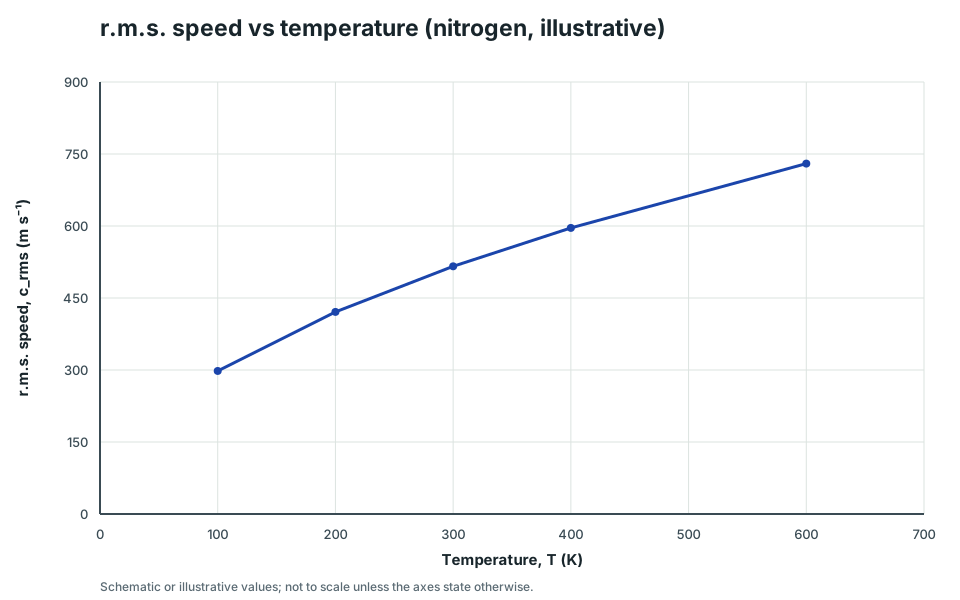
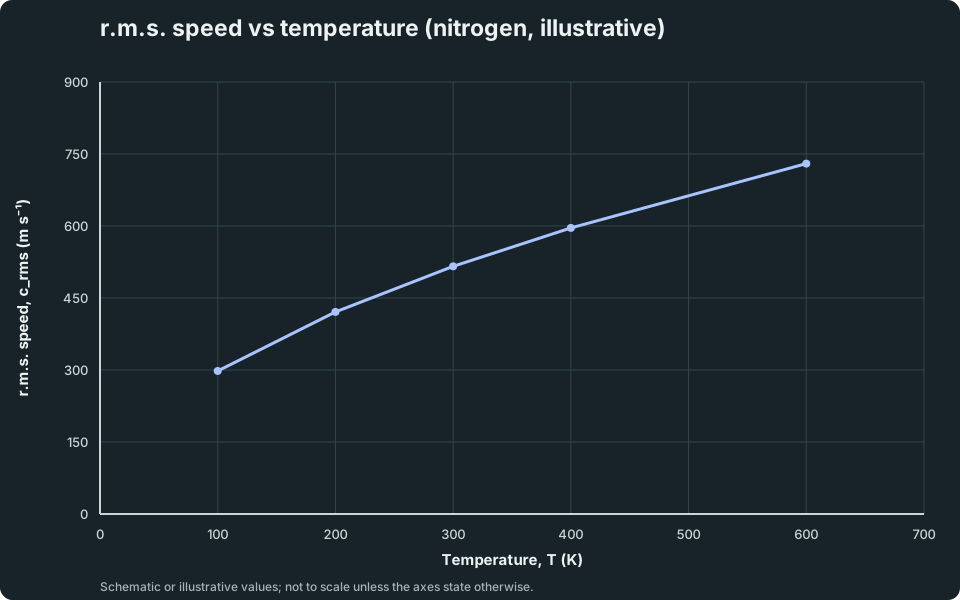
Graph intuition: cᵣₘₛ vs T
Exam trap: doubling thermodynamic temperature does not double molecular speed. Since cᵣₘₛ ∝ square root of T, it only increases by a factor of square root of 2.
r.m.s. speed vs temperature (nitrogen, illustrative)
A square-root curve showing c_rms increasing with temperature; doubling T increases c_rms by √2.
Scroll across the graph to read all labels.
View figure data
| Temperature, T (K) | Nitrogen (M = 0.028 kg mol⁻¹) |
|---|---|
| 100 | 298 |
| 200 | 421 |
| 300 | 516 |
| 400 | 596 |
| 600 | 730 |
3. Detailed Explanations
A. Assumptions of the kinetic theory (syllabus-level)
- A gas contains a very large number of identical particles in random motion.
- The particles occupy negligible volume compared to the container volume.
- There are no intermolecular forces except during collisions.
- Collisions between particles and with the container walls are perfectly elastic.
- The duration of collisions is negligible compared to the time between collisions.
B. Derivation of pV = (1/3)Nm⟨c²⟩
Consider a cubical container of side length L (so volume V = L³).
Take one molecule of mass m with velocity component cₓ towards a wall perpendicular to the x-axis.
-
Change in momentum in one elastic collision with the wall: Δ p = 2mcₓ
-
Time between successive collisions with the same wall: Δ t = 2L/cₓ
-
Average force on the wall from this molecule:
For N molecules,
Pressure is p = F/A and the wall area is A = L², so
So pV = Nm⟨cₓ²⟩
For random motion in 3D, the motion is symmetric so ⟨cₓ²⟩ = ⟨c_y²⟩ = ⟨c_z²⟩ = 1/3⟨c²⟩
Hence,
C. Mean translational kinetic energy and temperature
From the two equations of state: pV = NkT and pV = (1/3)Nm⟨c²⟩
Equate them and cancel N: kT = (1/3)m⟨c²⟩
Multiply both sides by 3/2: (3/2)kT = (1/2)m⟨c²⟩
So the mean translational kinetic energy per particle is proportional to T: Eₖ bar = (3/2)kT
4. Common Mistakes
- Using T in °C (must convert to K).
- Using molar mass (kg mol⁻¹) as m (kg). If you use molar mass M, use cᵣₘₛ = square root of (3RT/M).
- Mixing up mean speed and r.m.s. speed (exams usually want cᵣₘₛ).
- Using V in cm³ or p in kPa without converting to SI.
5. Exam Tips
- Decide early if you’re using:
- pV = NkT (particle count), or
- pV = nRT (moles).
- Show your conversion step clearly: N = nN_A.
- Unit check: pV has unit Pa·m³ = J.
6. Worked Examples
Modelled example 1
Find number of molecules using pV = NkT
Problem
Study the worked solution
Choose the particle equation
Method
Use pV = NkT.Reason
The unknown N is a number of molecules, so it pairs with Boltzmann’s constant.Working
pV = NkTRearrange and substitute
Method
Make N the subject and insert the SI quantities.Reason
pV and kT both have energy units, leaving a dimensionless particle count.Working
N = pV/kT = ((1.00 × 10⁵)(2.0 × 10⁻³))/((1.38 × 10⁻²³)(300))Evaluate
Method
The gas contains approximately 4.83 × 10²² molecules.Reason
The result is a count, so it has no physical unit.Working
N ≈ 4.83 × 10²²
Guided practice 2
Find cᵣₘₛ using cᵣₘₛ = square root of (3RT/M)
Problem
Try this before viewing the solution
Hints
Hint 1: match the mass scale
Hint 2: preserve the square root
View solution step by step
Select the molar form
Method
Use cᵣₘₛ = square root of (3RT/M).Reason
The supplied mass is molar mass in kg mol⁻¹, not the mass of one molecule.Working
cᵣₘₛ = square root of (3RT/M)Substitute
Method
Insert T in kelvin and M in SI units.Reason
The expression under the square root then has units of speed squared.Working
cᵣₘₛ = square root of (3(8.31)(300)/0.028)Evaluate
Method
The r.m.s. speed is about 5.2 × 10² m s⁻¹.Reason
The square root converts mean-square-speed scale to speed.Working
cᵣₘₛ ≈ 5.2 × 10² m s⁻¹
Common misconception 3
Use pV = (1/3)Nm⟨c²⟩
Learner claim
Try this before viewing the solution
View solution step by step
Correct the speed quantity
Method
Use ⟨c²⟩ = cᵣₘₛ² = 500².Reason
R.m.s. speed is defined as the square root of mean square speed.Working
⟨c²⟩ = (500 m s⁻¹)²Rearrange for pressure
Method
Divide the kinetic-theory result by volume.Reason
pV = (1/3)Nm⟨c²⟩.Working
p = (Nm cᵣₘₛ²)/3VCalculate
Method
The pressure is approximately 7.8 × 10⁴ Pa.Reason
Squaring the speed supplies the correct dimensions and magnitude.Working
p = ((2.0 × 10²²)(4.7 × 10⁻²⁶)(500²))/(3(1.0 × 10⁻³)) ≈ 7.8 × 10⁴ Pa
Examiner practice 4
Mean kinetic energy → temperature
Examination question
Try this before viewing the solution
View solution step by step
State the energy relation
1 markMethod
Use ⟨Eₖ⟩ = (3/2)kT.Reason
Thermodynamic temperature is proportional to mean translational kinetic energy per particle.Working
⟨Eₖ⟩ = (3/2)kTRearrange and substitute
1 markMethod
Make T the subject and insert the energy and k.Reason
The energy is per molecule, matching Boltzmann’s constant.Working
T = (2⟨Eₖ⟩)/3k = (2(6.21 × 10⁻²¹))/(3(1.38 × 10⁻²³))Evaluate
1 markMethod
The temperature is 3.00 × 10² K.Reason
The absolute-temperature unit follows from joules divided by joules per kelvin.Working
T = 300 K
Self-mark with the mark scheme
Compare your response with each mark point. Select a point only when your response contains that evidence.
Self-mark the relation, rearrangement and final temperature.
Challenge 5
Density form: p = (1/3)ρ cᵣₘₛ²
Independent transfer
Try this before viewing the solution
Hints
Hint 1: recognise the compressed representation
View solution step by step
Interpret the density form
Method
Use the given bulk density directly with the molecular r.m.s. speed.Reason
ρ = Nm/V compresses the particle-count, molecular-mass and volume factors in the original relation.Working
p = (1/3)ρ cᵣₘₛ²Substitute and calculate
Method
The pressure is 1.00 × 10⁵ Pa.Reason
Density times speed squared has pressure units.Working
p = (1/3)(1.2)(500²) = 1.00 × 10⁵ Pa
7. Mind Stretchers
Mind stretcher 1: Show pV = nRT starting from pV = NkTExtension
Show Answer
Use N = nN_A: pV = NkT = (nN_A)kT = n(N_Ak)T
Since R = N_Ak, this gives pV = nRT.
Mind stretcher 2: Link pressure to mean kinetic energyExtension
Show that: pV = (2/3)N⟨Eₖ⟩ where ⟨Eₖ⟩ is the mean translational kinetic energy per particle.
Show Answer
From kinetic theory: pV = (1/3)Nm⟨c²⟩ But ⟨Eₖ⟩ = (1/2)m⟨c²⟩, so m⟨c²⟩ = 2⟨Eₖ⟩.
Substitute: pV = (1/3)N(2⟨Eₖ⟩) = (2/3)N⟨Eₖ⟩
Mind stretcher 3: Optional (Enrichment)Extension
A. Pressure units you may see outside SI
- 1 atm = 1.013 × 10⁵ Pa (often rounded to 1.0 × 10⁵ Pa)
- 1 bar = 1.0 × 10⁵ Pa, and 1 mbar = 100 Pa (same as 1 hPa)
- 760 mmHg ≈ 1 atm, so 1 mmHg ≈ 133 Pa
- 1 inHg ≈ 3.39 × 10³ Pa
For barometer details (vacuum vs trapped gas), see Barometer.
Continue with the next resource in this course.
Course and syllabus information
- Course
- GCE A-Level H2 Physics
- Edition
- GCE A-Level H2 Physics 2027