Molecular energy, temperature and r.m.s. speed
Key idea: An ideal gas molecule's mean translational kinetic energy is 3kT/2. At the same kelvin temperature, heavier molecules have the same mean energy but a lower r.m.s. speed.
Offline pages
Saved on this device only. Connect at least once every 30 days to confirm Premium. Sign-out or a change of account removes saved copies.
Loading guide controls…
Guided lessons · coming soon
Guided lesson
Guided steps
- Use both pressure equations to connect temperature and molecular energy.
- Square the speeds before averaging, and use the matching mass constant.
- Follow the energy and speed calculation for nitrogen.
- Calculate the r.m.s. speed to three significant figures.
- Find both heating factors to three significant figures.
- Find both factors, then compare gases with different molecular masses.
- Calculate mean kinetic energy from the individual squared speeds.
- Find each temperature using that gas’s molar mass and speed.
- Derive the energy relation, find temperature and explain the mass effect.
On this page
You stopped at:
ContinueThe kinetic theory gives the pressure of a gas in terms of its molecules’ speeds; the equation of state gives the same pressure in terms of its temperature. Putting the two together reveals what temperature actually measures: the average translational kinetic energy of the molecules.
Temperature and the mean kinetic energy of a molecule
For the same sample of an ideal gas, pV = (1/3)Nm⟨c²⟩ and pV = NkT. Equating them and cancelling N:
Multiplying both sides by 3/2,
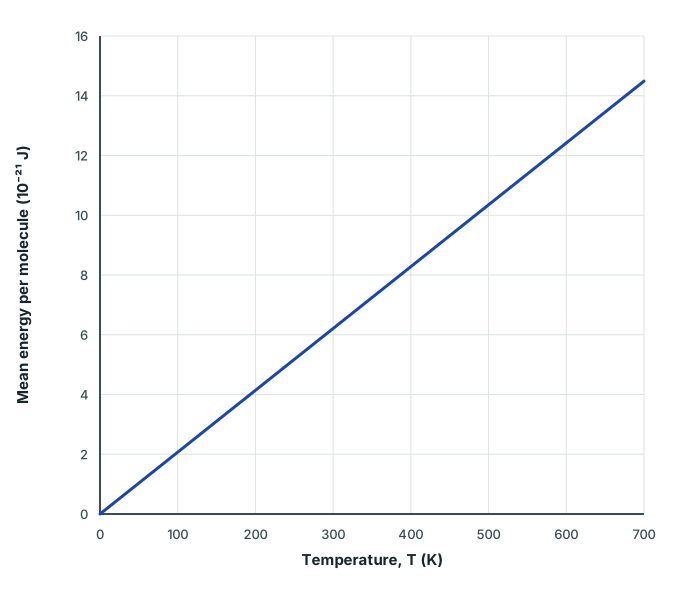
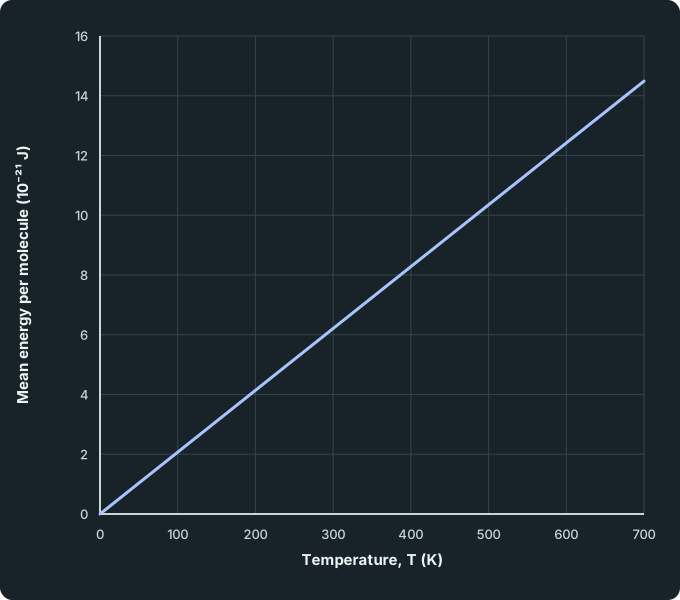
The left-hand side is the mean translational kinetic energy of a molecule: the average kinetic energy due to the motion of its centre of mass. So the mean translational kinetic energy of a molecule of an ideal gas is directly proportional to its thermodynamic temperature. Double the temperature in kelvin, and the mean kinetic energy doubles.
Two points to notice:
- It is a mean. At any instant the molecules have a wide spread of speeds and energies; (3/2)kT is their average.
- The mass of the molecule does not appear in (3/2)kT. At the same temperature, the molecules of every ideal gas have the same mean translational kinetic energy, whether they are light helium atoms or heavy carbon dioxide molecules.
Mean translational energy against temperature
A straight line through the origin has energy 6.21 times ten to the minus 21 joules at 300 kelvin.
Scroll across the figure to read all labels.
View figure data
| Temperature, T (K) | Any ideal-gas molecular mass |
|---|---|
| 0 | 0.000 |
| 10 | 0.207 |
| 20 | 0.414 |
| 30 | 0.621 |
| 40 | 0.828 |
| 50 | 1.035 |
| 60 | 1.242 |
| 70 | 1.449 |
| 80 | 1.656 |
| 90 | 1.863 |
| 100 | 2.070 |
| 110 | 2.277 |
| 120 | 2.484 |
| 130 | 2.691 |
| 140 | 2.898 |
| 150 | 3.105 |
| 160 | 3.312 |
| 170 | 3.519 |
| 180 | 3.726 |
| 190 | 3.933 |
| 200 | 4.140 |
| 210 | 4.347 |
| 220 | 4.554 |
| 230 | 4.761 |
| 240 | 4.968 |
| 250 | 5.175 |
| 260 | 5.382 |
| 270 | 5.589 |
| 280 | 5.796 |
| 290 | 6.003 |
| 300 | 6.210 |
| 310 | 6.417 |
| 320 | 6.624 |
| 330 | 6.831 |
| 340 | 7.038 |
| 350 | 7.245 |
| 360 | 7.452 |
| 370 | 7.659 |
| 380 | 7.866 |
| 390 | 8.073 |
| 400 | 8.280 |
| 410 | 8.487 |
| 420 | 8.694 |
| 430 | 8.901 |
| 440 | 9.108 |
| 450 | 9.315 |
| 460 | 9.522 |
| 470 | 9.729 |
| 480 | 9.936 |
| 490 | 10.143 |
| 500 | 10.350 |
| 510 | 10.557 |
| 520 | 10.764 |
| 530 | 10.971 |
| 540 | 11.178 |
| 550 | 11.385 |
| 560 | 11.592 |
| 570 | 11.799 |
| 580 | 12.006 |
| 590 | 12.213 |
| 600 | 12.420 |
| 610 | 12.627 |
| 620 | 12.834 |
| 630 | 13.041 |
| 640 | 13.248 |
| 650 | 13.455 |
| 660 | 13.662 |
| 670 | 13.869 |
| 680 | 14.076 |
| 690 | 14.283 |
| 700 | 14.490 |
Root-mean-square speed
The root-mean-square speed is the square root of the mean of the squares of the speeds:
Square each speed, find the mean, then take the square root, in that order. For four molecules moving at 100, 100, 300 and 300 m s⁻¹, the mean speed is 200 m s⁻¹, but the mean of the squares is 50 000 m² s⁻², so c_(r.m.s.) = 224 m s⁻¹. The r.m.s. speed is the one that goes with kinetic energy.
Rearranging (1/2)m⟨c²⟩ = (3/2)kT,
using either the mass m of one molecule with k, or the molar mass M (in kg mol⁻¹) with R. At the same temperature, lighter molecules move faster: they need a larger ⟨c²⟩ to have the same kinetic energy. For one gas, c_(r.m.s.) ∝ square root of T, so four times the thermodynamic temperature means twice the r.m.s. speed.
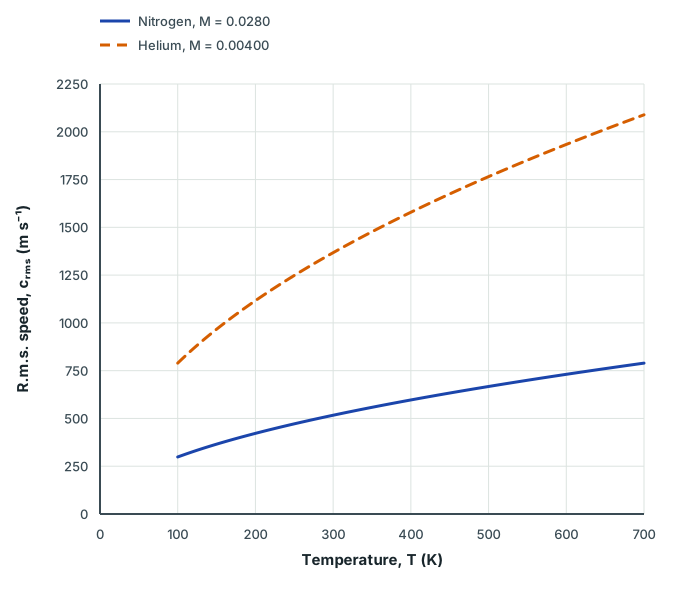
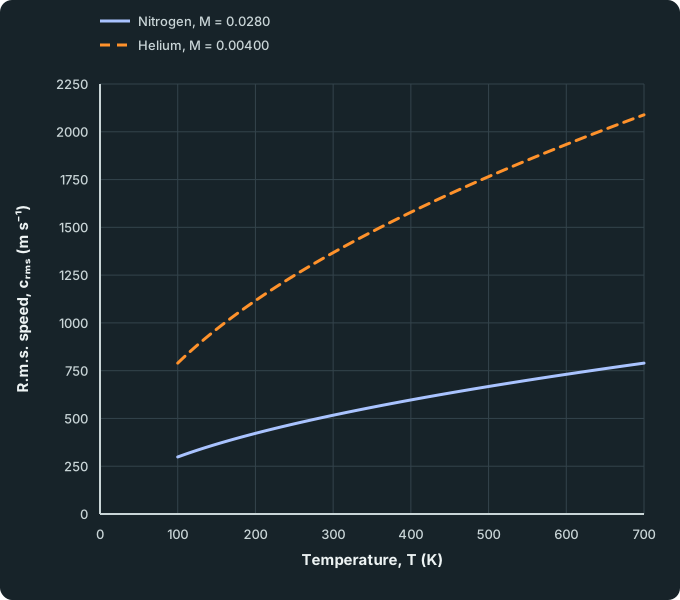
R.m.s. speed for nitrogen and helium
Both square-root curves increase from 100 to 700 kelvin. At 300 kelvin nitrogen is about 517 metres per second and helium about 1367 metres per second.
Scroll across the figure to read all labels.
View figure data
| Temperature, T (K) | Nitrogen, M = 0.0280 | Helium, M = 0.00400 |
|---|---|---|
| 100 | 298.4 | 789.5 |
| 105 | 305.8 | 809.0 |
| 110 | 313.0 | 828.0 |
| 115 | 320.0 | 846.6 |
| 120 | 326.9 | 864.8 |
| 125 | 333.6 | 882.6 |
| 130 | 340.2 | 900.1 |
| 135 | 346.7 | 917.3 |
| 140 | 353.1 | 934.1 |
| 145 | 359.3 | 950.6 |
| 150 | 365.4 | 966.9 |
| 155 | 371.5 | 982.9 |
| 160 | 377.4 | 998.6 |
| 165 | 383.3 | 1014.1 |
| 170 | 389.1 | 1029.3 |
| 175 | 394.7 | 1044.4 |
| 180 | 400.3 | 1059.2 |
| 185 | 405.9 | 1073.8 |
| 190 | 411.3 | 1088.2 |
| 195 | 416.7 | 1102.4 |
| 200 | 422.0 | 1116.5 |
| 205 | 427.2 | 1130.3 |
| 210 | 432.4 | 1144.0 |
| 215 | 437.5 | 1157.6 |
| 220 | 442.6 | 1171.0 |
| 225 | 447.6 | 1184.2 |
| 230 | 452.5 | 1197.3 |
| 235 | 457.4 | 1210.2 |
| 240 | 462.3 | 1223.0 |
| 245 | 467.1 | 1235.7 |
| 250 | 471.8 | 1248.2 |
| 255 | 476.5 | 1260.7 |
| 260 | 481.1 | 1273.0 |
| 265 | 485.7 | 1285.2 |
| 270 | 490.3 | 1297.2 |
| 275 | 494.8 | 1309.2 |
| 280 | 499.3 | 1321.0 |
| 285 | 503.7 | 1332.8 |
| 290 | 508.1 | 1344.4 |
| 295 | 512.5 | 1355.9 |
| 300 | 516.8 | 1367.4 |
| 305 | 521.1 | 1378.7 |
| 310 | 525.4 | 1390.0 |
| 315 | 529.6 | 1401.2 |
| 320 | 533.8 | 1412.2 |
| 325 | 537.9 | 1423.2 |
| 330 | 542.0 | 1434.1 |
| 335 | 546.1 | 1445.0 |
| 340 | 550.2 | 1455.7 |
| 345 | 554.2 | 1466.4 |
| 350 | 558.2 | 1476.9 |
| 355 | 562.2 | 1487.5 |
| 360 | 566.2 | 1497.9 |
| 365 | 570.1 | 1508.3 |
| 370 | 574.0 | 1518.6 |
| 375 | 577.8 | 1528.8 |
| 380 | 581.7 | 1538.9 |
| 385 | 585.5 | 1549.0 |
| 390 | 589.3 | 1559.1 |
| 395 | 593.0 | 1569.0 |
| 400 | 596.8 | 1578.9 |
| 405 | 600.5 | 1588.8 |
| 410 | 604.2 | 1598.5 |
| 415 | 607.9 | 1608.3 |
| 420 | 611.5 | 1617.9 |
| 425 | 615.1 | 1627.5 |
| 430 | 618.8 | 1637.1 |
| 435 | 622.3 | 1646.6 |
| 440 | 625.9 | 1656.0 |
| 445 | 629.5 | 1665.4 |
| 450 | 633.0 | 1674.7 |
| 455 | 636.5 | 1684.0 |
| 460 | 640.0 | 1693.2 |
| 465 | 643.4 | 1702.4 |
| 470 | 646.9 | 1711.5 |
| 475 | 650.3 | 1720.6 |
| 480 | 653.7 | 1729.6 |
| 485 | 657.1 | 1738.6 |
| 490 | 660.5 | 1747.5 |
| 495 | 663.9 | 1756.4 |
| 500 | 667.2 | 1765.3 |
| 505 | 670.5 | 1774.1 |
| 510 | 673.9 | 1782.9 |
| 515 | 677.2 | 1791.6 |
| 520 | 680.4 | 1800.2 |
| 525 | 683.7 | 1808.9 |
| 530 | 686.9 | 1817.5 |
| 535 | 690.2 | 1826.0 |
| 540 | 693.4 | 1834.5 |
| 545 | 696.6 | 1843.0 |
| 550 | 699.8 | 1851.5 |
| 555 | 703.0 | 1859.8 |
| 560 | 706.1 | 1868.2 |
| 565 | 709.3 | 1876.5 |
| 570 | 712.4 | 1884.8 |
| 575 | 715.5 | 1893.1 |
| 580 | 718.6 | 1901.3 |
| 585 | 721.7 | 1909.5 |
| 590 | 724.8 | 1917.6 |
| 595 | 727.8 | 1925.7 |
| 600 | 730.9 | 1933.8 |
| 605 | 733.9 | 1941.8 |
| 610 | 737.0 | 1949.8 |
| 615 | 740.0 | 1957.8 |
| 620 | 743.0 | 1965.7 |
| 625 | 746.0 | 1973.7 |
| 630 | 748.9 | 1981.5 |
| 635 | 751.9 | 1989.4 |
| 640 | 754.9 | 1997.2 |
| 645 | 757.8 | 2005.0 |
| 650 | 760.7 | 2012.7 |
| 655 | 763.7 | 2020.5 |
| 660 | 766.6 | 2028.2 |
| 665 | 769.5 | 2035.8 |
| 670 | 772.4 | 2043.5 |
| 675 | 775.2 | 2051.1 |
| 680 | 778.1 | 2058.7 |
| 685 | 781.0 | 2066.2 |
| 690 | 783.8 | 2073.7 |
| 695 | 786.6 | 2081.2 |
| 700 | 789.5 | 2088.7 |
Worked example 1
Nitrogen at room temperature
Problem
Nitrogen, of molar mass 0.0280 kg mol⁻¹, is at 300 K. Find the mean translational kinetic energy of a molecule and the r.m.s. speed.
Show full solution
Mean kinetic energy
Method
Use (1/2)m⟨c²⟩ = (3/2)kT.Reason
The mean energy per molecule depends only on the temperature.Working
Answer
(3/2)kT = (3/2)(1.38 × 10⁻²³)(300) = 6.21 × 10⁻²¹ J
R.m.s. speed
Working
Answer
The molar mass is given, so use R: c_(r.m.s.) = square root of (3RT/M) = square root of (3(8.31)(300)/0.0280) = 517 m s⁻¹
Quick check
Helium (M = 0.00400 kg mol⁻¹) at 300 K has the same mean kinetic energy, but an r.m.s. speed square root of 7 times larger, 1.37 × 10³ m s⁻¹, as the graph shows.
Check your understanding 1 Find the r.m.s. speed
Three molecules have speeds 100, 200 and 300 m s⁻¹. Calculate their r.m.s. speed to three significant figures.
Show the steps Optional working
Show answer
c_(r.m.s.) = square root of ((100² + 200² + 300²)/3) = 216 m s⁻¹. The mean speed is 200 m s⁻¹; squaring that mean would discard the spread in speeds.
Guided practice 2
Heating from 20 °C to 40 °C
Problem
A gas is heated from 20.0 °C to 40.0 °C. By what factor does the mean kinetic energy of its molecules increase? By what factor does the r.m.s. speed increase? Give both factors to three significant figures.
Find both factors
Show the steps Optional working
Hints
Hint 1
kelvin
Which temperature scale belongs in the energy and speed equations?
Show solution step by step
Temperature ratio
Reason
The relations use thermodynamic temperature.Working
Answer
T₂/T₁ = 313.15/293.15 = 1.068
Factors
Working
Answer
The mean kinetic energy rises by a factor of 1.07, and the r.m.s. speed by square root of (313.15/293.15) = 1.03, both to three significant figures. Neither doubles: 40 °C is not twice as hot as 20 °C.
Check your understanding 2 Twice the speed
The r.m.s. speed of the molecules of a gas doubles. By what factor have the thermodynamic temperature and the mean kinetic energy changed? Does a faster gas always have the higher temperature?
Show answer
Both increase four times, because they are proportional to ⟨c²⟩. Not when comparing different gases: temperature depends on m⟨c²⟩, so a gas of heavy, slow molecules can be hotter than a gas of light, fast ones.
Spot the mistake 3
Squaring the mean speed
Problem
In a group of identical molecules, each of mass 4.00 × 10⁻²⁶ kg, half move at 200 m s⁻¹ and half at 600 m s⁻¹. A learner finds the mean speed, 400 m s⁻¹, and gives the mean kinetic energy as (1/2)m(400)² = 3.20 × 10⁻²¹ J. Find the correct mean kinetic energy.
Find the mean kinetic energy
Show the steps Optional working
Show solution step by step
Mean of the squares
Reason
Each molecule’s kinetic energy depends on its own speed squared.Working
Answer
⟨c²⟩ = (200² + 600²)/2 = (40 000 + 360 000)/2 = 2.00 × 10⁵ m² s⁻²
Mean kinetic energy
Working
Answer
(1/2)m⟨c²⟩ = (1/2)(4.00 × 10⁻²⁶)(2.00 × 10⁵) = 4.00 × 10⁻²¹ J, and c_(r.m.s.) = square root of (2.00 × 10⁵) = 447 m s⁻¹
Common mistake
⟨c⟩² and ⟨c²⟩ are different: squaring the mean speed gave an energy 20% too small.
Try it yourself 4
Can the slower gas be hotter?
Problem
Helium atoms (M = 0.00400 kg mol⁻¹) in one container have an r.m.s. speed of 900 m s⁻¹. Nitrogen molecules (M = 0.0280 kg mol⁻¹) in another have an r.m.s. speed of 500 m s⁻¹. Find the temperature of each gas.
Find both temperatures
Hints
Hint 1
rearrange
Rearrange the r.m.s. speed equation to make temperature the subject.
Show solution step by step
Temperatures
Reason
Each gas has its own molar mass and speed.Working
Answer
Helium: T = 0.00400(900)²/3(8.31) = 130 K. Nitrogen: T = 0.0280(500)²/3(8.31) = 281 K.
Which is hotter
Working
Answer
The nitrogen is hotter, and its molecules have about 2.2 times the mean kinetic energy, even though they move more slowly. Speed alone does not decide temperature; mass matters too.
Exam-style question 1
Temperature from molecular energy
Examination question
(a) Use pV = (1/3)Nm⟨c²⟩ and pV = NkT to show that the mean translational kinetic energy of a molecule of an ideal gas is (3/2)kT. [2 marks]
(b) The molecules of a gas have a mean translational kinetic energy of 1.242 × 10⁻²⁰ J. Find the temperature of the gas. State whether molecules of twice the mass, at the same temperature, would have more kinetic energy. [3 marks]
Write your answer before viewing the mark scheme
Show solution step by step
(a) Derivation
2 marksMethod
Equate the two expressions for pV.Reason
They describe the same gas, so N cancels.Working
Answer
(1/3)Nm⟨c²⟩ = NkT, so (1/3)m⟨c²⟩ = kT. Multiplying by 3/2: (1/2)m⟨c²⟩ = (3/2)kT.
(b) Temperature and mass
3 marksWorking
Answer
T = (2(1.242 × 10⁻²⁰))/(3(1.38 × 10⁻²³)) = 600 K. No: at the same temperature the mean kinetic energy is the same, (3/2)kT; the heavier molecules have half the mean-square speed.
Self-mark with the mark scheme
Tick each mark point that your answer includes.
Tick each point only if your answer shows it.
Common mistakes
- Squaring the mean speed instead of finding the mean of the squared speeds.
- Thinking heavier molecules have more kinetic energy at the same temperature.
- Thinking every molecule has the energy (3/2)kT; that is the mean.
- Using a molar mass with k, or the mass of one molecule with R.
- Using Celsius temperatures in (3/2)kT.
Spotted an error? Report a correction
Syllabus and review details
- GCE A-Level H2 Physics 2027 · 2027
Content Overview, PDF pages 9–10; Subject Content, PDF pages 11–30
Last reviewed: