Gas changes at constant temperature, volume or pressure
Key idea: For a fixed amount of ideal gas, pV/T stays constant. Decide which quantity is held fixed and use absolute pressure and kelvin temperature when comparing states.
Offline pages
Saved on this device only. Connect at least once every 30 days to confirm Premium. Sign-out or a change of account removes saved copies.
Loading guide controls…
Guided lessons · coming soon
Guided lesson
Guided steps
- Identify the fixed quantities before cancelling terms.
- Use absolute temperatures for the fixed-volume pressure ratio.
- Find the pressure when the Celsius reading doubles.
- Choose what cancels and calculate the volume with kelvin temperatures.
- Find both volume ratios, keeping particle number changes.
- Find pressure after gas removal and heating.
- Explain inverse volume using molecular collisions and the graphs.
- Find absolute pressure before subtracting atmospheric pressure.
- Correct the experiment and explain the inverse-volume graph.
On this page
You stopped at:
ContinueHeat the air in a sealed bottle and its pressure rises; heat the air in a balloon and the balloon swells. Which happens depends on what is held fixed. Comparing two states of the same gas with the equation of state always starts by deciding what stays the same.
Comparing two states
For a fixed amount of gas, N and k are the same in both states, so pV = NkT gives
Cancel whatever else is fixed:
- at constant temperature, p₁V₁ = p₂V₂: pressure and volume are inversely proportional (Boyle’s law);
- at constant volume, p₂/p₁ = T₂/T₁: pressure is proportional to thermodynamic temperature;
- at constant pressure, V₂/V₁ = T₂/T₁: volume is proportional to thermodynamic temperature.
In a ratio, pressures and volumes can stay in any units, as long as both states use the same ones. Temperatures must be in kelvin, because the proportionality starts from absolute zero. Pressures must be absolute, not gauge readings.
If gas is added or removed, N changes and does not cancel: p₂V₂/p₁V₁ = N₂T₂/N₁T₁.
Worked example 1
Heating gas in a rigid container
Problem
A fixed amount of gas in a rigid container has an absolute pressure of 100 kPa at 27 °C. It is heated to 127 °C. Find the new pressure.
Show full solution
What is fixed
Method
Cancel the volume and the number of molecules.Reason
The container is rigid and sealed, so only p and T change.Working
Answer
p₂/p₁ = T₂/T₁
New pressure
Working
Answer
T₁ = 300.15 K and T₂ = 400.15 K, so p₂ = 100 × 400.15/300.15 = 133 kPa
Quick check
The thermodynamic temperature rises by about a third, so the pressure does too. The Celsius ratio, 127/27, would wrongly give more than four times the pressure.
Spot the mistake 2
Does the pressure double?
Problem
Gas in a rigid, sealed container has an absolute pressure of 80.0 kPa at 20.0 °C. It warms to 40.0 °C. A learner says the pressure doubles to 160 kPa, because the temperature has doubled. Find the actual pressure.
Find the pressure
Show the steps Optional working
Show solution step by step
Kelvin ratio
Reason
Pressure is proportional to temperature measured from absolute zero.Working
Answer
T₂/T₁ = 313.15/293.15 = 1.068, not 2
Pressure
Working
Answer
p₂ = 80.0 × 1.068 = 85.5 kPa
Common mistake
40 °C is not twice as hot as 20 °C: the Celsius zero is not absolute zero. Measured from absolute zero, the temperature has risen by only 7%.
Guided practice 3
Heating at constant pressure
Problem
A fixed amount of gas occupies 2.00 L at 20.0 °C. It is heated to 80.0 °C at constant pressure. Find its new volume.
Find the volume
Show the steps Optional working
Hints
Hint 1
what cancels
Which two quantities remain constant in the stated change?
Hint 2
temperatures
Convert both temperatures to kelvin and retain the unrounded readings for the ratio.
Show full solution
New volume
Working
Answer
V₂ = 2.00 × 353.15/293.15 = 2.41 L: about 20% larger, not four times larger.
Check your understanding 1 Choosing what cancels
At constant pressure, the thermodynamic temperature of a fixed amount of gas halves. What happens to its volume? What if, at the same time, the number of molecules doubled?
Show answer
The volume halves. If N also doubles, NT is unchanged, so at the same pressure the volume stays the same.
Try it yourself 4
Hotter, but at lower pressure
Problem
Gas in a rigid container has an absolute pressure of 100 kPa at 20.0 °C. Half of the gas is let out, then the container is sealed and the remaining gas is heated to 80.0 °C. Find the final pressure.
Find the pressure
Show the steps Optional working
Hints
Hint 1
what changes
Which terms can cancel, and which change between the initial and final states?
Show solution step by step
Two factors
Reason
Half the molecules remain, and the temperature ratio uses kelvin.Working
Answer
N₂/N₁ = 0.500 and T₂/T₁ = 353.15/293.15 = 1.205
Pressure
Working
Answer
p₂ = 100 × 0.500 × 353.15/293.15 = 60.2336… kPa ≈ 60.2 kPa. The gas is hotter, but with half as many molecules hitting the walls, the pressure is lower than at the start.
Boyle’s law
At constant temperature, halving the volume of a fixed amount of gas doubles its pressure. The molecules move just as fast as before, but there are twice as many in each cubic metre, so they hit each square metre of wall twice as often.
A graph of p against V is a curve: the product pV stays the same. Plotting p against 1/V gives a straight line through the origin.
Boyle’s law: pressure against volume
Pressure falls from four times reference pressure at one quarter reference volume to one quarter pressure at four times volume.
Scroll across the figure to read all labels.
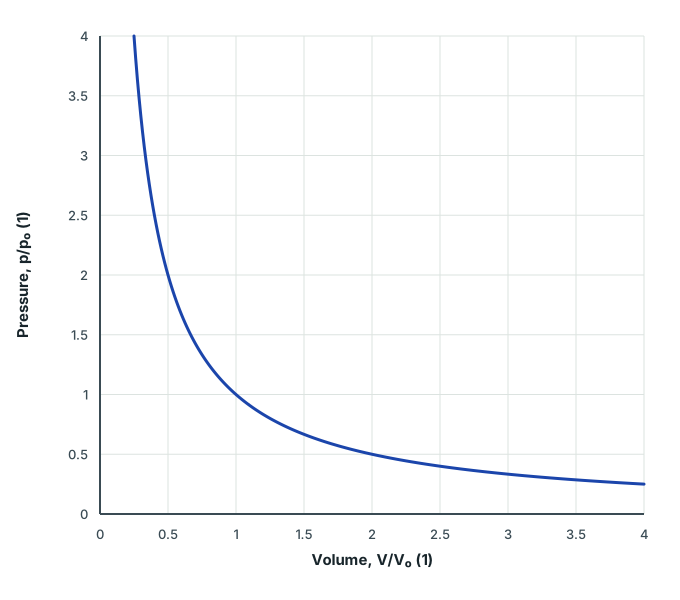
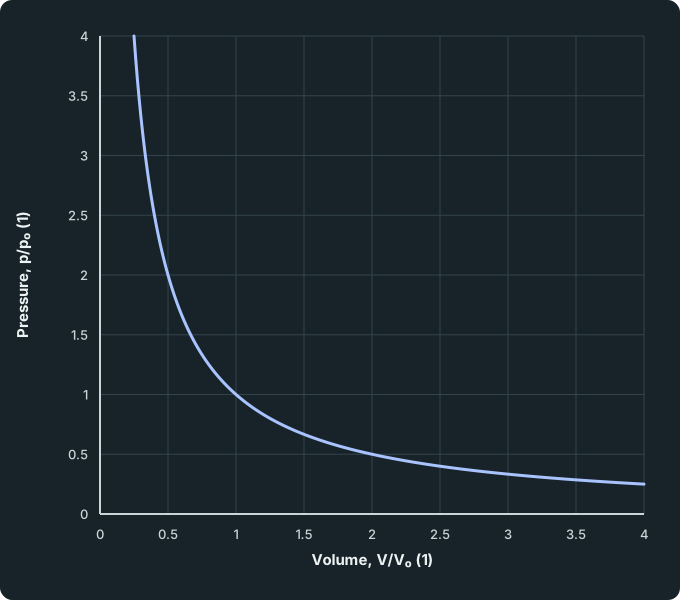
View figure data
| Volume, V/V₀ (1) | Fixed N and T |
|---|---|
| 0.2500 | 4.0000 |
| 0.2625 | 3.8095 |
| 0.2750 | 3.6364 |
| 0.2875 | 3.4783 |
| 0.3000 | 3.3333 |
| 0.3125 | 3.2000 |
| 0.3250 | 3.0769 |
| 0.3375 | 2.9630 |
| 0.3500 | 2.8571 |
| 0.3625 | 2.7586 |
| 0.3750 | 2.6667 |
| 0.3875 | 2.5806 |
| 0.4000 | 2.5000 |
| 0.4125 | 2.4242 |
| 0.4250 | 2.3529 |
| 0.4375 | 2.2857 |
| 0.4500 | 2.2222 |
| 0.4625 | 2.1622 |
| 0.4750 | 2.1053 |
| 0.4875 | 2.0513 |
| 0.5000 | 2.0000 |
| 0.5125 | 1.9512 |
| 0.5250 | 1.9048 |
| 0.5375 | 1.8605 |
| 0.5500 | 1.8182 |
| 0.5625 | 1.7778 |
| 0.5750 | 1.7391 |
| 0.5875 | 1.7021 |
| 0.6000 | 1.6667 |
| 0.6125 | 1.6327 |
| 0.6250 | 1.6000 |
| 0.6375 | 1.5686 |
| 0.6500 | 1.5385 |
| 0.6625 | 1.5094 |
| 0.6750 | 1.4815 |
| 0.6875 | 1.4545 |
| 0.7000 | 1.4286 |
| 0.7125 | 1.4035 |
| 0.7250 | 1.3793 |
| 0.7375 | 1.3559 |
| 0.7500 | 1.3333 |
| 0.7625 | 1.3115 |
| 0.7750 | 1.2903 |
| 0.7875 | 1.2698 |
| 0.8000 | 1.2500 |
| 0.8125 | 1.2308 |
| 0.8250 | 1.2121 |
| 0.8375 | 1.1940 |
| 0.8500 | 1.1765 |
| 0.8625 | 1.1594 |
| 0.8750 | 1.1429 |
| 0.8875 | 1.1268 |
| 0.9000 | 1.1111 |
| 0.9125 | 1.0959 |
| 0.9250 | 1.0811 |
| 0.9375 | 1.0667 |
| 0.9500 | 1.0526 |
| 0.9625 | 1.0390 |
| 0.9750 | 1.0256 |
| 0.9875 | 1.0127 |
| 1.0000 | 1.0000 |
| 1.0125 | 0.9877 |
| 1.0250 | 0.9756 |
| 1.0375 | 0.9639 |
| 1.0500 | 0.9524 |
| 1.0625 | 0.9412 |
| 1.0750 | 0.9302 |
| 1.0875 | 0.9195 |
| 1.1000 | 0.9091 |
| 1.1125 | 0.8989 |
| 1.1250 | 0.8889 |
| 1.1375 | 0.8791 |
| 1.1500 | 0.8696 |
| 1.1625 | 0.8602 |
| 1.1750 | 0.8511 |
| 1.1875 | 0.8421 |
| 1.2000 | 0.8333 |
| 1.2125 | 0.8247 |
| 1.2250 | 0.8163 |
| 1.2375 | 0.8081 |
| 1.2500 | 0.8000 |
| 1.2625 | 0.7921 |
| 1.2750 | 0.7843 |
| 1.2875 | 0.7767 |
| 1.3000 | 0.7692 |
| 1.3125 | 0.7619 |
| 1.3250 | 0.7547 |
| 1.3375 | 0.7477 |
| 1.3500 | 0.7407 |
| 1.3625 | 0.7339 |
| 1.3750 | 0.7273 |
| 1.3875 | 0.7207 |
| 1.4000 | 0.7143 |
| 1.4125 | 0.7080 |
| 1.4250 | 0.7018 |
| 1.4375 | 0.6957 |
| 1.4500 | 0.6897 |
| 1.4625 | 0.6838 |
| 1.4750 | 0.6780 |
| 1.4875 | 0.6723 |
| 1.5000 | 0.6667 |
| 1.5125 | 0.6612 |
| 1.5250 | 0.6557 |
| 1.5375 | 0.6504 |
| 1.5500 | 0.6452 |
| 1.5625 | 0.6400 |
| 1.5750 | 0.6349 |
| 1.5875 | 0.6299 |
| 1.6000 | 0.6250 |
| 1.6125 | 0.6202 |
| 1.6250 | 0.6154 |
| 1.6375 | 0.6107 |
| 1.6500 | 0.6061 |
| 1.6625 | 0.6015 |
| 1.6750 | 0.5970 |
| 1.6875 | 0.5926 |
| 1.7000 | 0.5882 |
| 1.7125 | 0.5839 |
| 1.7250 | 0.5797 |
| 1.7375 | 0.5755 |
| 1.7500 | 0.5714 |
| 1.7625 | 0.5674 |
| 1.7750 | 0.5634 |
| 1.7875 | 0.5594 |
| 1.8000 | 0.5556 |
| 1.8125 | 0.5517 |
| 1.8250 | 0.5479 |
| 1.8375 | 0.5442 |
| 1.8500 | 0.5405 |
| 1.8625 | 0.5369 |
| 1.8750 | 0.5333 |
| 1.8875 | 0.5298 |
| 1.9000 | 0.5263 |
| 1.9125 | 0.5229 |
| 1.9250 | 0.5195 |
| 1.9375 | 0.5161 |
| 1.9500 | 0.5128 |
| 1.9625 | 0.5096 |
| 1.9750 | 0.5063 |
| 1.9875 | 0.5031 |
| 2.0000 | 0.5000 |
| 2.0125 | 0.4969 |
| 2.0250 | 0.4938 |
| 2.0375 | 0.4908 |
| 2.0500 | 0.4878 |
| 2.0625 | 0.4848 |
| 2.0750 | 0.4819 |
| 2.0875 | 0.4790 |
| 2.1000 | 0.4762 |
| 2.1125 | 0.4734 |
| 2.1250 | 0.4706 |
| 2.1375 | 0.4678 |
| 2.1500 | 0.4651 |
| 2.1625 | 0.4624 |
| 2.1750 | 0.4598 |
| 2.1875 | 0.4571 |
| 2.2000 | 0.4545 |
| 2.2125 | 0.4520 |
| 2.2250 | 0.4494 |
| 2.2375 | 0.4469 |
| 2.2500 | 0.4444 |
| 2.2625 | 0.4420 |
| 2.2750 | 0.4396 |
| 2.2875 | 0.4372 |
| 2.3000 | 0.4348 |
| 2.3125 | 0.4324 |
| 2.3250 | 0.4301 |
| 2.3375 | 0.4278 |
| 2.3500 | 0.4255 |
| 2.3625 | 0.4233 |
| 2.3750 | 0.4211 |
| 2.3875 | 0.4188 |
| 2.4000 | 0.4167 |
| 2.4125 | 0.4145 |
| 2.4250 | 0.4124 |
| 2.4375 | 0.4103 |
| 2.4500 | 0.4082 |
| 2.4625 | 0.4061 |
| 2.4750 | 0.4040 |
| 2.4875 | 0.4020 |
| 2.5000 | 0.4000 |
| 2.5125 | 0.3980 |
| 2.5250 | 0.3960 |
| 2.5375 | 0.3941 |
| 2.5500 | 0.3922 |
| 2.5625 | 0.3902 |
| 2.5750 | 0.3883 |
| 2.5875 | 0.3865 |
| 2.6000 | 0.3846 |
| 2.6125 | 0.3828 |
| 2.6250 | 0.3810 |
| 2.6375 | 0.3791 |
| 2.6500 | 0.3774 |
| 2.6625 | 0.3756 |
| 2.6750 | 0.3738 |
| 2.6875 | 0.3721 |
| 2.7000 | 0.3704 |
| 2.7125 | 0.3687 |
| 2.7250 | 0.3670 |
| 2.7375 | 0.3653 |
| 2.7500 | 0.3636 |
| 2.7625 | 0.3620 |
| 2.7750 | 0.3604 |
| 2.7875 | 0.3587 |
| 2.8000 | 0.3571 |
| 2.8125 | 0.3556 |
| 2.8250 | 0.3540 |
| 2.8375 | 0.3524 |
| 2.8500 | 0.3509 |
| 2.8625 | 0.3493 |
| 2.8750 | 0.3478 |
| 2.8875 | 0.3463 |
| 2.9000 | 0.3448 |
| 2.9125 | 0.3433 |
| 2.9250 | 0.3419 |
| 2.9375 | 0.3404 |
| 2.9500 | 0.3390 |
| 2.9625 | 0.3376 |
| 2.9750 | 0.3361 |
| 2.9875 | 0.3347 |
| 3.0000 | 0.3333 |
| 3.0125 | 0.3320 |
| 3.0250 | 0.3306 |
| 3.0375 | 0.3292 |
| 3.0500 | 0.3279 |
| 3.0625 | 0.3265 |
| 3.0750 | 0.3252 |
| 3.0875 | 0.3239 |
| 3.1000 | 0.3226 |
| 3.1125 | 0.3213 |
| 3.1250 | 0.3200 |
| 3.1375 | 0.3187 |
| 3.1500 | 0.3175 |
| 3.1625 | 0.3162 |
| 3.1750 | 0.3150 |
| 3.1875 | 0.3137 |
| 3.2000 | 0.3125 |
| 3.2125 | 0.3113 |
| 3.2250 | 0.3101 |
| 3.2375 | 0.3089 |
| 3.2500 | 0.3077 |
| 3.2625 | 0.3065 |
| 3.2750 | 0.3053 |
| 3.2875 | 0.3042 |
| 3.3000 | 0.3030 |
| 3.3125 | 0.3019 |
| 3.3250 | 0.3008 |
| 3.3375 | 0.2996 |
| 3.3500 | 0.2985 |
| 3.3625 | 0.2974 |
| 3.3750 | 0.2963 |
| 3.3875 | 0.2952 |
| 3.4000 | 0.2941 |
| 3.4125 | 0.2930 |
| 3.4250 | 0.2920 |
| 3.4375 | 0.2909 |
| 3.4500 | 0.2899 |
| 3.4625 | 0.2888 |
| 3.4750 | 0.2878 |
| 3.4875 | 0.2867 |
| 3.5000 | 0.2857 |
| 3.5125 | 0.2847 |
| 3.5250 | 0.2837 |
| 3.5375 | 0.2827 |
| 3.5500 | 0.2817 |
| 3.5625 | 0.2807 |
| 3.5750 | 0.2797 |
| 3.5875 | 0.2787 |
| 3.6000 | 0.2778 |
| 3.6125 | 0.2768 |
| 3.6250 | 0.2759 |
| 3.6375 | 0.2749 |
| 3.6500 | 0.2740 |
| 3.6625 | 0.2730 |
| 3.6750 | 0.2721 |
| 3.6875 | 0.2712 |
| 3.7000 | 0.2703 |
| 3.7125 | 0.2694 |
| 3.7250 | 0.2685 |
| 3.7375 | 0.2676 |
| 3.7500 | 0.2667 |
| 3.7625 | 0.2658 |
| 3.7750 | 0.2649 |
| 3.7875 | 0.2640 |
| 3.8000 | 0.2632 |
| 3.8125 | 0.2623 |
| 3.8250 | 0.2614 |
| 3.8375 | 0.2606 |
| 3.8500 | 0.2597 |
| 3.8625 | 0.2589 |
| 3.8750 | 0.2581 |
| 3.8875 | 0.2572 |
| 3.9000 | 0.2564 |
| 3.9125 | 0.2556 |
| 3.9250 | 0.2548 |
| 3.9375 | 0.2540 |
| 3.9500 | 0.2532 |
| 3.9625 | 0.2524 |
| 3.9750 | 0.2516 |
| 3.9875 | 0.2508 |
| 4.0000 | 0.2500 |
Boyle’s law: pressure against reciprocal volume
A straight line joins the origin to reciprocal-volume ratio four and pressure ratio four.
Scroll across the figure to read all labels.
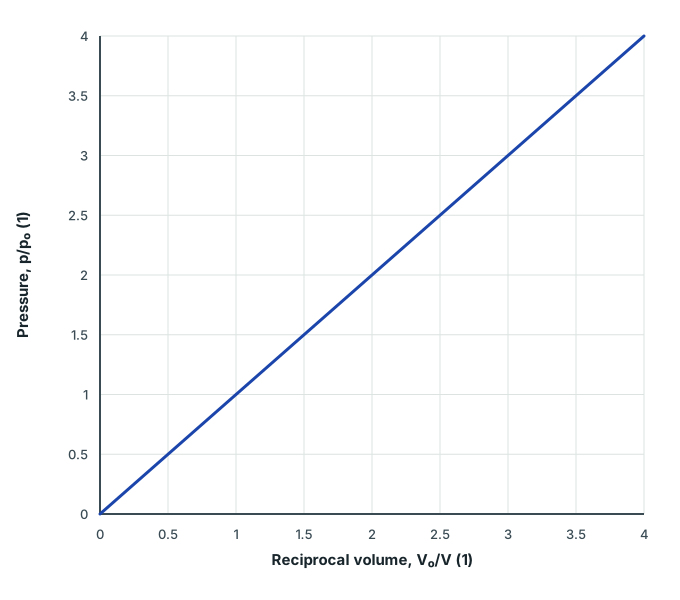
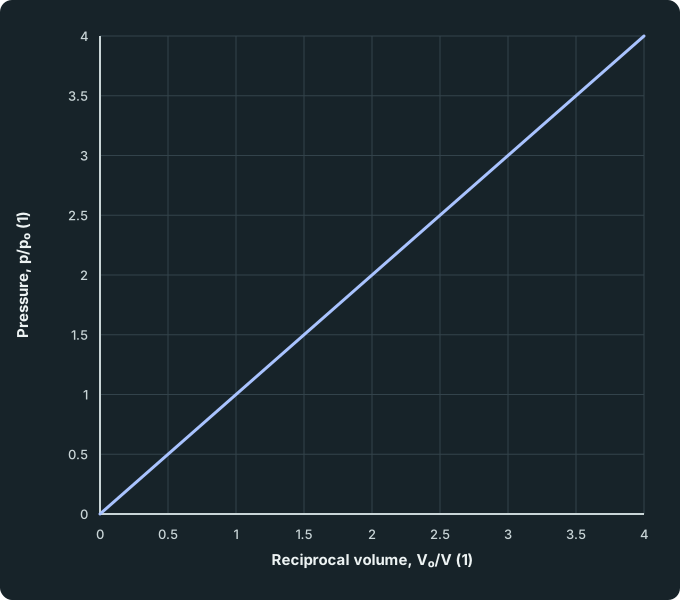
View figure data
| Reciprocal volume, V₀/V (1) | Fixed N and T |
|---|---|
| 0 | 0 |
| 4 | 4 |
A gas warms as it is compressed quickly, so compare states only after it has returned to its starting temperature.
Worked example 5
Compressing air slowly
Problem
Air at 1.0 × 10⁵ Pa is compressed slowly to one-fifth of its volume. Its mass and temperature do not change. Find its new pressure.
Show full solution
Check the conditions
Method
Confirm that Boyle’s law applies.Reason
pV is constant only for a fixed amount of gas at constant temperature.Working
Answer
p₁V₁ = p₂V₂, with V₁/V₂ = 5
New pressure
Working
Answer
p₂ = p₁V₁/V₂ = 5(1.0 × 10⁵) = 5.0 × 10⁵ Pa
Try it yourself 6
Absolute and gauge pressure
Problem
Air in a syringe occupies 60 cm³ at atmospheric pressure, 100 kPa. The outlet is sealed and the air is compressed slowly, at constant temperature, to 40 cm³. Find the final absolute pressure and the final gauge pressure.
Find both pressures
Show the steps Optional working
Hints
Hint 1
which pressure
From which pressure zero is Boyle’s law measured?
Show solution step by step
Absolute pressure
Reason
Boyle’s law holds for absolute pressures.Working
Answer
p₂ = (100 × 60)/40 = 150 kPa
Gauge pressure
Working
Answer
150-100 = 50 kPa. Using the starting gauge pressure, zero, in Boyle’s law would wrongly give zero.
Check your understanding 2 Testing an inverse-volume graph
A sealed syringe is compressed rapidly. A learner plots its immediate pressure against 1/V and calls the graph a test of Boyle’s law. What condition is missing? Explain how to collect a fair set of data and what an ideal-gas graph should show.
Show answer
Rapid compression can warm the gas, so the states may have different temperatures. Keep the syringe sealed, use absolute pressure, and wait at each volume until the gas returns to the same room temperature. Then plot p against 1/V: an ideal gas gives a straight line through the origin because pV is constant. Check fixed amount, fixed temperature, pressure reference and both axes.
Common mistakes
- Using Celsius temperatures in a temperature ratio.
- Cancelling the number of molecules when gas has been added or let out.
- Using gauge pressures in the gas laws.
- Using Boyle’s law when the temperature has changed, for example straight after a rapid compression.
Spotted an error? Report a correction
Syllabus and review details
- GCE A-Level H2 Physics 2027 · 2027
Content Overview, PDF pages 9–10; Subject Content, PDF pages 11–30
Last reviewed: