Standing sound waves in air columns
Explain displacement and pressure nodes in a tube, and use successive resonance lengths to measure the wavelength of sound.
On this page
Blow across the top of a bottle and it hums at one particular note. Sound reflected inside the bottle forms a standing wave in the air, and only certain wavelengths fit. This lesson explains how standing sound waves form in tubes, why sound has two kinds of node, one for displacement and one for pressure, and how a resonance tube measures the wavelength of sound.
Displacement and pressure in a sound wave
Sound is a longitudinal wave, so a standing sound wave can be described in two ways:
- the displacement of the air, back and forth along the tube;
- the pressure variation: how far the pressure rises above or falls below normal air pressure.
The nodes of one are the antinodes of the other. At a displacement node the air does not move, but the air on either side of it moves towards it together and then away from it together. So the air there is squeezed and stretched more than anywhere else: it is a pressure antinode. At a displacement antinode, the air on either side moves the same way as the air at that point, so it is hardly squeezed at all: it is a pressure node.
The ends of a tube fix the pattern:
- at a closed end, the air cannot move: a displacement node and pressure antinode;
- at an open end, the air connects to the atmosphere, which holds the pressure close to normal: a pressure node and displacement antinode.
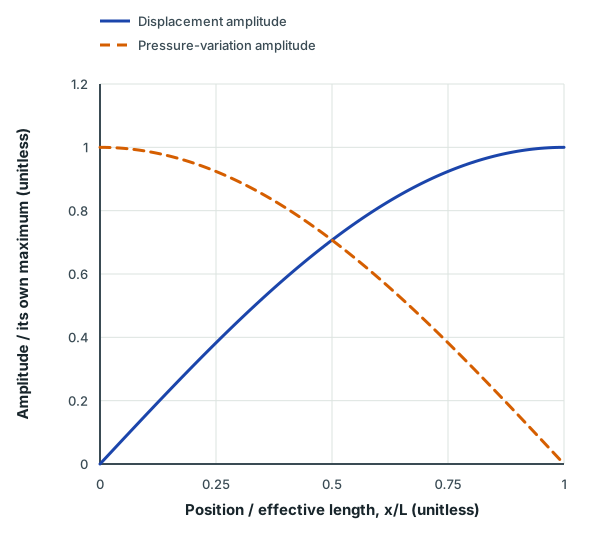
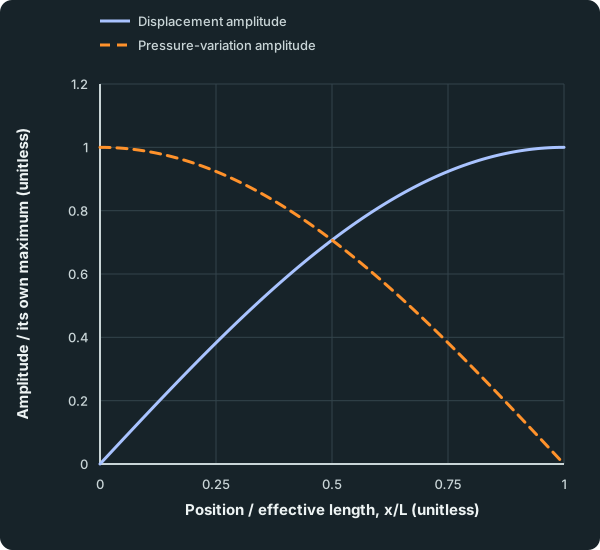
Air-column displacement and pressure amplitudes
The closed end at x/L = 0 has zero displacement amplitude and maximum pressure-variation amplitude. The open end at x/L = 1 has the opposite pair.
Scroll across the figure to read all labels.
View figure data
| Position / effective length, x/L (unitless) | Displacement amplitude | Pressure-variation amplitude |
|---|---|---|
| 0 | 0 | 1 |
| 0.008333 | 0.01309 | 0.9999 |
| 0.01667 | 0.02618 | 0.9997 |
| 0.025 | 0.03926 | 0.9992 |
| 0.03333 | 0.05234 | 0.9986 |
| 0.04167 | 0.0654 | 0.9979 |
| 0.05 | 0.07846 | 0.9969 |
| 0.05833 | 0.0915 | 0.9958 |
| 0.06667 | 0.1045 | 0.9945 |
| 0.075 | 0.1175 | 0.9931 |
| 0.08333 | 0.1305 | 0.9914 |
| 0.09167 | 0.1435 | 0.9897 |
| 0.1 | 0.1564 | 0.9877 |
| 0.1083 | 0.1693 | 0.9856 |
| 0.1167 | 0.1822 | 0.9833 |
| 0.125 | 0.1951 | 0.9808 |
| 0.1333 | 0.2079 | 0.9781 |
| 0.1417 | 0.2207 | 0.9753 |
| 0.15 | 0.2334 | 0.9724 |
| 0.1583 | 0.2462 | 0.9692 |
| 0.1667 | 0.2588 | 0.9659 |
| 0.175 | 0.2714 | 0.9625 |
| 0.1833 | 0.284 | 0.9588 |
| 0.1917 | 0.2965 | 0.955 |
| 0.2 | 0.309 | 0.9511 |
| 0.2083 | 0.3214 | 0.9469 |
| 0.2167 | 0.3338 | 0.9426 |
| 0.225 | 0.3461 | 0.9382 |
| 0.2333 | 0.3584 | 0.9336 |
| 0.2417 | 0.3706 | 0.9288 |
| 0.25 | 0.3827 | 0.9239 |
| 0.2583 | 0.3947 | 0.9188 |
| 0.2667 | 0.4067 | 0.9135 |
| 0.275 | 0.4187 | 0.9081 |
| 0.2833 | 0.4305 | 0.9026 |
| 0.2917 | 0.4423 | 0.8969 |
| 0.3 | 0.454 | 0.891 |
| 0.3083 | 0.4656 | 0.885 |
| 0.3167 | 0.4772 | 0.8788 |
| 0.325 | 0.4886 | 0.8725 |
| 0.3333 | 0.5 | 0.866 |
| 0.3417 | 0.5113 | 0.8594 |
| 0.35 | 0.5225 | 0.8526 |
| 0.3583 | 0.5336 | 0.8457 |
| 0.3667 | 0.5446 | 0.8387 |
| 0.375 | 0.5556 | 0.8315 |
| 0.3833 | 0.5664 | 0.8241 |
| 0.3917 | 0.5771 | 0.8166 |
| 0.4 | 0.5878 | 0.809 |
| 0.4083 | 0.5983 | 0.8013 |
| 0.4167 | 0.6088 | 0.7934 |
| 0.425 | 0.6191 | 0.7853 |
| 0.4333 | 0.6293 | 0.7771 |
| 0.4417 | 0.6394 | 0.7688 |
| 0.45 | 0.6494 | 0.7604 |
| 0.4583 | 0.6593 | 0.7518 |
| 0.4667 | 0.6691 | 0.7431 |
| 0.475 | 0.6788 | 0.7343 |
| 0.4833 | 0.6884 | 0.7254 |
| 0.4917 | 0.6978 | 0.7163 |
| 0.5 | 0.7071 | 0.7071 |
| 0.5083 | 0.7163 | 0.6978 |
| 0.5167 | 0.7254 | 0.6884 |
| 0.525 | 0.7343 | 0.6788 |
| 0.5333 | 0.7431 | 0.6691 |
| 0.5417 | 0.7518 | 0.6593 |
| 0.55 | 0.7604 | 0.6494 |
| 0.5583 | 0.7688 | 0.6394 |
| 0.5667 | 0.7771 | 0.6293 |
| 0.575 | 0.7853 | 0.6191 |
| 0.5833 | 0.7934 | 0.6088 |
| 0.5917 | 0.8013 | 0.5983 |
| 0.6 | 0.809 | 0.5878 |
| 0.6083 | 0.8166 | 0.5771 |
| 0.6167 | 0.8241 | 0.5664 |
| 0.625 | 0.8315 | 0.5556 |
| 0.6333 | 0.8387 | 0.5446 |
| 0.6417 | 0.8457 | 0.5336 |
| 0.65 | 0.8526 | 0.5225 |
| 0.6583 | 0.8594 | 0.5113 |
| 0.6667 | 0.866 | 0.5 |
| 0.675 | 0.8725 | 0.4886 |
| 0.6833 | 0.8788 | 0.4772 |
| 0.6917 | 0.885 | 0.4656 |
| 0.7 | 0.891 | 0.454 |
| 0.7083 | 0.8969 | 0.4423 |
| 0.7167 | 0.9026 | 0.4305 |
| 0.725 | 0.9081 | 0.4187 |
| 0.7333 | 0.9135 | 0.4067 |
| 0.7417 | 0.9188 | 0.3947 |
| 0.75 | 0.9239 | 0.3827 |
| 0.7583 | 0.9288 | 0.3706 |
| 0.7667 | 0.9336 | 0.3584 |
| 0.775 | 0.9382 | 0.3461 |
| 0.7833 | 0.9426 | 0.3338 |
| 0.7917 | 0.9469 | 0.3214 |
| 0.8 | 0.9511 | 0.309 |
| 0.8083 | 0.955 | 0.2965 |
| 0.8167 | 0.9588 | 0.284 |
| 0.825 | 0.9625 | 0.2714 |
| 0.8333 | 0.9659 | 0.2588 |
| 0.8417 | 0.9692 | 0.2462 |
| 0.85 | 0.9724 | 0.2334 |
| 0.8583 | 0.9753 | 0.2207 |
| 0.8667 | 0.9781 | 0.2079 |
| 0.875 | 0.9808 | 0.1951 |
| 0.8833 | 0.9833 | 0.1822 |
| 0.8917 | 0.9856 | 0.1693 |
| 0.9 | 0.9877 | 0.1564 |
| 0.9083 | 0.9897 | 0.1435 |
| 0.9167 | 0.9914 | 0.1305 |
| 0.925 | 0.9931 | 0.1175 |
| 0.9333 | 0.9945 | 0.1045 |
| 0.9417 | 0.9958 | 0.0915 |
| 0.95 | 0.9969 | 0.07846 |
| 0.9583 | 0.9979 | 0.0654 |
| 0.9667 | 0.9986 | 0.05234 |
| 0.975 | 0.9992 | 0.03926 |
| 0.9833 | 0.9997 | 0.02618 |
| 0.9917 | 0.9999 | 0.01309 |
| 1 | 1 | 6.123e-17 |
These curves show how large each oscillation is at each point, each scaled to its own maximum. They are not values at one instant, and their heights cannot be compared, because displacement and pressure have different units.
Check your understanding 1
Does a pressure node at the open end of a tube mean the air there does not move?
Show answer
No. The air at the open end moves the most: it is a displacement antinode. Only the pressure variation is close to zero there. A closed end has the opposite pair: no movement, largest pressure variation.
Which wavelengths fit in a tube
A standing wave forms only if the length of the tube fits its end conditions.
- A tube closed at one end needs a displacement node at the closed end and an antinode at the open end. The distance from a node to an antinode is an odd number of quarter-wavelengths, so L = λ/4, 3λ/4, 5λ/4, …, and only odd harmonics occur.
- A tube open at both ends needs a displacement antinode at each end, so L = λ/2, λ, 3λ/2, …, and all harmonics occur.
These formulas treat the open end as the exact position of the antinode. In fact it lies a little outside the tube, by a distance called the end correction, so the effective length is slightly longer than the tube.
Guided practice 1
Modes of a closed tube
Problem
A tube closed at one end is 0.850 m long. The speed of sound is 3.40 × 10² m s⁻¹. Neglecting the end correction, find the lowest frequency at which the tube resonates, and the next one.
Find the two lowest resonant frequencies
Hints
Hint 1: the fundamental
With a node at the closed end and an antinode at the open end, the fundamental fits λ/4 into the tube.
Hint 2: the next mode
The next pattern that fits has 3λ/4 in the tube, not 2λ/4.
Show solution step by step
Find the fundamental
Reason
One quarter-wavelength fits between the node and the antinode.Working
λ = 4L = 3.40 m, so f₁ = v/λ = 340/3.40 = 1.00 × 10² Hz.
Find the next mode
Working
The next fit is L = 3λ/4, which is the third harmonic: 3f₁ = 3.00 × 10² Hz. There is no 200 Hz resonance, because a whole half-wavelength would put a node at the open end.
Measuring the wavelength of sound
In a resonance tube, a vertical tube stands in water, so the water surface closes its lower end. A tuning fork of known frequency is held over the open top, and the tube is raised slowly. At certain lengths of air column the sound becomes much louder: the air column is resonating. Its length is measured from the top of the tube to the water surface.
At a fixed frequency, the first resonance is at L₁ = λ/4-e and the next at L₂ = 3λ/4-e, where e is the end correction. Their difference is
L₂-L₁ = λ/2
The end correction cancels, which is why the difference method is used: you never need to know e.
In the simulation, drag the closed end of the tube to find two successive resonance lengths at 512 Hz, then calculate λ = 2(L₂-L₁). Switch the curve to pressure to see the pressure node at the open end.
A pipe closed at the far end, 0.300 metres long, driven at 512.0 hertz. It is not resonating, so the reflected waves do not build up.
- Frequency, f
- 512 Hz
- Wavelength, λ
- 0.664 m
- Length, L
- 0.300 m
- Wave speed, v
- 340 m/s
- Harmonic
- none
Try this
0 of 4 doneMake the string vibrate in three loops. (not done yet)
Three loops is the 3rd harmonic: L = 3λ/2, at three times the fundamental frequency.
Find the lowest resonant frequency of a closed pipe, then of an open pipe of the same length. (not done yet)
The open pipe's fundamental is about twice the closed pipe's: L ≈ λ/2 for an open pipe but L ≈ λ/4 for a closed one.
Find the closed pipe's next resonance above its fundamental. (not done yet)
It is at 3f₁, not 2f₁: a closed end must be a node and an open end an antinode, so only odd harmonics fit.
Keep the frequency fixed and find two successive resonance lengths of the closed pipe. (not done yet)
They differ by half a wavelength, so λ = 2(L₂ − L₁). The end correction cancels in the subtraction.
Your readings
| # | f / Hz | L / m | 1/f / s | Remove |
|---|---|---|---|---|
| No readings yet. Set up a measurement, then record it. | ||||
Worked example 2
Two successive resonance lengths
Problem
With a 5.00 × 10² Hz tuning fork, a resonance tube resonates at air-column lengths of 0.165 m and then 0.505 m. Find the wavelength, the speed of sound and the end correction.
Worked solution
Take the difference
Method
Subtract the shorter resonant length from the longer one.Reason
Successive resonances differ by half a wavelength, and the end correction cancels.Working
L₂-L₁ = 0.505-0.165 = 0.340 m = λ/2, so λ = 0.680 m.
Find the speed
Reason
The frequency is fixed by the tuning fork.Working
v = fλ = (500)(0.680) = 3.40 × 10² m s⁻¹
Find the end correction
Working
L₁ + e = λ/4 = 0.170 m, so e = 0.170-0.165 = 0.005 m.
Check your understanding 2
At 1.00 kHz, three successive resonance lengths are 0.079 m, 0.249 m and 0.419 m. Find the wavelength and the speed of sound. Why is it better to use all three lengths than just two?
Show answer
The three lengths span two half-wavelengths: (0.419-0.079)/2 = 0.170 m = λ/2, so λ = 0.340 m and v = (1000)(0.340) = 340 m s⁻¹. Spreading the same reading uncertainty over a longer distance halves its effect on λ, and two equal spacings confirm that the resonances really are successive.
Exam-style question 1
Design a resonance-tube measurement
Examination question
Describe how to measure the wavelength of sound of a known frequency using a resonance tube. Explain how you find each resonance, how you deal with the end correction and how you reduce the uncertainty in your result. [5 marks]
Write your answer before viewing the mark scheme
Show solution step by step
Find the resonances
2 marksMethod
Vary the length of the air column at one frequency.Reason
Resonance happens only at lengths that fit the end conditions for that wavelength.Working
Hold a tuning fork, or a loudspeaker driven at a fixed frequency, over the open end. Raise the tube slowly from the water and mark each length where the sound is loudest. Record several successive resonant lengths, finding each one from both directions.
Process the lengths
3 marksWorking
Successive lengths differ by λ/2, so λ = 2(L₂-L₁). The end correction is the same for every resonance, so it cancels in the difference. Using several resonances, divide the total change in length by the number of intervals to reduce the percentage uncertainty.
Self-mark with the mark scheme
Compare your response with each mark point. Select a point only when your response contains that evidence.
Tick each point only if your answer states it clearly.
Common mistakes
- Thinking a pressure node is a point of zero pressure. It is a point where the pressure does not vary from normal.
- Giving a closed tube even harmonics. With a node at one end and an antinode at the other, only odd multiples of λ/4 fit.
- Treating the first resonant length as exactly λ/4. The end correction makes it slightly shorter; use the difference between lengths.
- Taking successive resonant lengths as a whole wavelength apart. They are half a wavelength apart.
Before you move on
Check your understanding 3
Without looking back: why is a displacement node also a pressure antinode? What are the conditions at the closed and open ends of a tube? How do you get λ from two successive resonance lengths?
Show answer
At a displacement node the air on both sides moves towards it, then away from it, together, so the pressure there varies most. A closed end is a displacement node and pressure antinode; an open end is a displacement antinode and pressure node. Successive resonance lengths differ by λ/2, so λ = 2(L₂-L₁).
Was this lesson helpful?
Syllabus and review details
- GCE A-Level H2 Physics 2027 · 2027
Content Overview, PDF pages 9–10; Subject Content, PDF pages 11–30
Last reviewed: