A Level Waves & Superposition Hub
A Level Physics waves hub: wave graphs, phase, intensity, polarisation, superposition, interference, diffraction and standing waves.
Learning goals
- Describe wave models, use wave quantities and interpret wave graphs in space and time.
- Relate phase difference to separations in time and position.
- Use wave intensity, amplitude and inverse-square relationships with their assumptions.
- Explain polarisation and apply Malus’ law to amplitude and intensity.
- Apply the principle of superposition to resultant displacement.
- Explain standing-wave formation, nodes, antinodes and energy transfer.
- Apply boundary conditions to standing waves on stretched strings.
- Analyse displacement and pressure patterns in resonant air columns and determine sound wavelength.
- Explain single-aperture diffraction and apply first-minimum and Rayleigh criteria.
- Explain coherent two-source interference using phase and path difference.
- Analyse Young double-slit interference and its small-angle assumptions.
- Use diffraction gratings to analyse principal maxima and determine wavelength.
Wave Motion and Superposition develops one connected model: local oscillations create a travelling disturbance, overlapping displacements produce interference, and reflections can establish standing patterns. The route below separates the graph, boundary-condition and path-difference decisions that exam questions often combine.
Understand first: revise transverse and longitudinal waves in O Level Waves, then use Oscillations for period, frequency, phase and radians.
Common mark-loss errors: reading wavelength from a time graph, adding intensities instead of signed displacements, using a line density as a grating spacing, and assigning the same node type to pressure and displacement in an air column.
Move to structured work when: you can state the model assumptions beside each equation and decide whether a question requires phase, path difference, boundary conditions or aperture geometry.
Lessons
Work through these lessons in order.
- Wave models, quantities, graphs and transfer
- Intensity, amplitude and inverse-square spreading
- Polarisation and Malus' law
- Superposition and standing-wave experiments
- Two-source interference and Young double slit
- Diffraction-grating maxima and wavelength
- Single-aperture diffraction and Rayleigh resolution
- Wave Motion
Compare mechanical and electromagnetic waves, interpret displacement–time and displacement–position graphs, and derive and use v = fλ.
- Phase Difference
Define phase and phase difference, and calculate phase difference from path difference or time delay (A Level Physics).
- Intensity
Define intensity as power per unit area, use I ∝ A², and apply the inverse-square law for point sources (A Level Physics).
- Polarisation
Explain what polarisation is, why it only occurs for transverse waves, and how polarisers affect intensity (A Level Physics).
- Malus' Law
Use Malus’ law (I ∝ cos²θ) to calculate intensity and amplitude of plane-polarised light after a polarising filter (A Level Physics).
- Principle Of Superposition
Use the principle of superposition to add displacements and explain constructive and destructive interference (A Level Physics).
- Interference Pattern
State the conditions for a stable interference pattern and use phase/path difference to identify maxima and minima (A Level Physics).
- Young's Double Slit Experiment
Use YDSE to link wavelength, slit separation and fringe spacing, and solve x = λD/a under the small-angle approximation (A Level Physics).
- Diffraction
Explain diffraction as spreading of waves, and predict when diffraction is significant using the wavelength-to-aperture size idea (A Level Physics).
- Single-Slit Diffraction (First Minimum)
Use b sin θ = λ (and small-angle approximations) to solve single-slit diffraction questions, including the width of the central maximum (A Level Physics).
- Rayleigh Criterion (Resolving Power of a Single Aperture)
Use the Rayleigh criterion θ ≈ λ/b to solve resolving power questions for a single aperture (A Level Physics).
- Diffraction Grating
Use the diffraction grating equation d sinθ = nλ, convert line density to grating spacing, and find maximum order (A Level Physics).
- Stationary Waves
Explain how standing waves form, define nodes and antinodes, and use key properties like no net energy transfer (A Level Physics).
- Standing Waves on a String
Use boundary conditions on a string to relate length to wavelength and frequency for standing-wave harmonics (A Level Physics).
- Standing Waves in Air Columns (Wavelength of Sound)
Identify displacement vs pressure nodes/antinodes in air columns and determine the wavelength of sound using standing waves (A Level Physics).
- Questions for Superposition (JC) Set 1
A Level Physics waves and superposition practice questions (JC Set 1), with worked answers.
Revision
Quick Reference
| Concept | Formula / Condition |
|---|---|
| Progressive wave | v = fλ; energy transfer without net matter transfer |
| Intensity | I ∝ A² |
| Malus’ Law | I = I₀ cos² θ |
| Double slit | λ = ax/D (small-angle) |
| Grating | d sin θ = nλ |
| Single Slit | sin θ = λ/b (First minimum) |
| Resolution | θ ≈ λ/b (Rayleigh Criterion) |
| Path/phase link | φ = (2π/λ)Δ x |
| Interference conditions | maxima: Δ x = nλ; minima: Δ x = (n + 1/2)λ |
Exam Templates (fast marks)
Double slit (fringe spacing)
- State conditions: coherent sources, small angles.
- Use λ = ax/D (or x = (λ D)/a).
- Use consistent units (usually convert mm → m).
- Interpret x correctly (fringe spacing: between adjacent bright/dark fringes).
Diffraction grating
- Write d sin θ = nλ.
- Convert lines/mm to spacing: d = 1/N (with N in lines per metre).
- Use n = 1,2,3,… and check sin θ ≤ 1 to find the maximum possible order.
Stationary waves (strings/air columns)
- State the boundary conditions (nodes/antinodes at ends).
- Link length to wavelength for the mode, then use v = fλ.
- State node/antinode spacing facts (adjacent nodes/antinodes are λ/2 apart).
Graph Skills (Exam + Practical)
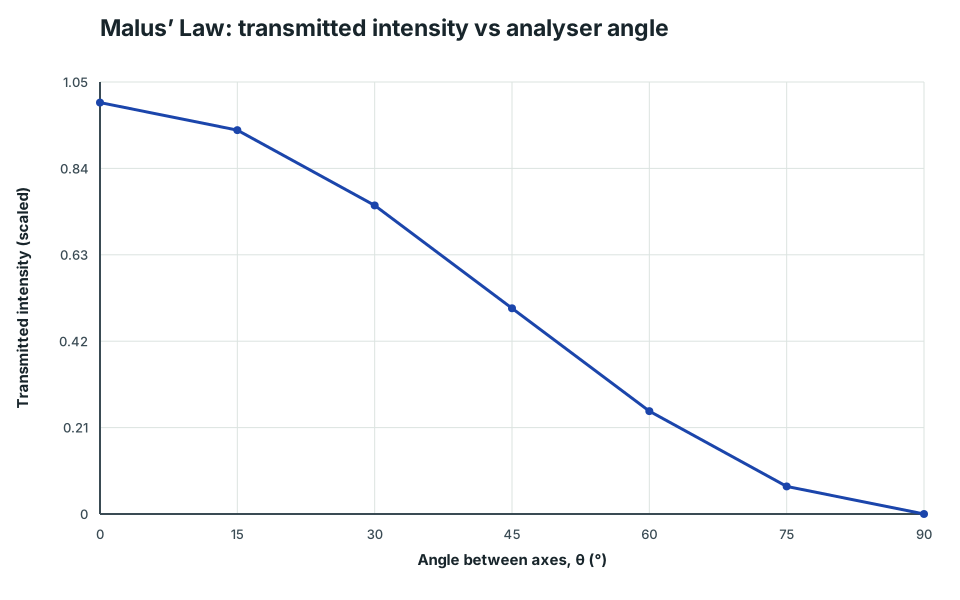
Polarisation: Malus’ Law curve
Malus’ Law: transmitted intensity vs analyser angle
A curve showing transmitted intensity following cos squared of the angle between polariser and analyser axes.
Scroll across the graph to read all labels.
View figure data
| Angle between axes, θ (°) | I/I0 = cos²θ |
|---|---|
| 0 | 1 |
| 15 | 0.933 |
| 30 | 0.75 |
| 45 | 0.5 |
| 60 | 0.25 |
| 75 | 0.067 |
| 90 | 0 |
Interference: intensity depends on phase difference
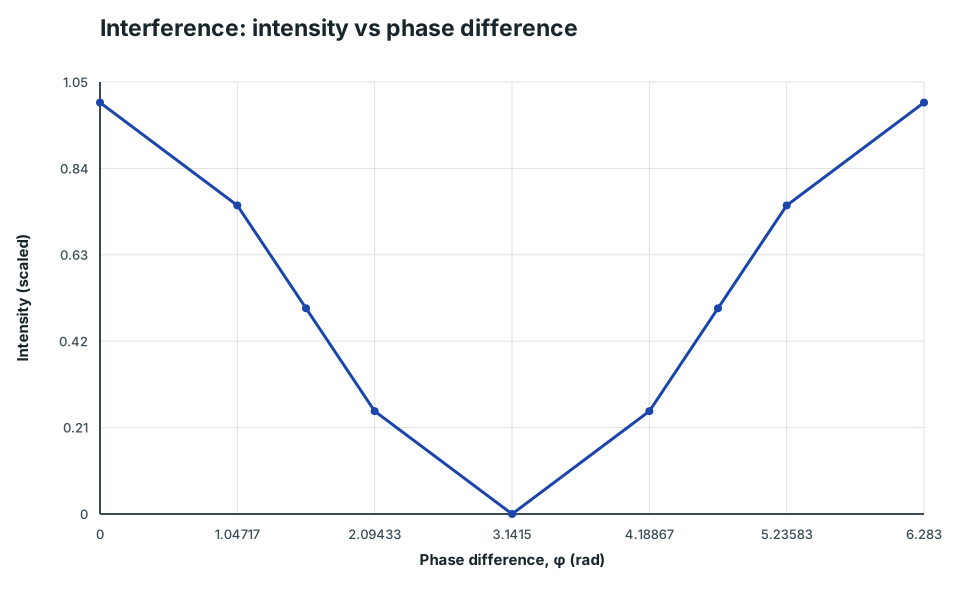
For two coherent waves of equal amplitude, the resultant intensity varies with phase difference: φ = 2π/λ Δ x and I ∝ cos² (φ/2)
Interference: intensity vs phase difference
A curve showing how interference intensity varies with phase difference for two equal-amplitude coherent waves.
Scroll across the graph to read all labels.
View figure data
| Phase difference, φ (rad) | I/Imax = cos²(φ/2) |
|---|---|
| 0 | 1 |
| 1.047 | 0.75 |
| 1.571 | 0.5 |
| 2.094 | 0.25 |
| 3.142 | 0 |
| 4.189 | 0.25 |
| 4.712 | 0.5 |
| 5.236 | 0.75 |
| 6.283 | 1 |
What You Must Memorise
- Principle of Superposition: When two or more waves of the same type meet, the resultant displacement is the vector sum of the individual displacements.
- Coherence: Waves with a constant phase difference and therefore the same frequency. They need not have equal amplitudes.
- Transverse vs longitudinal: transverse waves can be polarised; longitudinal waves cannot.
- Stationary Wave: Formed by superposition of two progressive waves of the same frequency and amplitude travelling in opposite directions. The time-averaged energy flow along the medium is zero; energy is still present and changes form locally.
- Diffraction: The spreading of waves as they pass through an aperture or around an obstacle.
Top Exam Traps
- Path difference vs phase difference: path difference is in metres; phase difference is in radians. Relation: φ = 2π/λ × path difference.
- Grating vs Double Slit: Gratings produce sharper, brighter spots at larger angles. Use d sin θ = nλ for gratings (large angles), not x = λ D/a.
- Single Slit Formula: The formula sin θ = λ/b gives the MINIMUM (dark fringe), whereas d sin θ = nλ for gratings gives the MAXIMUM (bright fringe).
- Stationary Wave Phase: Between two adjacent nodes, all particles vibrate in phase. In progressive waves, phase changes continuously with position.
- Malus’ law: θ is the angle between the polariser axis and the analyser axis (or the incoming polarisation direction).
- Small-angle use: λ = ax/D assumes small angles and that x is the fringe spacing (adjacent bright-to-bright or dark-to-dark).
- Grating spacing conversion: If given “N lines per mm”, convert to lines per metre before using d = 1/N.
Practice
First compare boundary conditions in the Standing Wave Explorer. Use the quiz to diagnose gaps, then complete a structured set without formula prompts:
A Level Waves & Superposition Quiz Structured Waves Practice A Level Quiz Hub
The legacy JC question set is retained for four additional interference, grating and standing-wave prompts, but the current routes above provide broader syllabus coverage.
Next hub: Thermal Physics
Continue with the next resource in this course.
Course and syllabus information
- Course
- GCE A-Level H2 Physics
- Edition
- GCE A-Level H2 Physics 2027