Standing Waves in Air Columns (Wavelength of Sound)
Key idea: Identify displacement vs pressure nodes/antinodes in air columns and determine the wavelength of sound using standing waves (A Level Physics).
Continue where you stopped
The core idea
On this page
Learning objectives
- Explain standing-wave formation, nodes, antinodes and energy transfer.
- Apply boundary conditions to standing waves on stretched strings.
- Analyse displacement and pressure patterns in resonant air columns and determine sound wavelength.
1. Definitions (Must Know)
- Standing wave: a wave pattern produced by superposition of two waves of the same frequency travelling in opposite directions.
- Displacement node: a point where particle displacement is always zero.
- Displacement antinode: a point where particle displacement amplitude is maximum.
- Pressure node: a point where pressure variation is zero.
- Pressure antinode: a point where pressure variation amplitude is maximum.
- Air column: a column of air in a tube, which can support standing sound waves.
2. Key Ideas (What Earns Marks)
- Sound in air is longitudinal:
- particle displacement and pressure variations are along the tube.
- End conditions (important):
- Open end:
- displacement antinode
- pressure node
- Closed end:
- displacement node
- pressure antinode
- Open end:
- Allowed wavelengths (tube length L):
- Open–open tube (both ends open):
- L = nλ/2 (n = 1,2,3,…)
- Closed–open tube (one end closed):
- L = ((2n-1)λ)/4 (n = 1,2,3,…)
- Open–open tube (both ends open):
- Finding wavelength from resonance lengths:
- successive resonances differ by:
- Δ L = λ/2
- successive resonances differ by:
3. Detailed Explanations
A. Why open and closed ends differ
- At a closed end, air cannot move, so displacement must be zero → displacement node.
- At an open end, air can move freely, so displacement is maximum → displacement antinode.
Pressure variation is “opposite”:
- where displacement is a node, pressure is an antinode
- where displacement is an antinode, pressure is a node
B. Open–open tube
Both ends are displacement antinodes, so a whole number of half-wavelengths fits: L = nλ/2
Fundamental (n = 1): L = λ/2.
C. Closed–open tube
Closed end is a displacement node, open end is a displacement antinode, so an odd number of quarter-wavelengths fits: L = ((2n-1)λ)/4
Fundamental (n = 1): L = λ/4.
Only odd harmonics occur for the closed–open tube.
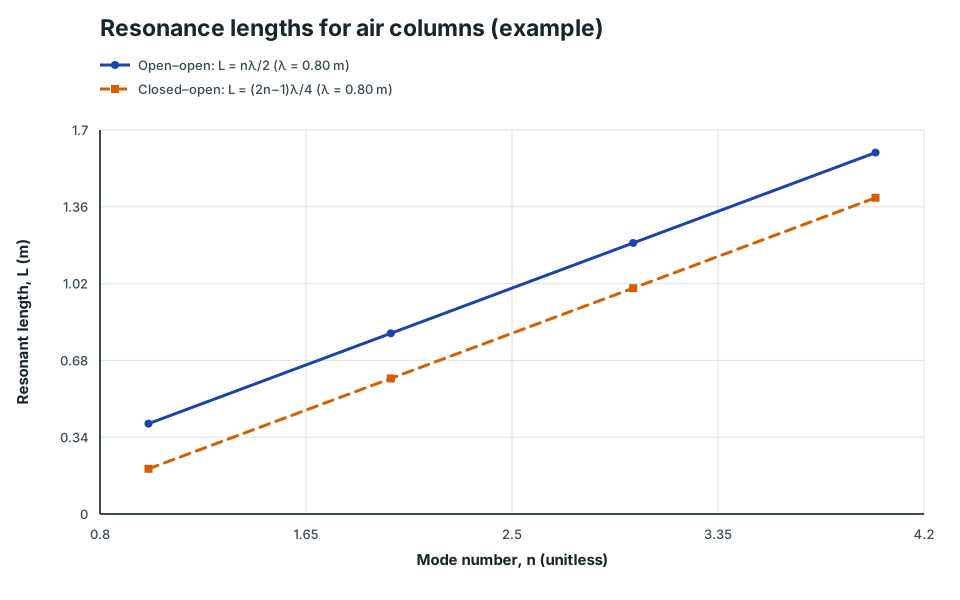
Resonance lengths for air columns (example)
Resonant lengths for open–open and closed–open tubes for the same wavelength.
Scroll across the graph to read all labels.
View figure data
| Mode number, n (unitless) | Open–open: L = nλ/2 (λ = 0.80 m) | Closed–open: L = (2n−1)λ/4 (λ = 0.80 m) |
|---|---|---|
| 1 | 0.4 | 0.2 |
| 2 | 0.8 | 0.6 |
| 3 | 1.2 | 1 |
| 4 | 1.6 | 1.4 |
D. Measuring wavelength using resonance
In a resonance tube experiment, you adjust the air-column length until the sound is loudest (resonance).
If you find two successive resonance lengths L₁ and L₂ for the same frequency: λ = 2(L₂-L₁)
Then wave speed: v = fλ
4. Common Mistakes
- Saying “node at open end” for displacement (it is an antinode).
- Mixing up displacement and pressure nodes/antinodes.
- Using L = λ/2 for a closed–open tube fundamental (it should be L = λ/4).
- Using v = fλ with inconsistent units (Hz with cm).
5. Exam Tips
- If a question mentions “loudest sound” in a tube: it is a standing-wave resonance condition.
- State end conditions explicitly before writing the wavelength relation.
- When using two resonance lengths, quote Δ L = λ/2 first (easy marks).
6. Worked Examples
Modelled example 1
Wavelength from two resonance lengths
Problem
Study the worked solution
Use resonance spacing
Method
The length difference is half a wavelength.Reason
Successive modes add one half-wavelength while retaining the same end conditions.Working
L₂-L₁ = λ/2Find wavelength
Method
λ = 0.66 m.Reason
Double the measured difference.Working
λ = 2(0.49-0.16) = 0.66 mFind speed
Method
v = 3.38 × 10² m s⁻¹.Reason
Use v = fλ with the tuning-fork frequency.Working
v = (512)(0.66) = 3.38 × 10² m s⁻¹
Guided practice 2
Fundamental length for a closed–open tube
Problem
Try this before viewing the solution
Hints
Hint 1: apply unlike end conditions
View solution step by step
Identify the geometry
Method
The tube contains one quarter-wavelength.Reason
A node-to-nearest-antinode separation is λ/4.Working
L = λ/4Calculate
Method
L = 0.20 m.Reason
Divide the wavelength by four.Working
L = 0.80/4 = 0.20 m
Common misconception 3
Identifying nodes/antinodes
Learner claim
Try this before viewing the solution
View solution step by step
Label the open end
Method
The open end is a displacement antinode and pressure node.Reason
Air moves freely while pressure stays close to atmospheric.Working
open: displacement A; pressure NLabel the closed end
Method
The closed end is a displacement node and pressure antinode.Reason
Air cannot move through the wall while pressure variation is largest.Working
closed: displacement N; pressure AState the pairing
Method
Displacement nodes correspond to pressure antinodes, and conversely.Reason
Particle motion and pressure variation are spatially offset.Working
displacement N ↔ pressure A
Examiner practice 4
Open–open tube fundamental
Examination question
Try this before viewing the solution
View solution step by step
State the ends
1 markMethod
Both open ends are displacement antinodes.Reason
The fundamental spans adjacent antinodes with one node between.Working
open–open: A–N–ARelate length and wavelength
1 markMethod
L = λ/2.Reason
Adjacent antinodes are separated by half a wavelength.Working
λ = 2LCalculate
1 markMethod
λ = 1.70 m.Reason
Double the tube length.Working
λ = 2(0.85) = 1.70 m
Self-mark with the mark scheme
Compare your response with each mark point. Select a point only when your response contains that evidence.
Self-mark the end condition, mode relation and wavelength.
Challenge 5
Finding frequency from resonance spacing
Independent transfer
Try this before viewing the solution
Hints
Hint 1: convert spacing before wave speed
View solution step by step
Recover wavelength
Method
λ = 0.36 m.Reason
Successive resonant lengths differ by half a wavelength.Working
λ = 2(0.18) = 0.36 mUse the wave relation
Method
f = 9.44 × 10² Hz.Reason
Rearrange v = fλ after obtaining the full wavelength.Working
f = 340/0.36 = 9.44 × 10² Hz
7. Mind Stretchers
Mind stretcher 1: Which harmonics exist?Extension
Explain why a closed–open tube has only odd harmonics.
Show Answer
The boundary conditions are different at the two ends (node at closed end, antinode at open end). This requires the length to contain an odd number of quarter-wavelengths, L = (2n-1)λ/4, which corresponds to odd harmonics only.
Mind stretcher 2: Why is pressure a node at an open end?Extension
Explain (qualitatively) why the open end of a tube is a pressure node for a standing sound wave.
Show Answer
At an open end, the air is in contact with the atmosphere, so the pressure must stay close to atmospheric pressure.
That means the pressure variation is minimal there (approximately zero), so it is a pressure node.
Mind stretcher 3: Simulation Bridge: Standing Wave ExplorerExtension
Concept Explorer: Standing Wave Explorer
Toggle string and air-column boundary conditions, change harmonic mode, and test wavelength-frequency relations.
- Boundary Conditions
- Harmonics
- Resonance Spacing
- f–λ–v Links
Investigate air columns in the Standing Wave Explorer.
Continue with the next resource in this course.
Course and syllabus information
- Course
- GCE A-Level H2 Physics
- Edition
- GCE A-Level H2 Physics 2027