Single-Slit Diffraction (First Minimum)
Key idea: Use b sin θ = λ (and small-angle approximations) to solve single-slit diffraction questions, including the width of the central maximum (A Level Physics).
Continue where you stopped
The core idea
On this page
Learning objectives
- Explain single-aperture diffraction and apply first-minimum and Rayleigh criteria.
- Relate phase difference to separations in time and position.
- Explain coherent two-source interference using phase and path difference.
1. Definitions (Must Know)
- Diffraction: spreading of waves when they pass through an aperture or around an obstacle.
- Single slit: an aperture of width b.
- Minima: angles where intensity is (approximately) zero.
- First minimum: the first dark fringe on either side of the central maximum.
- Geometry symbols (typical exam setup):
- b = slit width (m)
- λ = wavelength (m)
- D = slit-to-screen distance (m)
- y = distance from central maximum to a minimum on the screen (m)
- θ = angle to the minimum (rad or °)
2. Key Ideas (What Earns Marks)
- Single-slit minima occur at:
- b sin θ = mλ (m = 1,2,3,…)
- For the first minimum (m = 1):
- b sin θ = λ
- For small angles (θ small, and D≫ b):
- sin θ ≈ tan θ ≈ y/D
- so the first-minimum position is:
- y ≈ (λ D)/b
- Width of the central maximum:
- from -y to + y:
- w ≈ 2y ≈ (2λ D)/b
- from -y to + y:
Central maximum width vs slit width (example)
For fixed wavelength and screen distance, the central maximum width is inversely proportional to slit width.
Scroll across the graph to read all labels.
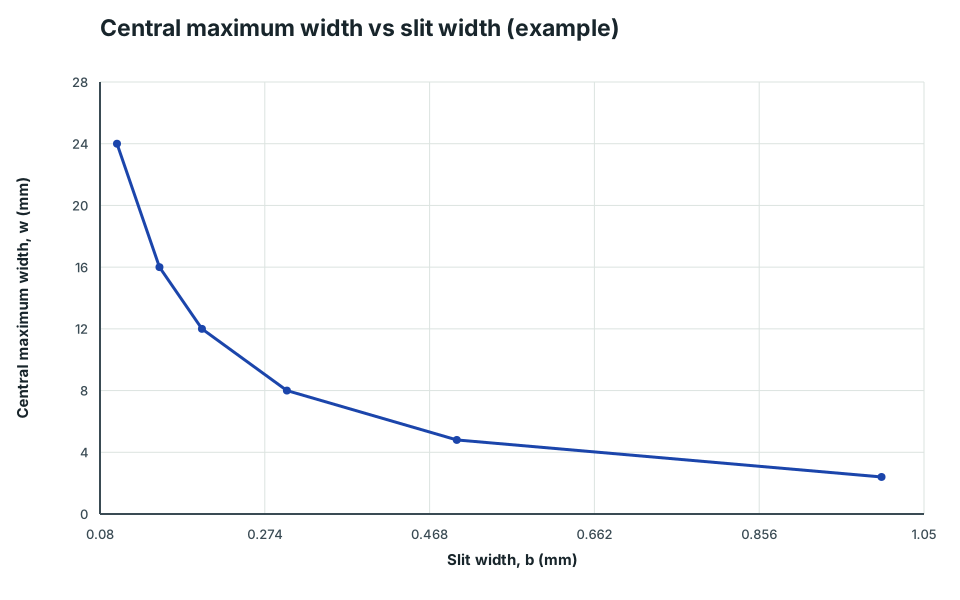
View figure data
| Slit width, b (mm) | w ∝ 1/b |
|---|---|
| 0.1 | 24 |
| 0.15 | 16 |
| 0.2 | 12 |
| 0.3 | 8 |
| 0.5 | 4.8 |
| 1 | 2.4 |
3. Detailed Explanations
A. Why minima happen (idea-level explanation)
Different parts of the slit act like many wave sources. At certain angles, contributions from different parts of the slit arrive out of phase and cancel.
For the first minimum, the phase difference across the slit corresponds to one full wavelength, giving: b sin θ = λ
B. Using the small-angle approximation on a screen
If the screen is far away: tan θ ≈ y/D
and for small θ: sin θ ≈ tan θ
So: b(y/D) ≈ λ ⇒ y ≈ (λ D)/b
4. Common Mistakes
- Using the double-slit formula x = λ D/a (wrong symbol: a is slit separation, not slit width).
- Forgetting that m = 1 for the first minimum.
- Using y/D when the question gives θ directly (then use b sin θ = λ).
- Mixing mm and m (convert everything to SI).
5. Exam Tips
- Write the correct starting equation first:
- single slit: b sin θ = mλ
- diffraction grating: d sin θ = nλ
- If a diagram shows a screen distance D and a position y, explicitly state “small angle, so sin θ ≈ tan θ ≈ y/D”.
6. Worked Examples
Modelled example 1
Find wavelength from first minimum position
Problem
Study the worked solution
Connect angle to screen position
Method
For a distant screen, use sin θ ≈ y/D.Reason
The first minimum is observed at a small angle.Working
b sin θ = λ ⇒ λ ≈ by/DConvert the measured lengths
Method
Use y = 6.0 × 10⁻³ m and b = 0.20 × 10⁻³ m.Reason
Consistent SI units are required with D = 2.0 m.Working
6.0 mm = 6.0 × 10⁻³ m; 0.20 mm = 0.20 × 10⁻³ mCalculate wavelength
Method
λ = 6.0 × 10⁻⁷ m.Reason
The measured y is the centre-to-first-minimum distance, not the full central width.Working
λ ≈ yb/D = ((6.0 × 10⁻³)(0.20 × 10⁻³))/2.0 = 6.0 × 10⁻⁷ m
Guided practice 2
Find the central maximum width
Problem
Try this before viewing the solution
Hints
Hint 1: include both sides
View solution step by step
Use the full-width relation
Method
w ≈ 2λ D/b.Reason
λ D/b gives the distance from the centre to one first minimum only.Working
w = 2y ≈ 2λ D/bSubstitute in SI units
Method
w = 1.65 × 10⁻² m.Reason
Convert nanometres and millimetres to metres.Working
w = (2(550 × 10⁻⁹)(1.5))/(0.10 × 10⁻³) = 1.65 × 10⁻² mConvert to millimetres
Method
w = 16.5 mm.Reason
The screen measurement is conveniently expressed in millimetres.Working
1.65 × 10⁻² m = 16.5 mm
Common misconception 3
Using the angle form
Learner claim
Try this before viewing the solution
View solution step by step
Keep the trigonometric function
Method
Use b = λ/sin θ.Reason
The exact first-minimum relation is b sin θ = λ; a numerical degree measure is not itself a sine value.Working
b sin θ = λ ⇒ b = λ/sin θEvaluate the angle correctly
Method
sin 0.20° = 3.49 × 10⁻³.Reason
The calculator must interpret the supplied angle in degrees.Working
0.20° = 3.49 × 10⁻³ rad for this small angle.Calculate and convert
Method
b = 1.72 × 10⁻⁴ m = 0.172 mm.Reason
Divide the SI wavelength by the dimensionless sine ratio.Working
b = (600 × 10⁻⁹)/(3.49 × 10⁻³) = 1.72 × 10⁻⁴ m
Examiner practice 4
Find the first-minimum angle
Examination question
Try this before viewing the solution
View solution step by step
Select the first-minimum condition
1 markMethod
b sin θ = λ.Reason
The first minimum has m = 1.Working
b sin θ = mλ with m = 1Calculate the sine ratio
1 markMethod
sin θ = 3.33 × 10⁻³.Reason
Both wavelength and slit width are converted to metres.Working
sin θ = (500 × 10⁻⁹)/(0.15 × 10⁻³) = 3.33 × 10⁻³State the requested angle
1 markMethod
θ = 0.191°.Reason
The inverse sine gives 3.33 × 10⁻³ rad, equivalent to 0.191°.Working
θ = sin⁻¹ (3.33 × 10⁻³) = 0.191°
Self-mark with the mark scheme
Compare your response with each mark point. Select a point only when your response contains that evidence.
Self-mark the first-minimum relation, ratio and angle.
Challenge 5
Find wavelength from central maximum width
Independent transfer
Try this before viewing the solution
Hints
Hint 1: distinguish width from half-width
View solution step by step
Rearrange the central-width relation
Method
λ ≈ wb/(2D).Reason
The measured w is twice the centre-to-first-minimum distance.Working
w ≈ 2λ D/b ⇒ λ ≈ wb/(2D)Substitute consistent units
Method
λ = 8.0 × 10⁻⁷ m.Reason
Convert both millimetre measurements to metres.Working
λ = ((12 × 10⁻³)(0.20 × 10⁻³))/2(1.5) = 8.0 × 10⁻⁷ mExpress the wavelength
Method
λ = 800 nm.Reason
This is the same physical result in a convenient optical unit.Working
8.0 × 10⁻⁷ m = 800 × 10⁻⁹ m
7. Mind Stretchers
Mind stretcher 1: How does changing slit width affect the pattern?Extension
Explain what happens to the central maximum width if the slit width b is halved.
Show Answer
Since w ≈ (2λ D)/b, halving b makes w double. The diffraction pattern spreads out.
Mind stretcher 2: Comparing first and second minima (small-angle)Extension
For a single slit, minima occur at b sin θ = mλ (m = 1,2,…).
For small angles, compare the angle of the second minimum (m = 2) with the first minimum (m = 1).
Show Answer
For small angles, sin θ ≈ θ, so: bθₘ ≈ mλ ⇒ θₘ ≈ mλ/b Therefore θ₂ ≈ 2θ₁ (second minimum is at about twice the angle of the first).
Continue with the next resource in this course.
Course and syllabus information
- Course
- GCE A-Level H2 Physics
- Edition
- GCE A-Level H2 Physics 2027