Stationary Waves
Key idea: Explain how standing waves form, define nodes and antinodes, and use key properties like no net energy transfer (A Level Physics).
Continue where you stopped
The core idea
On this page
Learning objectives
- Explain standing-wave formation, nodes, antinodes and energy transfer.
- Apply boundary conditions to standing waves on stretched strings.
- Analyse displacement and pressure patterns in resonant air columns and determine sound wavelength.
1. Definitions (Must Know)
A. Standing (stationary) wave
A standing (stationary) wave is a wave pattern formed by superposition of two progressive waves of the same frequency and amplitude travelling in opposite directions.
B. Node
A node is a point where the displacement is always zero.
C. Antinode
An antinode is a point where the displacement amplitude is maximum.
2. Key Ideas (What Earns Marks)
- Standing waves form when two waves:
- are the same type,
- have the same frequency,
- travel in opposite directions,
- and have equal amplitudes for a perfect standing wave with true nodes.
- Nodes and antinodes are fixed in position.
- Between two adjacent nodes, points oscillate in phase.
- Neighbouring segments (between neighbouring node pairs) are in antiphase (phase difference π).
- There is no net energy transfer along the medium (unlike a progressive wave).
Applications:
3. Detailed Explanations
A. How a standing wave forms (reflection idea)
A common way to form standing waves is reflection:
- an incident wave travels towards a boundary,
- it reflects and travels back,
- the incident and reflected waves overlap and superpose.
If the frequency is right, the pattern has stable nodes and antinodes.
B. Why there is no net energy transfer
In a standing wave, energy sloshes back and forth locally between neighbouring sections, but there is no overall flow of energy from one end to the other.
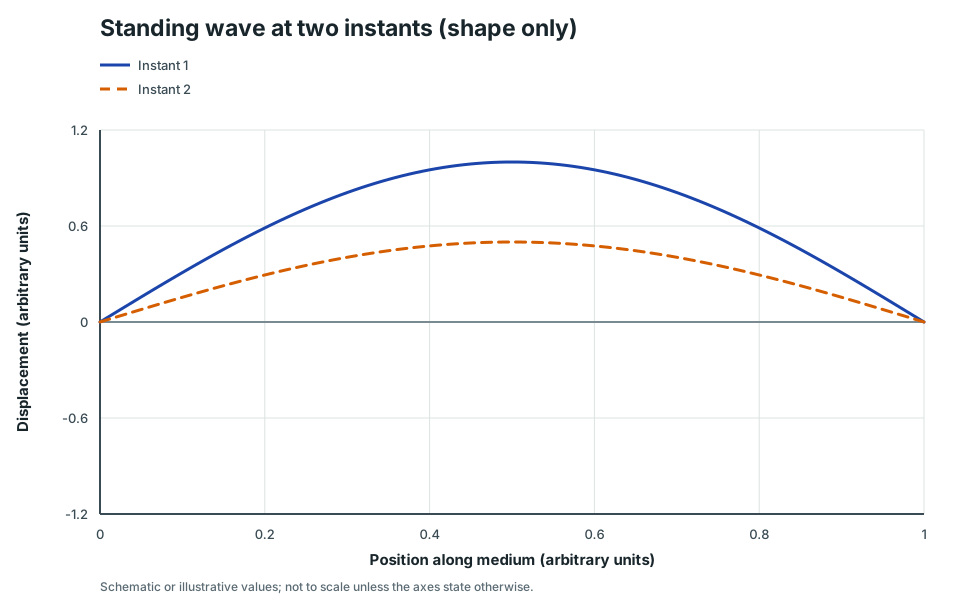
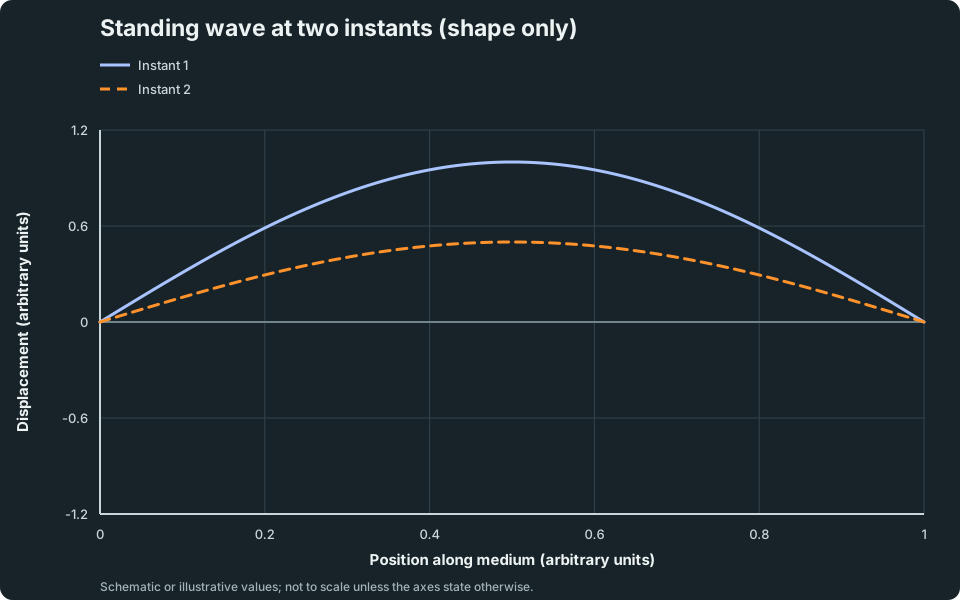
C. Visualising a standing wave (shape only)
This plot shows the same standing wave at two different instants. The nodes stay at the same positions.
Standing wave at two instants (shape only)
The same standing wave shown at two instants; node positions remain fixed.
Scroll across the graph to read all labels.
View figure data
| Position along medium (arbitrary units) | Instant 1 | Instant 2 |
|---|---|---|
| 0 | 0 | 0 |
| 0.008333333333333333 | 0.02617694830787315 | 0.013088474153936575 |
| 0.016666666666666666 | 0.05233595624294383 | 0.026167978121471914 |
| 0.025 | 0.07845909572784494 | 0.03922954786392247 |
| 0.03333333333333333 | 0.10452846326765346 | 0.05226423163382673 |
| 0.041666666666666664 | 0.13052619222005157 | 0.06526309611002579 |
| 0.05 | 0.15643446504023087 | 0.07821723252011543 |
| 0.058333333333333334 | 0.18223552549214747 | 0.09111776274607374 |
| 0.06666666666666667 | 0.20791169081775931 | 0.10395584540887966 |
| 0.075 | 0.2334453638559054 | 0.1167226819279527 |
| 0.08333333333333333 | 0.25881904510252074 | 0.12940952255126037 |
| 0.09166666666666666 | 0.2840153447039226 | 0.1420076723519613 |
| 0.1 | 0.3090169943749474 | 0.1545084971874737 |
| 0.10833333333333334 | 0.33380685923377096 | 0.16690342961688548 |
| 0.11666666666666667 | 0.35836794954530027 | 0.17918397477265013 |
| 0.125 | 0.3826834323650898 | 0.1913417161825449 |
| 0.13333333333333333 | 0.40673664307580015 | 0.20336832153790008 |
| 0.14166666666666666 | 0.4305110968082951 | 0.21525554840414754 |
| 0.15 | 0.45399049973954675 | 0.22699524986977337 |
| 0.15833333333333333 | 0.4771587602596084 | 0.2385793801298042 |
| 0.16666666666666666 | 0.49999999999999994 | 0.24999999999999997 |
| 0.175 | 0.5224985647159488 | 0.2612492823579744 |
| 0.18333333333333332 | 0.544639035015027 | 0.2723195175075135 |
| 0.19166666666666668 | 0.5664062369248328 | 0.2832031184624164 |
| 0.2 | 0.5877852522924731 | 0.29389262614623657 |
| 0.20833333333333334 | 0.6087614290087207 | 0.30438071450436033 |
| 0.21666666666666667 | 0.6293203910498375 | 0.31466019552491875 |
| 0.225 | 0.6494480483301837 | 0.32472402416509183 |
| 0.23333333333333334 | 0.6691306063588582 | 0.3345653031794291 |
| 0.24166666666666667 | 0.6883545756937539 | 0.34417728784687696 |
| 0.25 | 0.7071067811865475 | 0.35355339059327373 |
| 0.25833333333333336 | 0.7253743710122876 | 0.3626871855061438 |
| 0.26666666666666666 | 0.7431448254773942 | 0.3715724127386971 |
| 0.275 | 0.760405965600031 | 0.3802029828000155 |
| 0.2833333333333333 | 0.7771459614569708 | 0.3885729807284854 |
| 0.2916666666666667 | 0.7933533402912352 | 0.3966766701456176 |
| 0.3 | 0.8090169943749475 | 0.4045084971874737 |
| 0.30833333333333335 | 0.8241261886220157 | 0.41206309431100785 |
| 0.31666666666666665 | 0.8386705679454239 | 0.41933528397271197 |
| 0.325 | 0.8526401643540922 | 0.4263200821770461 |
| 0.3333333333333333 | 0.8660254037844386 | 0.4330127018922193 |
| 0.3416666666666667 | 0.8788171126619654 | 0.4394085563309827 |
| 0.35 | 0.8910065241883678 | 0.4455032620941839 |
| 0.35833333333333334 | 0.9025852843498605 | 0.45129264217493026 |
| 0.36666666666666664 | 0.9135454576426009 | 0.45677272882130043 |
| 0.375 | 0.9238795325112867 | 0.46193976625564337 |
| 0.38333333333333336 | 0.9335804264972017 | 0.46679021324860087 |
| 0.39166666666666666 | 0.9426414910921784 | 0.4713207455460892 |
| 0.4 | 0.9510565162951535 | 0.47552825814757677 |
| 0.4083333333333333 | 0.958819734868193 | 0.4794098674340965 |
| 0.4166666666666667 | 0.9659258262890683 | 0.48296291314453416 |
| 0.425 | 0.9723699203976766 | 0.4861849601988383 |
| 0.43333333333333335 | 0.9781476007338057 | 0.48907380036690284 |
| 0.44166666666666665 | 0.9832549075639545 | 0.49162745378197725 |
| 0.45 | 0.9876883405951378 | 0.4938441702975689 |
| 0.4583333333333333 | 0.9914448613738104 | 0.4957224306869052 |
| 0.4666666666666667 | 0.9945218953682733 | 0.49726094768413664 |
| 0.475 | 0.996917333733128 | 0.498458666866564 |
| 0.48333333333333334 | 0.9986295347545738 | 0.4993147673772869 |
| 0.49166666666666664 | 0.9996573249755573 | 0.49982866248777863 |
| 0.5 | 1 | 0.5 |
| 0.5083333333333333 | 0.9996573249755573 | 0.49982866248777863 |
| 0.5166666666666667 | 0.9986295347545738 | 0.4993147673772869 |
| 0.525 | 0.996917333733128 | 0.498458666866564 |
| 0.5333333333333333 | 0.9945218953682734 | 0.4972609476841367 |
| 0.5416666666666666 | 0.9914448613738105 | 0.49572243068690525 |
| 0.55 | 0.9876883405951377 | 0.49384417029756883 |
| 0.5583333333333333 | 0.9832549075639546 | 0.4916274537819773 |
| 0.5666666666666667 | 0.9781476007338057 | 0.48907380036690284 |
| 0.575 | 0.9723699203976767 | 0.48618496019883833 |
| 0.5833333333333334 | 0.9659258262890683 | 0.48296291314453416 |
| 0.5916666666666667 | 0.958819734868193 | 0.4794098674340965 |
| 0.6 | 0.9510565162951536 | 0.4755282581475768 |
| 0.6083333333333333 | 0.9426414910921784 | 0.4713207455460892 |
| 0.6166666666666667 | 0.9335804264972017 | 0.46679021324860087 |
| 0.625 | 0.9238795325112867 | 0.46193976625564337 |
| 0.6333333333333333 | 0.913545457642601 | 0.4567727288213005 |
| 0.6416666666666667 | 0.9025852843498605 | 0.45129264217493026 |
| 0.65 | 0.8910065241883679 | 0.44550326209418395 |
| 0.6583333333333333 | 0.8788171126619654 | 0.4394085563309827 |
| 0.6666666666666666 | 0.8660254037844387 | 0.43301270189221935 |
| 0.675 | 0.8526401643540923 | 0.42632008217704614 |
| 0.6833333333333333 | 0.838670567945424 | 0.419335283972712 |
| 0.6916666666666667 | 0.8241261886220158 | 0.4120630943110079 |
| 0.7 | 0.8090169943749475 | 0.4045084971874737 |
| 0.7083333333333334 | 0.7933533402912352 | 0.3966766701456176 |
| 0.7166666666666667 | 0.777145961456971 | 0.3885729807284855 |
| 0.725 | 0.760405965600031 | 0.3802029828000155 |
| 0.7333333333333333 | 0.7431448254773945 | 0.37157241273869723 |
| 0.7416666666666667 | 0.7253743710122875 | 0.36268718550614376 |
| 0.75 | 0.7071067811865476 | 0.3535533905932738 |
| 0.7583333333333333 | 0.6883545756937542 | 0.3441772878468771 |
| 0.7666666666666667 | 0.669130606358858 | 0.334565303179429 |
| 0.775 | 0.6494480483301838 | 0.3247240241650919 |
| 0.7833333333333333 | 0.6293203910498374 | 0.3146601955249187 |
| 0.7916666666666666 | 0.6087614290087209 | 0.30438071450436044 |
| 0.8 | 0.5877852522924732 | 0.2938926261462366 |
| 0.8083333333333333 | 0.5664062369248328 | 0.2832031184624164 |
| 0.8166666666666667 | 0.5446390350150273 | 0.27231951750751365 |
| 0.825 | 0.5224985647159489 | 0.26124928235797445 |
| 0.8333333333333334 | 0.49999999999999994 | 0.24999999999999997 |
| 0.8416666666666667 | 0.4771587602596086 | 0.2385793801298043 |
| 0.85 | 0.45399049973954686 | 0.22699524986977343 |
| 0.8583333333333333 | 0.4305110968082955 | 0.21525554840414776 |
| 0.8666666666666667 | 0.40673664307580004 | 0.20336832153790002 |
| 0.875 | 0.3826834323650899 | 0.19134171618254495 |
| 0.8833333333333333 | 0.35836794954530066 | 0.17918397477265033 |
| 0.8916666666666667 | 0.33380685923377074 | 0.16690342961688537 |
| 0.9 | 0.3090169943749475 | 0.15450849718747375 |
| 0.9083333333333333 | 0.2840153447039226 | 0.1420076723519613 |
| 0.9166666666666666 | 0.258819045102521 | 0.1294095225512605 |
| 0.925 | 0.23344536385590553 | 0.11672268192795276 |
| 0.9333333333333333 | 0.20791169081775931 | 0.10395584540887966 |
| 0.9416666666666667 | 0.18223552549214772 | 0.09111776274607386 |
| 0.95 | 0.15643446504023098 | 0.07821723252011549 |
| 0.9583333333333334 | 0.13052619222005157 | 0.06526309611002579 |
| 0.9666666666666667 | 0.10452846326765373 | 0.05226423163382687 |
| 0.975 | 0.07845909572784507 | 0.039229547863922534 |
| 0.9833333333333333 | 0.05233595624294425 | 0.026167978121472125 |
| 0.9916666666666667 | 0.02617694830787298 | 0.01308847415393649 |
| 1 | 1.2246467991473532e-16 | 6.123233995736766e-17 |
4. Common Mistakes
- Saying “standing waves travel” (they do not propagate; the pattern is fixed).
- Thinking “nodes move along the string/tube” (node positions are fixed).
- Saying “no energy anywhere” (energy exists, but there is no net transfer along the medium).
- Mixing up nodes and antinodes (node = always zero displacement).
5. Exam Tips
- Use the words “superposition of two opposite-travelling waves of the same frequency”.
- For phase language:
- in phase between adjacent nodes,
- antiphase between neighbouring segments.
- If the question involves resonance (“loudest” or “maximum amplitude”), it is usually a standing-wave condition.
6. Worked Examples
Modelled example 1
Maximum resultant displacement at an antinode
Problem
Study the worked solution
Identify the antinode condition
Method
At an antinode, the two component waves reach corresponding maxima in phase.Reason
The fixed phase relation there makes their instantaneous displacements reinforce.Working
y₁ = +A, y₂ = +A at a maximumApply superposition
Method
The maximum displacement amplitude is 2A.Reason
Equal in-phase displacements add algebraically.Working
Aₘₐₓ = A + A = 2A
Guided practice 2
Resultant displacement at a node
Problem
Try this before viewing the solution
Hints
Hint 1: compare both component waves
View solution step by step
Use equal amplitudes
Method
The two opposite-travelling waves contribute equal-magnitude displacements at the node.Reason
A perfect standing wave is formed from component waves of equal amplitude.Working
|y₁| = |y₂|Use opposite phase
Method
The two displacements have opposite signs at every instant.Reason
The component waves remain antiphase at the node.Working
y₂ = -y₁Apply superposition
Method
The resultant displacement is always zero.Reason
Equal and opposite instantaneous displacements cancel point-by-point.Working
y = y₁ + y₂ = 0
Common misconception 3
Node spacing and wavelength
Learner claim
Try this before viewing the solution
View solution step by step
Identify the spatial relation
Method
Adjacent nodes are separated by λ/2.Reason
Neighbouring nodes bound one standing-wave loop; two loops make one full wavelength.Working
d_(node-node) = λ/2Calculate wavelength
Method
The wavelength is 0.30 m.Reason
Double the adjacent-node spacing.Working
λ = 2(0.15) = 0.30 m
Examiner practice 4
Phase difference in a standing wave
Examination question
Try this before viewing the solution
View solution step by step
Compare within one segment
1 markMethod
Points between the same adjacent nodes are in phase: Δφ = 0 modulo 2π.Reason
They pass equilibrium and reach extrema in the same direction together, though with different amplitudes.Working
Δφ = 2π nState the shared motion
1 markMethod
All non-node points in that segment have the same time dependence.Reason
The standing-wave spatial factor changes amplitude, not phase sign within the segment.Working
same segment → same oscillation signCompare neighbouring segments
1 markMethod
Points in adjacent segments are in antiphase: Δφ = π modulo 2π.Reason
A node separates regions whose displacements have opposite signs at each instant.Working
Δφ = (2n + 1)πState the motion contrast
1 markMethod
When one neighbouring segment moves in the positive direction, the other moves in the negative direction.Reason
This opposite motion expresses their half-cycle phase difference.Working
neighbouring segments → opposite signs
Self-mark with the mark scheme
Compare your response with each mark point. Select a point only when your response contains that evidence.
Self-mark both phase statements and their motion explanations.
Challenge 5
Standing vs progressive wave (exam comparison)
Independent transfer
Try this before viewing the solution
Hints
Hint 1: compare the same feature in both columns
View solution step by step
Compare energy transfer
Method
A progressive wave transfers energy along the medium; a standing wave has no net energy transfer along it.Reason
The progressive disturbance travels, whereas opposite energy flows in the standing pattern average to zero.Working
progressive: net flow; standing: zero net flowCompare spatial pattern
Method
Standing-wave nodes and antinodes are fixed and amplitude depends on position; a progressive pattern moves.Reason
Interference fixes the standing-wave spatial envelope, while phase propagates in a progressive wave.Working
standing: fixed nodes; progressive: travelling phase
7. Mind Stretchers
Mind stretcher 1: What if the amplitudes are not equal?Extension
Two opposite-travelling waves have the same frequency but different amplitudes. Can you get nodes with zero displacement everywhere?
Show Answer
No.
The resultant is no longer a perfect standing wave. Cancellation is incomplete, so “nodes” are not points of zero displacement at all times.
Mind stretcher 2: Why is there “no net energy transfer”?Extension
Standing waves clearly involve moving particles. Explain why we still say there is no net energy transfer along the medium.
Show Answer
Energy oscillates locally: neighbouring sections exchange energy back and forth as the pattern oscillates.
But there is no overall progression of the wave pattern carrying energy from one end to the other (unlike a travelling wave), so the average energy flow along the medium is zero.
Mind stretcher 3: Optional (Enrichment)Extension
A. Video demonstration (optional)
Mind stretcher 4: Simulation Bridge: Standing Wave ExplorerExtension
Concept Explorer: Standing Wave Explorer
Toggle string and air-column boundary conditions, change harmonic mode, and test wavelength-frequency relations.
- Boundary Conditions
- Harmonics
- Resonance Spacing
- f–λ–v Links
Investigate nodes and antinodes in the Standing Wave Explorer.
Continue with the next resource in this course.
Course and syllabus information
- Course
- GCE A-Level H2 Physics
- Edition
- GCE A-Level H2 Physics 2027